
When you're running a small business, your phone system is more than just a convenience—it's a lifeline. But an outdated, single-line setup can quickly become a bottleneck that stifles growth. Think about it: customers hitting a busy signal, your team missing critical calls when they step away from the desk, and you having no way to stay connected when you're off-site.
A small business VoIP system is the modern answer to these all-too-common headaches. It works by routing your business calls over the internet, completely replacing traditional landlines. This move to a cloud-based phone service gives you more flexibility, better features, and lower costs than any old-school phone setup ever could, letting your team work professionally from anywhere.
What Is a Small Business VoIP System
So, what exactly is VoIP? The acronym stands for Voice over Internet Protocol, which is just a technical way of saying your phone service runs through your existing internet connection. Instead of being chained to a physical phone line installed by the phone company, your business communications live securely in the cloud.
The easiest way to understand the shift is with a simple analogy.
A traditional phone system is like a DVD collection—it's physical, limited in what it can do, and stuck in one place. A modern VoIP system is like a streaming service—it’s accessible from any device, anywhere you are, with a whole library of advanced features available whenever you need them.
This move from hardware to software unlocks incredible flexibility. Your team can make and take calls on a traditional desk phone, a computer softphone, or a mobile app, effectively turning any location with an internet connection into a fully functional office.
How Is VoIP Different from a Landline?
The advantages of VoIP become crystal clear when you put the two technologies side-by-side. Old-school systems depend on expensive on-premise hardware (a Private Branch Exchange, or PBX) and are physically limited by copper wiring. A small business VoIP system, on the other hand, is managed entirely through a simple online portal. You can find a deeper dive into this on our guide explaining what a cloud phone system is and how it works.
This isn't just some passing trend; it's a fundamental shift in how businesses operate. The numbers don't lie. The global VoIP market hit $161.79 billion in 2025 and is on track to become a $415.20 billion industry by 2034. Small and medium-sized businesses are fueling this explosion, with over 60% already using VoIP to compete and win.
To make the differences even clearer, this table breaks down how an old phone system stacks up against a modern VoIP solution.
Traditional Phone System vs Modern VoIP System
| Feature | Traditional Phone System | Small Business VoIP System |
|---|---|---|
| Infrastructure | Needs bulky on-premise PBX hardware and physical phone lines. | Hosted in the cloud; all you need is a solid internet connection. |
| Cost Structure | High upfront hardware and installation costs, plus maintenance fees. | Low to zero upfront cost with a predictable monthly subscription per user. |
| Flexibility | Calls are tied to a physical phone at a single office location. | Your team can use desk phones, computers, or mobile apps from anywhere. |
| Scalability | Adding a new line is slow and expensive, usually requiring a technician. | Add or remove users and phone lines instantly through an online dashboard. |
| Features | You get a dial tone and maybe voicemail. Advanced features are pricey add-ons. | Packed with advanced tools like auto-attendant, call recording, and mobile apps. |
As you can see, the operational models are worlds apart. One requires you to become a phone system expert, while the other lets you focus on running your business while the provider handles all the tech. For most small businesses, the agility and predictable costs of VoIP make it the obvious choice.
Why Your Business Needs a VoIP System
Moving beyond the technical "what," let's get into the results a small business VoIP system actually delivers. An upgrade isn't just about getting new tech; it's about unlocking real-world wins in your budget, your professional image, and your ability to grow. The return on investment becomes crystal clear once you see how it changes your day-to-day operations.
The most immediate and powerful reason businesses make the switch is the dramatic cost savings. Imagine slashing one of your biggest operational bills nearly in half. VoIP gets rid of the need for expensive, clunky on-premise hardware and the costly maintenance contracts that come with it, turning a huge capital expense into a predictable, low monthly bill.
This isn't just trimming the edges; it's a major financial advantage. Cost reduction is the number one driver for VoIP adoption, with businesses lowering their phone costs by an average of 40%. Some studies even show that 75% of users point to savings as the main benefit.
For new companies, the impact is even bigger. Startups can cut their initial communication costs by up to 90% just by choosing VoIP over traditional phone lines from day one.
Project a Fortune 500 Image
Beyond the savings, a VoIP system completely changes how customers see your business. It gives your small team the tools to sound as established and professional as a massive corporation. First impressions are everything, and your phone system is often the first handshake.
Features like an auto-attendant (your "digital receptionist") professionally greet every single caller and route them to the right person or department. This simple tool makes sure no call goes unanswered and puts an end to the unprofessional scramble of a single phone ringing off the hook. That polish builds instant credibility.
To truly professionalize your communications, it's time for your business to graduate from the WhatsApp Trap and adopt a more robust solution. A dedicated business phone system creates clear boundaries between personal and professional life, leading to a much more organized workflow for everyone on your team.
Scale Your Business with a Few Clicks
Maybe the most powerful long-term benefit of VoIP is its incredible scalability. With traditional phone systems, growth is a painful, expensive, and slow process. Adding a new employee meant calling a technician, installing new physical lines, and dealing with costly disruptions.
A small business VoIP system, on the other hand, grows with you effortlessly.
- Adding a New User: Just log in to your online portal, add a new user, and assign a number. The whole process takes minutes, not weeks.
- Opening a New Office: You can expand to a new city or support a fully remote workforce without any new hardware. As long as your team has an internet connection, they're on the same phone network.
- Handling More Calls: VoIP allows for unlimited concurrent calls, so your customers will never hear a busy signal again, no matter how fast your business grows.
This flexibility means your communication system is no longer a roadblock to growth—it's a catalyst for it. You can scale up during a busy season and scale back down just as easily, paying only for what you actually need.
This agility, combined with enterprise-grade features, is a core part of any modern business strategy. By integrating your voice calls with other tools, you create a command center for all your communications. You can check out our article on the advantages of unified communications to see how this all comes together.
A VoIP system doesn't just replace your phone line. It provides the foundation for a smarter, more connected, and more profitable business.
VoIP Features That Unlock Business Growth

A modern small business VoIP system is so much more than a way to make and take calls. It’s a complete communication toolkit built to make your team more productive, keep customers happy, and drive real growth. Let's skip the dense technical jargon and look at what these features actually do for your business day in and day out.
Think of it like the jump from a basic flip phone to a new smartphone. One just makes calls; the other helps run your entire operation. The right features turn your phone system from a simple utility into a strategic asset that works for you.
Your 24/7 Digital Receptionist
One of the first features that makes a huge, immediate impact is the Auto-Attendant. This is your digital receptionist, greeting callers with a professional message and a simple menu of options, like "Press 1 for Sales, Press 2 for Support."
This instantly makes your two-person startup sound as buttoned-up as a Fortune 500 company. More importantly, it gets every caller to the right person without delay, plugging the leaks that cause lost opportunities and frustrated customers. It's your first line of defense against missed leads.
And those missed calls are a massive source of lost revenue. Data shows that businesses only manage to answer 37.8% of their inbound calls. Another 37.8% go to voicemail, and a shocking 24.3% get no answer at all. That means nearly two-thirds of callers never reach a live person. As this analysis of business phone statistics highlights, modern VoIP solves this with smart routing and AI tools that seriously boost answer rates.
The "Office in Your Pocket" With Smart Routing
One of the most powerful things a VoIP system can do is route calls intelligently. This isn't just basic call forwarding. Advanced call routing creates a unified presence for your team, no matter where they happen to be working.
Imagine a call comes in on your main business line. You can set the system to:
- First, ring an employee's desk phone for 15 seconds.
- If there’s no answer, have it ring their desktop softphone and mobile app simultaneously.
- If it's still unanswered, forward the call to another team member or send it directly to a visual voicemail box.
This creates a seamless "office in your pocket," making sure that critical calls always find the right person. To your customers, the experience is simple—they dial one number and get the help they need. For your team, it delivers the freedom to work from anywhere without ever feeling disconnected.
Pro-Level Call Center Tools for Any Size Team
You don't need a huge budget or a massive call center to manage customer calls like a professional. A good small business VoIP system puts enterprise-grade call center features right at your fingertips, letting even a small team handle high call volumes with total confidence.
These tools don’t just help you answer more calls; they help you answer them smarter. By organizing your inbound communications, you can deliver a faster, more professional customer experience every single time.
A few key call center features include:
- Smart Queues: Instead of a frustrating busy signal, callers are placed in a virtual line with on-hold music and periodic updates on their place in the queue.
- Wait-Time Announcements: The system can tell callers their estimated wait time, which helps manage their expectations and reduces the number of people who hang up.
- Real-Time Analytics: Dashboards give you a live look at call volumes, wait times, and agent performance, providing the data you need to optimize staffing and improve service on the fly.
Tools That Boost Team Productivity
Beyond just routing calls, a great VoIP system comes loaded with features designed to make your team more efficient and accountable. These small tools add up to huge time savings and smoother operations.
Visual Voicemail is a game-changer. It transcribes audio messages into text and sends them right to your email or mobile app. This lets you quickly scan a message to see what's important without having to listen to every single recording.
Call Recording is another invaluable tool for training new hires, confirming order details, and ensuring quality control. It also creates a solid record of important conversations for compliance or resolving disputes. These features become even more powerful when connected to other business software. A VoIP CRM integration can automate your data entry and give you a complete picture of every single customer interaction.
How to Choose the Right VoIP Provider
Choosing a provider for your small business VoIP system is one of the most important tech decisions you'll make. This isn't just about getting a lower phone bill. It’s about finding a true partner for your business communications.
The right provider delivers a rock-solid service that empowers your team, while the wrong one can lead to constant frustration, dropped calls, and missed opportunities.
Think of it like choosing the power company for your office. You don't just shop for the cheapest rate; you demand reliability because you need the lights to stay on. Your phone system is just as critical. Your evaluation has to go way beyond the monthly fee and focus on the pillars that ensure long-term success.
Prioritize Reliability and Uptime
The absolute first question you should ask is about reliability. A VoIP provider’s uptime guarantee is their promise that your phone system will be there when you need it. Look for providers that guarantee at least 99.99% uptime, often called "four nines."
This isn't just a number; it translates to real-world availability. A 99.99% uptime means the service could be down for no more than 52 minutes over an entire year. Anything less than that introduces an unacceptable risk for a business that depends on its phones.
Ask potential providers about their network infrastructure. Do they have redundant data centers in different geographic locations? This is key. It ensures that if one center has an issue, your service automatically fails over to another, keeping your business online without a single hiccup.
Evaluate the Quality of Customer Support
When an issue does pop up—and eventually, it will—the quality of customer support becomes everything. You can't afford to navigate endless automated phone trees or wait days for an email response when your business is on the line.
A provider's support model reveals how much they value your business. A company that invests in a well-trained, responsive support team sees you as a partner. One that hides behind bots and slow-response tickets views you as just another account number.
You need a provider that offers accessible, expert human help whenever you need it. Look for companies like SnapDial that offer 24/7 support from a dedicated, in-house team. This is a clear sign they understand the urgency of business communications and are committed to solving problems fast.
Verify Security and Compliance Standards
In an age where data breaches are common, the security of your communications is non-negotiable. A reputable VoIP provider should use multiple layers of protection to safeguard your calls and data from prying eyes.
Here are the key security measures to look for:
- Call Encryption: Protocols like Transport Layer Security (TLS) and Secure Real-time Transport Protocol (SRTP) scramble your call data, making it unreadable to anyone who might try to intercept it.
- Secure Data Centers: Physical and digital security at the provider's data centers is crucial for protecting your account information and call records.
- Compliance Certifications: If you operate in a regulated industry, like healthcare or finance, make sure the provider meets specific standards like HIPAA (for healthcare) or PCI DSS (for payment card information).
Ask the Right Questions Before You Sign
To move from a passive shopper to a savvy evaluator, you need to ask insightful questions that cut through the sales pitch. This is how you uncover the reality of working with a provider day-to-day.
Here are some essential questions to ask every potential VoIP provider:
- What does your customer onboarding process look like? A good provider offers a white-glove setup to get your system configured correctly from day one, not just a link to a help guide.
- Can you describe your support model in detail? Find out their support hours, average response times, and whether you'll be speaking with a real person right away.
- How do you ensure call quality and reliability? They should be able to clearly explain their network redundancy and back up their uptime guarantees.
- Are all features included, or are there hidden fees? Clarify what's in the base package versus what costs extra. Don't get surprised by à la carte pricing.
- Can I port my existing business numbers, and do you handle the process? A smooth, provider-managed number porting process is vital to avoid service interruptions.
Asking these questions ensures you find a small business VoIP system provider that is not just a vendor, but a strategic partner dedicated to helping your business grow.
How to Plan Your Migration to a New System
Thinking about switching your business phone system can feel overwhelming. I get it. But moving from an old, clunky setup to a modern cloud VoIP solution doesn't have to be a headache that grinds your business to a halt.
The number one fear for most owners is the risk of disruption. The good news is that with a solid, step-by-step plan, the entire process can be seamless. It's all about mapping out the journey before you take the first step.
A reputable provider will manage the heavy lifting, but understanding the key steps gives you the confidence that your move to VoIP will be smooth. The goal is simple: get your new system running perfectly without your customers ever knowing a change occurred.
VoIP Migration and Setup Checklist
To guarantee a smooth switch, it’s best to break the process down into a few manageable phases. This checklist demystifies the steps, giving you a clear path from your old landlines to a modern communication platform that just works.
| Phase | Key Task | Pro Tip |
|---|---|---|
| 1. Assess | Test Your Internet Readiness | Your VoIP system's quality lives and dies by your internet connection. Use an online speed test to check for at least 100 Kbps of upload and download speed per simultaneous call. More importantly, look for low latency (delay) and jitter (variation in delay) to ensure crystal-clear audio. |
| 2. Plan | Inventory Your Feature Needs | Make a list of the must-have features your business needs, like an auto-attendant, call recording, or a mobile app. This helps you select the right plan and provider without paying for tools you won’t use. |
| 3. Prepare | Schedule Your Number Porting | "Porting" is the process of moving your existing business phone number to your new VoIP provider. Your provider handles this, but it can take a few weeks. Start early to ensure your number is ready when you go live. Your old system stays active until the switch is complete. |
| 4. Implement | Set Up Call Flows and Greetings | Before your go-live date, configure your auto-attendant greeting and call routing rules. Decide exactly where calls should go—to a specific person, a department-based ring group, or a voicemail box. |
| 5. Train | Get Your Team Onboard | Even the best system is only effective if your team knows how to use it. Schedule a brief training session to cover basics like transferring calls, checking voicemail, and using the mobile app. Many providers offer training resources to make this easy. |
Following these steps in order builds a solid foundation, ensuring no detail gets overlooked and you're set up for success from day one.
Avoiding Common Migration Pitfalls
Knowing the path forward is one part of the equation; knowing the potential roadblocks is the other. Being aware of these common slip-ups can help you proactively steer clear of them, ensuring your transition doesn't hit any snags.
The most successful VoIP migrations are not just about technology but also about people and process. Underestimating the human element is the most common mistake businesses make during the switch.
Here are a few key traps to watch out for:
- Failing to Involve Your Team: Don't just spring the new system on your employees. Get their feedback early on about what they need and keep them in the loop throughout the process. A team that feels included is far more likely to embrace the change.
- Forgetting About Physical Hardware: Do you need new IP phones? Most providers, like SnapDial, offer pre-configured phones that work right out of the box. Make sure you order them ahead of time so they arrive before your go-live date.
- Neglecting Post-Launch Support: The transition isn't over the moment the system goes live. Check in with your team after a week to see if they have any questions or are running into issues. A great provider will offer robust post-launch support to help you fine-tune your setup.
The Future of Business Communications Is VoIP
Switching to a **small business VoIP system** isn’t just another item on your IT to-do list. It’s a fundamental business decision that gets your company ready for the future. Moving your communications to the cloud changes the game, turning your phone from a simple utility into a tool that actually drives growth.This shift helps you deliver a better customer experience by making sure no call gets lost in the shuffle. It boosts your professional image with tools that were once only available to large enterprises, and it frees your team to work effectively from absolutely anywhere. The result? A stronger bottom line, thanks to real cost savings and a big jump in productivity.
Sticking with an outdated, hardware-based phone system is actively holding you back. It's an anchor in a business world that demands speed and flexibility. The time to modernize isn't somewhere down the road—it’s right now.
Looking Ahead at VoIP Trends
The world of VoIP isn't standing still. The next wave of innovation is already rolling in, bringing with it even smarter, more connected ways to talk with customers and collaborate with your team. It's all about creating one truly unified experience.
These emerging trends are about to add even more power to your daily operations:
- Deeper AI Integration: Artificial intelligence is moving way beyond just transcribing voicemails. Get ready for systems that can analyze a caller's sentiment in real-time, offer live coaching to your agents during a call, and automatically summarize complex conversations for instant follow-up.
- Complete Platform Convergence: The lines separating voice calls, text messages, video meetings, and internal chats are disappearing completely. All your business communications will live on a single, seamless platform, so you can stop juggling a half-dozen apps and work in one cohesive flow.
- Proactive Analytics: Future phone systems won't just report on what happened last week. They'll offer predictive insights. Imagine getting an alert about a potential staff shortage before your call queue gets backed up, or spotting a customer service trend before it becomes a major problem.
These advancements will make your small business VoIP system an even more indispensable part of how you run your business.
Take Your First Step Toward a Better System
Continuing to rely on an old phone system is a choice to let outdated technology dictate your company’s potential. It's a decision that impacts your customer satisfaction, team efficiency, and ultimately, your profitability. The path to a more agile, professional, and profitable future starts with one simple step.
Making the switch isn't some overwhelming technical project. It's a manageable process that breaks down into three clear stages: assessing what you truly need, choosing the right partner, and getting your team ready for success.
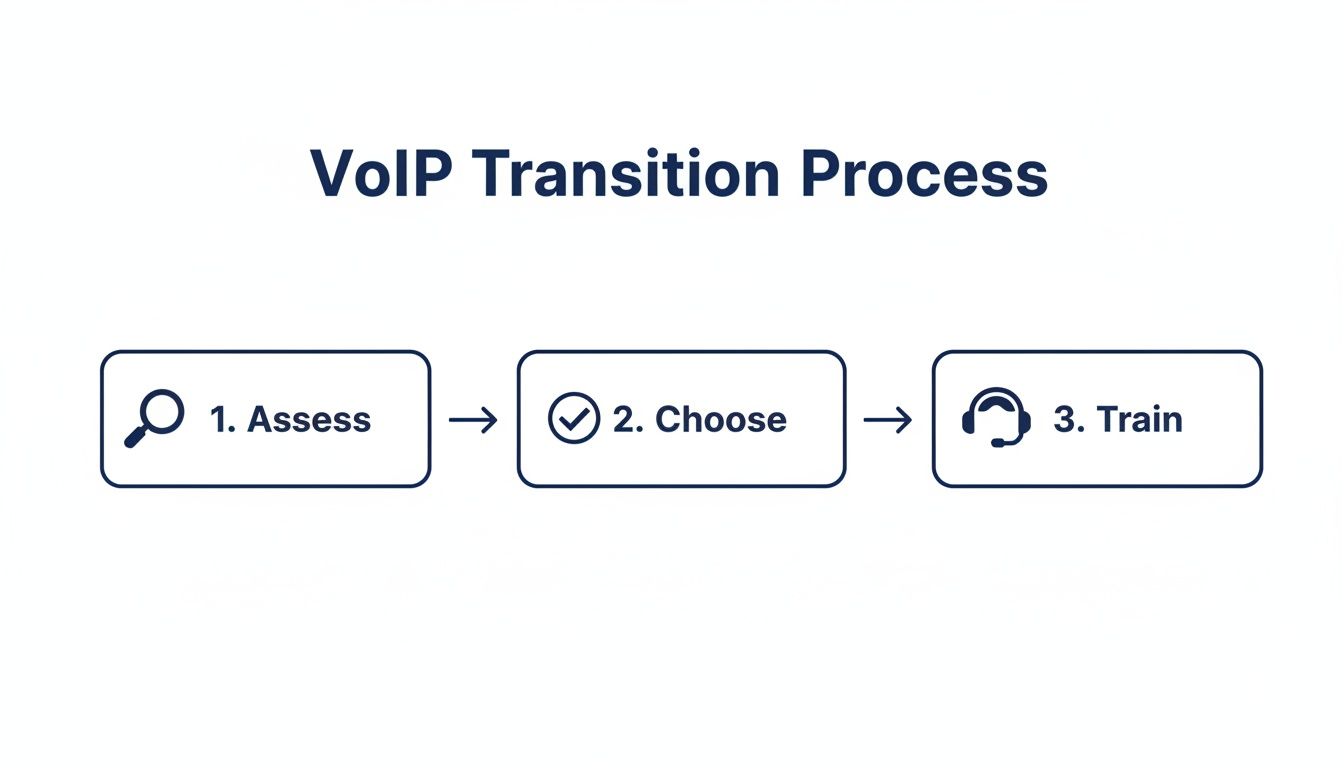
The key to a smooth transition is finding a provider like SnapDial that offers white-glove setup and 24/7 support. A true partner guides you through every stage, from planning to launch. Stop letting your phone system hold you back—schedule a demo today and see for yourself how a modern communications platform can transform your business.
Got Questions? We've Got Answers
Making the final call on a new phone system can feel like a big step. To help you feel confident in your choice, we’ve put together straightforward answers to the questions we hear most often from businesses just like yours.
Can I Keep My Existing Business Phone Number?
Yes, absolutely. You don't have to give up the numbers your customers already know and trust.
The process is called "number porting," and it’s a standard, regulated procedure that lets you move your current local and toll-free numbers, and even your team's direct-dial numbers, to your new provider.
A good provider will handle the entire porting process for you. Their job is to make sure the switch happens behind the scenes with zero downtime, so your old service keeps working right up until the new one is live.
What Kind of Internet Connection Do I Need?
The quality of your VoIP calls is tied directly to your internet connection. Think of it like a water pipe—the flow has to be steady and strong for it to work well.
As a rule of thumb, you'll want at least 100 Kbps (or 0.1 Mbps) of both upload and download speed for every simultaneous call. For a typical small office with 10 people, a standard business-grade connection like fiber or cable is more than enough.
But it's not just about speed. The real enemies of a clear call are latency and jitter, which cause those annoying echoes and garbled audio. A quality provider can help you test your network to confirm it's ready for crystal-clear conversations.
Is a VoIP System Secure for My Business?
This is a big one, and the short answer is: very secure. Reputable business VoIP providers build their systems with multiple layers of protection that are often far more advanced than what a typical small business could manage on its own.
This includes call encryption (using protocols like TLS and SRTP) that scrambles your conversations, making them unreadable to anyone trying to eavesdrop.
They also run their services from secure data centers with built-in redundancy and 24/7 monitoring to protect against cyber threats and service outages. If you handle sensitive information, always ask a potential provider if they meet compliance standards like HIPAA or PCI.
What Happens If My Internet Goes Down?
It's a valid concern, but professional VoIP systems are built for this. They come with smart failover features to keep your business running, no matter what.
Most providers let you create rules that automatically forward all incoming calls to a backup number—like your cell phone, a different office, or a special voicemail—the instant your internet connection drops.
Plus, features like a mobile app mean your team can keep making and taking calls on your business line using their phone's cellular data. You won't miss a critical call, even in the middle of an outage.
Ready to see how a reliable, feature-rich VoIP system can transform your business communications? The team at SnapDial offers white-glove setup and 24/7 Texas-based support to make your transition seamless. Learn more about how SnapDial can help you upgrade your phone system today.