

You open the monthly phone bill expecting a familiar amount. Instead, the total has nearly doubled, and the invoice offers no obvious explanation beyond a larger number of minutes, calls, or services. Your team hasn't added many employees, so the increase feels less like a normal operating cost and more like a billing mystery.
That experience is the central challenge of metered billing. The model can be fair because customers pay for measured consumption rather than unused capacity, but it also shifts more cost risk to the buyer. To manage it well, you need to understand not only how vendors calculate usage, but also how they capture events, handle exceptions, explain charges, and prevent errors.
What Is Metered Billing and Why It Matters Now
Metered billing is a usage-based model in which charges are calculated from measurable consumption during a billing period. The measured unit might be an outbound phone minute, an API call, data stored, a transaction, or an active device. Billing platforms support usage reporting throughout the period so the provider can finalize charges when the invoice is created, as described in Stripe's usage records documentation.
The easiest analogy is a utility meter. An electricity provider doesn't charge every household the same amount because each has an account. It records consumption, applies the relevant pricing rules, and produces a bill from that record. The same basic logic now powers cloud platforms, SaaS products, application programming interfaces, telecommunications services, and business phone systems.
A VoIP provider might measure minutes, messages, recordings, or other billable services. A SaaS vendor might count requests, processed files, storage, or active devices. Each event becomes a data point that can be aggregated into an invoice. That makes metered billing more than a pricing label. It's an operating system for converting activity into revenue.
Why buyers need to understand the model
Metered billing has a long history in essential services. World Bank guidance for South Asian power utilities discusses billing analytics, arrears trends, and consumer-category analysis as uses of advanced metering data, while utility portals may provide customers with detailed historical billing and usage records, including charges and consumption history. Zuora's metered billing overview places the model in that wider context.
The modern shift is that businesses now encounter the same framework when buying software and communications tools. Usage-based pricing lets a vendor align revenue with consumption instead of charging only by seat, but it also means a buyer's bill can move when traffic changes.
Practical rule: A metered plan is only predictable when the customer can see, understand, and control the meter.
If you're evaluating the business case, why choose usage based billing is a useful companion resource because it focuses on the reasons organizations adopt consumption-linked pricing. The important question isn't whether metered billing is good or bad. It's whether the measured unit reflects value, the rate is clear, and both parties have safeguards against unexpected usage.
How Metered Billing Actually Works
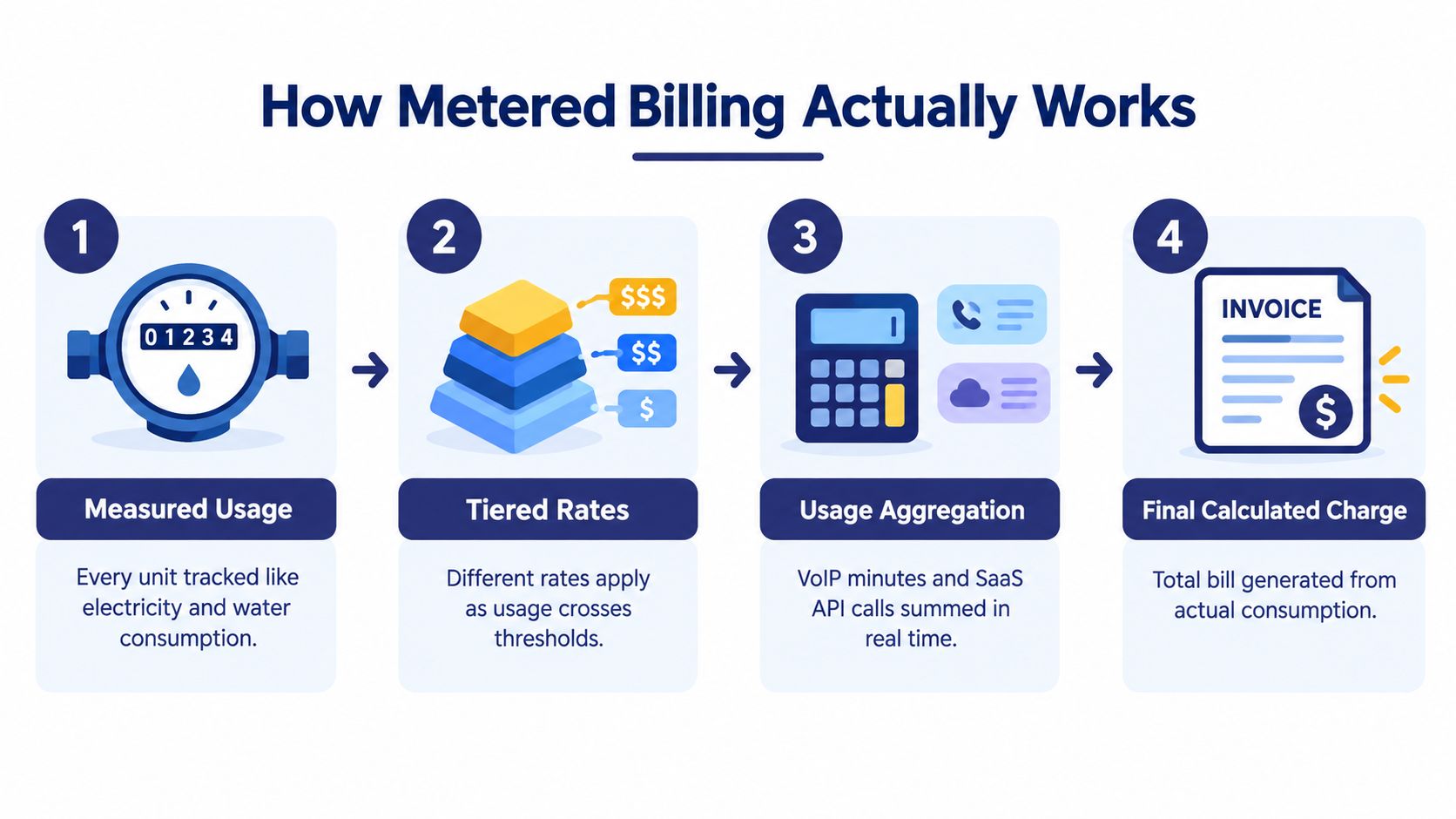
Metered billing becomes straightforward once you separate the process into its working parts. Think about an electricity bill: a meter records consumption, the provider applies rates, the system totals the readings, and the customer receives an itemized charge. A VoIP or SaaS platform follows the same pattern, even though the meter is software rather than a physical device.
The four parts of the calculation
Billable event: The system records something that can be charged, such as an outbound call, an SMS, an API request, or stored data.
Unit of measure: The vendor defines what counts as one unit. That could be a minute, call, request, or GB-month. The unit definition matters because rounding and timing can change the result.
Rate card: The provider publishes the price assigned to each unit. A plan might charge $0.0085 per SMS, $0.01 per outbound minute, or $0.0001 per API call.
Aggregation and invoicing: The billing engine collects the events, applies the rate, handles tiers or allowances, and turns the result into invoice line items.
The arithmetic is simple. If a customer sends 10,000 messages at $0.0085 each, the usage charge is the number of messages multiplied by the message rate. The complexity appears around the arithmetic: duplicated events, late records, plan changes, bundled allowances, credits, refunds, and different rates for different destinations or services.
What the customer should verify
Ask four questions before signing a metered agreement:
- What counts: Does a failed API request count? Does a transferred call count from connection or answer time?
- How it rounds: Are partial minutes rounded, and at what stage?
- When it posts: Does usage appear immediately, hourly, daily, or only on the final invoice?
- What happens at the limit: Does the service alert, throttle, stop, or continue generating overage?
For a phone system, the answers should be traceable to call detail records. A call detail record guide can help non-finance teams understand the type of underlying call information that supports an itemized communications bill.
Hybrid plans use the same mechanism. A subscription might include an allowance, then apply metered overage once the customer exceeds it. That structure gives the buyer a fixed starting point while preserving a usage-linked charge for additional consumption.
You can also watch the accompanying explainer for a visual walkthrough:
Metered Billing vs Flat Rate vs Tiered Pricing
The choice among pricing models is a trade-off, not a contest with one universal winner. A buyer usually pays in one of three ways: for unused capacity under a flat plan, for surprise overage under a pure metered plan, or for the complexity of understanding thresholds and package boundaries under a tiered plan.
| Factor | Metered Billing | Flat Rate | Tiered Pricing |
|---|---|---|---|
| Predictability | Lower, because the invoice follows actual usage | High, because the recurring charge stays stable | Moderate, because package limits and thresholds matter |
| Fairness | Strong for customers with variable or light usage | Weaker for customers who consistently use less than the allowance | Balanced, because packages group similar usage patterns |
| Cost ceiling | Usually open-ended unless caps or controls exist | Clear contractual ceiling for the recurring charge | A soft ceiling, with possible upgrades or overage |
| Customer experience | Transparent when usage is visible and rates are simple | Easy to understand, with little monitoring required | Familiar, but customers must understand package boundaries |
| Best fit | Spiky workloads, APIs, variable calling, and consumption-linked services | Stable budgets, steady usage, and organizations prioritizing certainty | Growing teams that want allowances with room to expand |
Metered plans
Metered billing works best when consumption varies and the customer can connect usage to value. A startup with uneven API traffic may prefer not to pay for a large fixed capacity during quiet periods. A call center may value a direct relationship between active calling and cost, provided managers can monitor queues and campaigns.
The drawback is exposure to unexpected activity. A useful metered plan therefore needs a dashboard, alerts, a clear unit definition, and a way to pause or cap charges. Without those controls, fairness becomes difficult to experience in practice.
Flat-rate plans
Flat pricing trades optimization for certainty. The customer pays a known recurring amount, which simplifies budgeting, procurement, and accruals. It can also protect a business from seasonal spikes or a sudden increase in call volume.
The cost is potential overpayment. A company with light usage may subsidize heavier users, while a vendor may build a risk buffer into the price. For a broader view of communications costs and package structures, cloud PBX pricing provides useful context.
Tiered plans
Tiered pricing sits between the two. The vendor offers named packages or thresholds, and customers move into a different price band as usage grows. This approach can be easier to sell than pure metering because buyers recognize the package, while the provider retains a path for expansion.
The right model depends on which risk your organization can manage best: unused capacity, variable invoices, or pricing complexity.
Metered Billing in the Real World
The unit rate tells only part of the story. The same rate can produce a manageable bill for one customer and a major operating expense for another because volume, seasonality, and team behavior determine the total.
Consider a SaaS API product priced at $0.002 per call. A startup that makes 250,000 calls in a month pays $500. A mid-market customer making 2 million calls pays $4,000, while an enterprise sending 50 million calls reaches a $100,000 monthly invoice.
| Scenario | Usage Volume | Per-Unit Rate | Monthly Cost |
|---|---|---|---|
| SaaS startup | 250,000 API calls | $0.002 per call | $500 |
| SaaS mid-market firm | 2 million API calls | $0.002 per call | $4,000 |
| SaaS enterprise | 50 million API calls | $0.002 per call | $100,000 |
The provider hasn't changed the price in these examples. The invoice changes because the customer's activity changes. That distinction matters during budget planning. A team shouldn't ask only, “What's the rate?” It should ask, “What usage range do we expect, and what event could push us outside it?”
The VoIP example
Now take a VoIP provider charging $0.015 per outbound minute. A 10-seat SMB using 4,000 minutes in a month generates a $60 usage charge. A 50-agent call center using 120,000 minutes generates $1,800. A seasonal retailer that reaches 300,000 minutes during a holiday period faces a $4,500 charge.
| Scenario | Usage Volume | Per-Unit Rate | Monthly Cost |
|---|---|---|---|
| 10-seat SMB | 4,000 outbound minutes | $0.015 per minute | $60 |
| 50-agent call center | 120,000 outbound minutes | $0.015 per minute | $1,800 |
| Seasonal retailer | 300,000 outbound minutes | $0.015 per minute | $4,500 |
These examples reveal why seat count alone doesn't predict a communications bill. A small team can produce heavy usage during a campaign, while a larger team may have modest outbound activity. After-hours calling, automated dialing, customer callbacks, and holiday demand can all alter the usage pattern.
A responsible buyer should model ordinary activity and plausible spikes, then decide whether a cap, allowance, or hybrid structure is necessary.
When Metered Billing Becomes a Problem
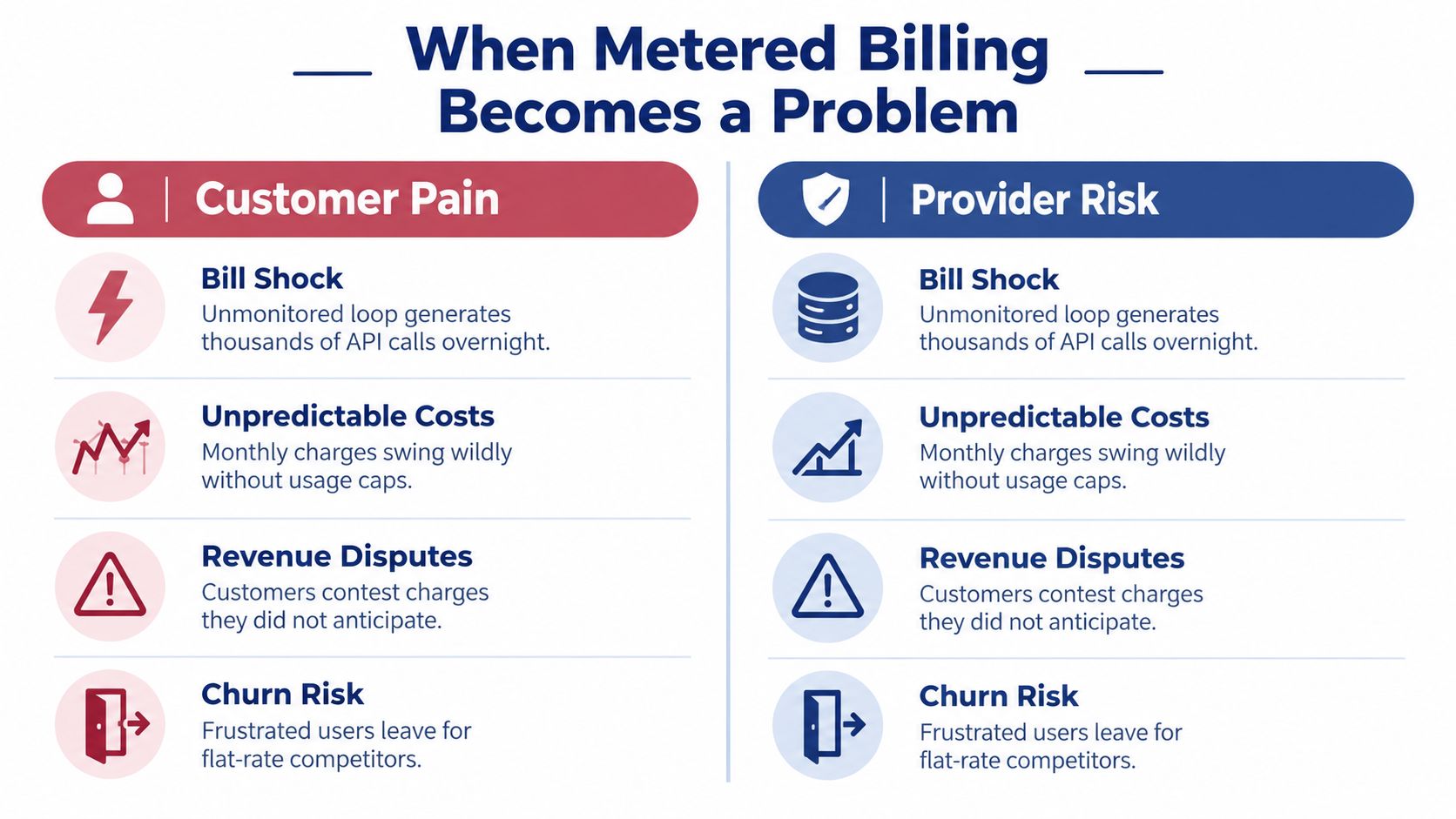
Metered billing fails when the system treats measurement as a back-office detail. A software loop can generate thousands of API calls overnight. An automated calling workflow can continue after a campaign should have ended. If the customer sees neither the activity nor a warning, the final invoice arrives after the opportunity to intervene has passed.
Disputes also arise when the event record and invoice don't line up. Rounding rules, timezone differences, delayed events, and missing deduplication keys can produce totals that are difficult to reproduce. The customer sees a charge, but the provider can't show the underlying event, pricing rule, and exception decision that created it.
The provider's exposure
The seller faces the opposite problem. Usage can be captured but never invoiced, rated against the wrong tier, or lost when a free allowance overflows into paid usage. That is revenue leakage, and it often hides until someone compares the source data with the invoice ledger.
An operational analysis of disconnected metering, invoicing, and reconciliation describes the need for every billed line to trace back to a usage event, pricing rule, and exception decision in this metered billing reconciliation resource. The architecture source also identifies ingestion, normalization, enrichment, rating, and settlement as separate stages, each with its own failure modes, in this metered billing architecture guide.
Guardrails that restore trust
Good design addresses both sides:
- Usage visibility: Give customers a live or regularly refreshed dashboard instead of hiding consumption until invoice day.
- Budget alerts: Notify the account owner as usage approaches a defined allowance or spending limit.
- Soft and hard controls: A soft cap can warn the customer, while a hard cap can pause billable activity when the customer chooses that protection.
- Change handling: Prorate plan changes and record the effective time so mid-cycle upgrades don't create ambiguous charges.
- Contract clarity: Define units, rounding, timestamps, included usage, retries, refunds, and disputed events in plain language.
Bill shock is usually a control failure, not an unavoidable feature of usage pricing.
Implementing Metered Billing Without Revenue Leakage
Reliable metered billing starts at the source. Every billable event should carry a stable customer identifier, an event type, a quantity, and a timestamp. It also needs an idempotency key, which allows the system to recognize a retried event and avoid counting it twice.
Build the pipeline in layers
The operational design should separate event capture from pricing and settlement. A practical five-stage pipeline contains:
- Ingestion: Accept usage events from the application, gateway, telephony platform, or device layer.
- Normalization: Apply a consistent schema, timestamps, units, and deduplication rules.
- Enrichment: Map the event to the correct account, contract, product, plan, and allowance.
- Rating: Apply the versioned rate card, tiers, bundles, caps, credits, or overage rules.
- Settlement: Create invoice lines, refunds, adjustments, and analytics outputs.
This separation makes troubleshooting possible. If a total is wrong, the team can determine whether the event was missing, duplicated, mapped incorrectly, rated under an outdated plan, or omitted during settlement.
Reconcile before the invoice becomes final
Finance and engineering should compare the raw event count with the aggregated meter and then compare the meter with invoice line items. An anomaly workflow should flag unexpected differences for review rather than allowing the invoice to finalize without notification.
Pricing versions deserve the same discipline. Store the rate card used for each invoice so a later price change doesn't rewrite historical calculations. For customer support, an usage reporting resource can help clarify how operational dashboards turn raw activity into information people can act on.
Customer-facing controls should include:
- Usage widgets: Show consumption in the product, with the refresh timing clearly labeled.
- Threshold alerts: Warn customers before they reach a committed allowance or budget.
- Caps and pauses: Let account owners choose whether activity continues after a limit.
- Proration: Calculate fair charges when a plan, allowance, or account scope changes mid-cycle.
- Correction records: Use adjustments or credits instead of editing finalized invoices.
Audit readiness requires durable records. Retain event metadata, rate versions, mappings, exception decisions, and invoice line items for at least seven years when that retention period is part of the organization's finance or compliance policy. The record should let a reviewer reconstruct why a charge appeared, not merely confirm that a total exists.
Choosing the Right Model for Your Business
Choose a pricing model by examining usage volatility, budget posture, and operational capacity. A metered plan suits a business that can observe and manage consumption. A flat-rate plan suits one that values a stable invoice more than precise allocation. A tiered plan fits the middle ground, especially when customers want a known package but still expect room to grow.
Start with three diagnostic signals:
- Usage pattern: Steady consumption supports flat or tiered pricing. Spiky usage makes metering more attractive, but only if alerts and caps are available.
- Finance tolerance: If finance needs predictable quarterly accruals, an uncapped variable bill may be a poor fit. If the team can forecast a usage range and review exceptions, metering becomes easier to manage.
- Concentration of risk: If one queue, location, integration, or customer account can create most of the overage, isolate that usage and apply account-level controls.
Multi-location companies need to examine traffic by site and time of day. A marketing campaign at one branch shouldn't make the entire organization's communications budget opaque. Call centers should separate ordinary agent activity from automated workflows, callbacks, recording, and seasonal programs so managers can identify the source of a spike.
| Business Signal | Choose Metered | Choose Flat Rate | Choose Tiered |
|---|---|---|---|
| Monthly usage | Variable or difficult to predict | Stable and bounded | Generally stable with occasional growth |
| Budget priority | Optimize cost around actual consumption | Protect a fixed operating budget | Keep a package-based budget with expansion room |
| Monitoring ability | Strong dashboards and ownership exist | Limited time for usage reviews | Some monitoring is available |
| Risk pattern | Spikes can be isolated and controlled | Spikes would damage planning | Growth is gradual and threshold-based |
| Best operational fit | APIs, variable calling, and usage-linked services | Predictable communications or software needs | Growing SMBs and teams crossing usage bands |
My rule is direct. Choose metered billing when fairness and elasticity matter, and you have the controls to monitor usage. Choose flat rate when budget certainty outweighs optimization. Choose tiered pricing when you want a soft ceiling without giving up the upside of growth.
Key Takeaways and Next Steps
Metered billing charges for measured units. It can align price with consumption, but it transfers more responsibility for monitoring from the vendor to the customer.
Six principles matter most:
- Measured units: The invoice depends on defined events such as minutes, calls, requests, or stored data.
- Fairness and predictability: Paying for actual use can feel fair, but the total is harder to forecast.
- Visibility: Customers need timely dashboards, itemized invoices, and understandable usage definitions.
- Shared risk: Poor controls can create customer bill shock and provider revenue leakage.
- Operational discipline: Idempotency, normalization, rate versioning, reconciliation, and correction workflows protect accuracy.
- Model fit: The right choice depends on usage volatility, budget requirements, and the team's ability to manage exceptions.
The next action depends on your role:
- SMB owner: Review recent usage records, identify the events driving the bill, and request itemized statements before renewing.
- Call center manager: Test metered pricing on one queue with an explicit cap, alerts, and a clear process for reviewing spikes before expanding it.
- SaaS or VoIP operator: Trace a sample invoice from the final line item back to the usage event, pricing rule, deduplication decision, and settlement record.
As usage-based pricing expands from utilities into APIs, cloud services, AI products, and communications platforms, successful companies will treat metering as part of the customer experience rather than a hidden finance function. Your best next step isn't another vendor comparison. It's a focused usage audit that shows what your organization consumes, how that activity is measured, and which controls would prevent an unpleasant invoice.
SnapDial helps businesses manage cloud calling, conferencing, call routing, reporting, and unified communications with predictable, all-inclusive pricing and hands-on setup. Visit SnapDial to see how a managed phone system can give your team clearer usage visibility without making communications budgeting harder.