A homeowner calls a regional HVAC company because the heating has stopped working. She waits through a recorded greeting, reaches an agent who sounds rushed, and explains the problem twice because the first system doesn't show the service history. The agent checks the scheduling tool, then a billing screen, then messages a technician. Nobody can say who owns the outcome or when the customer will hear back.
The company may have “we care about customers” printed in the office. That statement doesn't help the agent decide whether to interrupt a queue, escalate a safety concern, offer a callback, or stay responsible after transferring the call. A missed-call notification workflow can prevent one avoidable failure, but technology can't replace a clear care standard.
Customer care orientation is the difference between a stated value and repeatable behavior. It has to work when the phone queue is full, a customer switches from chat to email, an AI assistant suggests an incomplete answer, and the employee handling the issue is new. Treat it as an operating system, not a half-day soft-skills session.
The Phone Call That Exposes the Gap
The HVAC agent isn't necessarily uncaring. She may be trying to help while navigating disconnected systems, unclear authority, and a queue timer that rewards short calls. The problem is operational. The company has asked her to be empathetic without defining what empathy looks like when a customer needs an appointment, a refund, or a safety escalation.
A useful orientation program answers practical questions before the call arrives:
- Ownership: Who remains accountable after another team becomes involved?
- Escalation: Which situations require a supervisor, specialist, or emergency route?
- Expectation setting: What response time can the agent promise reliably?
- Channel continuity: How does the next employee see what the customer already explained?
- Closure: What confirms that the problem was resolved rather than merely transferred?
Practical rule: If two capable agents can handle the same situation in completely different ways, the company has a values statement, not an operating standard.
This distinction matters for growing SMBs. A founder may personally remember customers and solve problems through informal messages. As staff, locations, and communication channels multiply, that memory becomes a weak control system. New hires learn from whoever sits nearby, and the loudest queue metric starts to define “good service.”
The stronger approach turns care into observable actions. The greeting, discovery questions, system notes, escalation path, callback promise, and closing confirmation should reinforce the same customer outcome. Agents still need judgment, but they shouldn't have to invent the rules while a customer waits.
What Customer Care Orientation Actually Means
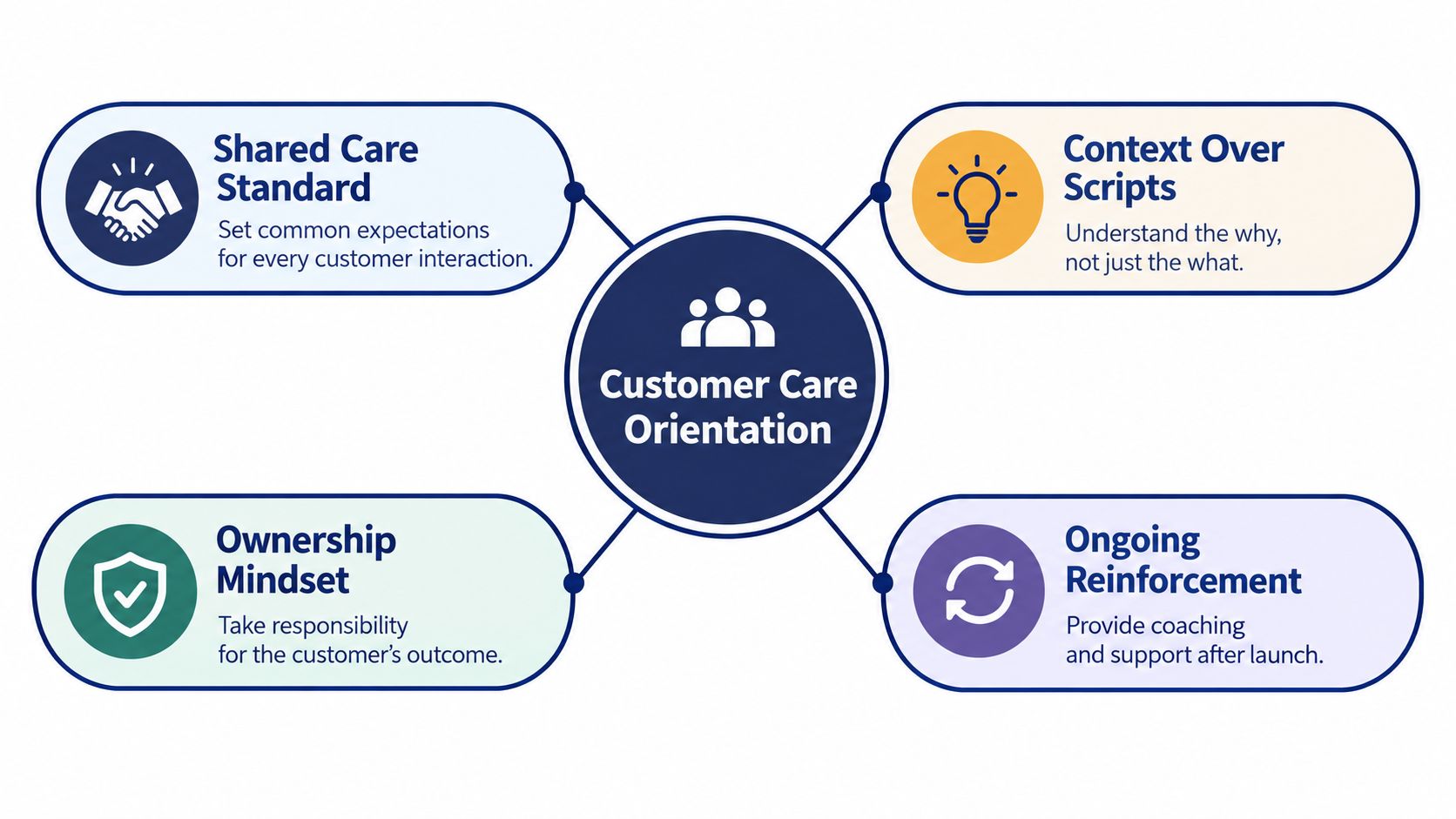
Customer care orientation is the operating standard that tells employees and systems how to reduce customer effort while protecting competent human help for difficult cases. It includes the behaviors people use, the decisions tools support, and the evidence managers review afterward.
That definition separates orientation from generic customer service training. Training may teach active listening, product knowledge, or de-escalation. A values speech may tell employees to put customers first. Orientation connects both to the workflow: what the agent does, what the system does, and how the business knows the interaction worked.
The standard has to be visible
Write a short care standard in language an agent can use during a live conversation. “Be helpful” is too broad. “Confirm the customer's goal, summarize the next action, name the owner, and record the promised follow-up” is coachable.
Apply the standard across phone, chat, email, and self-service. The wording can change by channel, but the customer shouldn't lose ownership when moving between them. A customer asking for a refund by email deserves the same clarity about evidence, timing, and next steps as someone calling the support line.
The system should support judgment
A script can protect consistency, but rigid scripts often make complex conversations feel mechanical. Give agents approved language for sensitive moments, then let them adapt it to the customer's context. Your digital customer care approach should make relevant history, policies, and escalation routes easy to find.
Reinforcement makes orientation real
Managers reinforce orientation through call reviews, coaching, knowledge updates, and feedback loops. A new hire should hear the standard during onboarding, practice it in realistic scenarios, see it in the CRM and phone workflow, and receive feedback after handling real interactions.
A simple test works well: ask a new agent to explain what good looks like, when they must escalate, and how they close the loop. If the answer depends on a supervisor being available, the program still has a gap.
Core Components of an Effective Orientation Program
A usable program contains operating pieces, not just principles. Each piece should help an agent make a decision on a difficult day, not merely sound reassuring during onboarding.
Start with observable behaviors
Document how agents open an interaction, verify context, identify the request, explain options, record commitments, and close the loop. Include examples of acceptable judgment, such as when an agent can solve a billing issue independently and when a supervisor must review it.
Channel standards should describe accessibility, response expectations, and handoff quality. Don't promise instant replies everywhere if your team can't sustain them. A credible promise protects trust better than an ambitious target that creates repeated breaches.
Ownership rules are equally important. The first agent may not solve every issue, but that agent should either remain accountable or make a documented handoff with a named owner and next action. “Someone from billing will contact you” is not an ownership rule.
Set boundaries around AI and automation
AI can summarize conversations, surface knowledge articles, draft replies, and classify routine requests. It shouldn't make consequential decisions on its own or create a false impression that a person reviewed an answer.
Define four boundaries:
- Permitted assistance: What AI may summarize, recommend, or draft.
- Human review: Which topics require an employee to verify the output.
- Disclosure: How the customer learns that automation is involved.
- Failure logging: Where the team records inaccurate answers, bias concerns, privacy risks, and failed handoffs.
Employees also need practice challenging AI suggestions. An AI tool that speeds up an incorrect response can increase customer effort rather than reduce it.
Choose a delivery model deliberately
Some SMBs should build orientation internally. Others need a blended model, especially when managers understand the operation but lack time to design training materials. A structured client onboarding workflow can help teams turn informal knowledge into repeatable stages, owners, and follow-up tasks.
| Model | Best For | Main Trade-Off | Typical Cost Shape |
|---|---|---|---|
| In-house | Teams with experienced supervisors and stable processes | Internal leaders carry design and coaching work | Staff time, tooling, and manager capacity |
| Blended | Growing teams with subject-matter experts but limited training bandwidth | External structure must be adapted to local policies | Combination of service fees and internal time |
| Fully outsourced | Operations that need a ready-made program or temporary capacity | External trainers may miss operational nuance | Provider fees plus ongoing internal quality control |
Finally, create a coaching rhythm and feedback loop. Review representative interactions, categorize recurring friction, assign a process owner, and tell customers when their issue produced a change. A call center coaching platform is useful only when managers connect its records to specific behaviors and decisions.
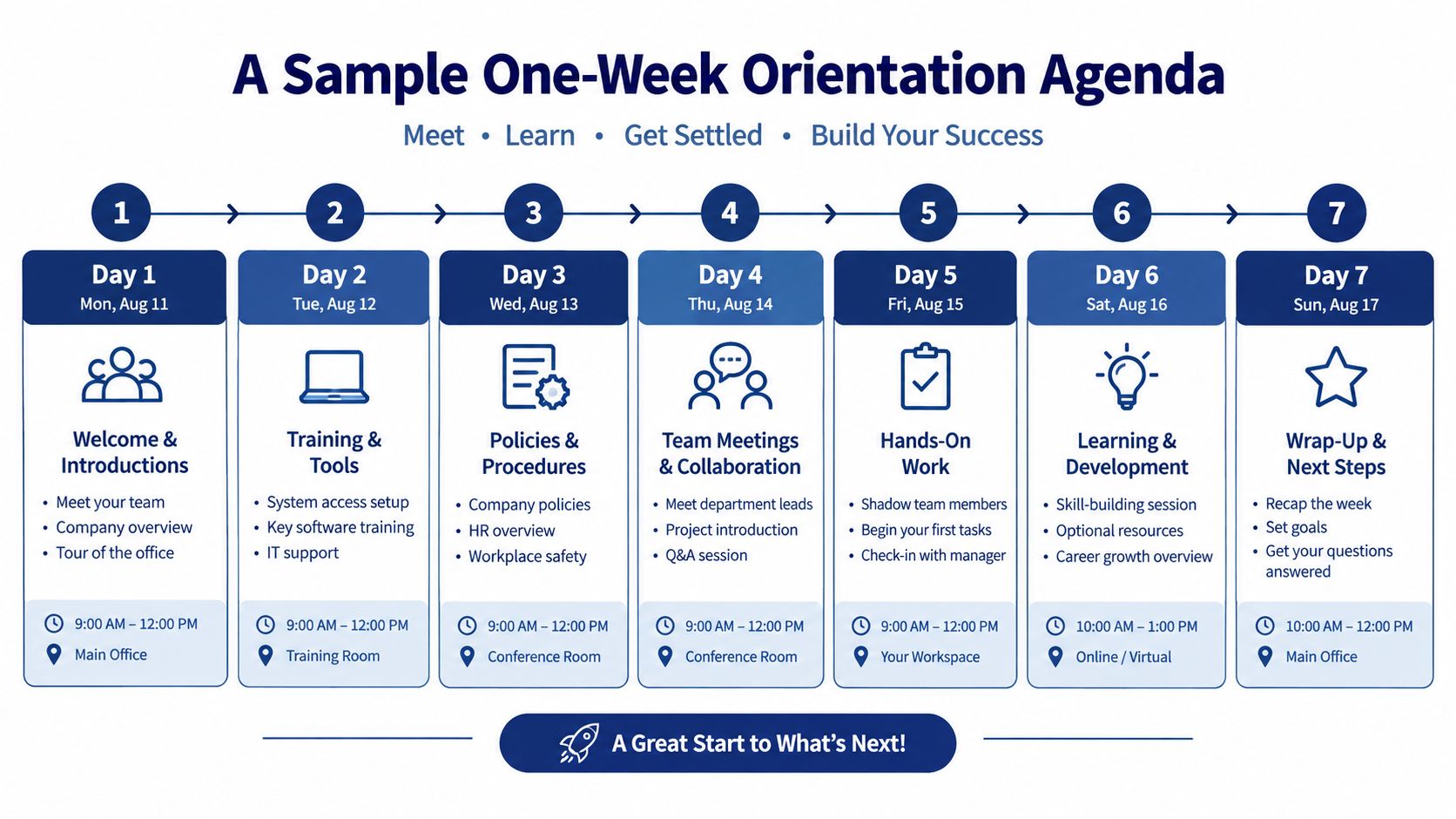
A Sample One-Week Orientation Agenda
A strong orientation week ends with an agent able to perform the job under supervision. It doesn't try to turn a new hire into an expert through presentations alone.
Day 1 builds context
Explain who the customer is, what problems bring them to the company, and what the care standard requires. Use real examples of good ownership, poor handoffs, and appropriate escalation. The job is simple: the agent can describe the desired customer outcome and recognize when a request needs help.
Day 2 makes the tools usable
Walk through the phone system, CRM, knowledge base, ticket queue, authentication steps, notes, transfers, and follow-up tasks. Don't demonstrate only the happy path. Have the new hire recover from a dropped call, locate an incomplete record, and document a handoff.
The end-of-day test is a simulated interaction completed without a trainer taking over. The agent should know where to look, what to record, and how to ask for help.
Day 3 turns observation into judgment
Pair the new hire with an experienced agent for call shadowing. Provide a short observation sheet covering discovery, clarity, ownership, system use, and closing. Debrief each interaction with one question: what did the customer need next, and what made that next step clear or unclear?
Day 4 adds supervised live work
Let the agent handle suitable calls while a coach listens and intervenes only when necessary. Review the interaction soon afterward, while the details remain fresh. Correct one behavior at a time, such as asking a better diagnostic question or naming the next owner.
Day 5 connects behavior to measurement
Introduce the metrics managers will use, explain their limitations, and review recorded examples. The agent should leave knowing how quality is assessed, how coaching works, and how feedback changes the process. Orientation ends with a supported launch, not a graduation from help.
How Phone and UC Features Reinforce the Program
A care standard survives busy queues only if the phone system supports the behavior you expect on live calls. If the menu is confusing, the callback never comes, or the agent cannot see what happened before the transfer, orientation turns into a poster instead of an operating system.
Start with the entry point. An auto attendant can sort requests by need and reduce handoffs, but only if the menu uses plain language and gives callers a clear path to a person. If agents are trained to take ownership while the IVR keeps trapping customers in irrelevant options, the system is training the opposite behavior.
The same rule applies inside the queue. Call recording gives supervisors something concrete to coach against, not vague reminders to “show empathy.” Visual voicemail transcription helps an agent recover context before calling back. Queue callback and wait-time announcements reduce uncertainty and make delays explicit. Real-time statistics show when service levels are slipping because staffing, routing, or call mix changed, not because agents suddenly stopped caring.
That balance matters. Customers value reaching the right support person at 92%, convenience at 91%, knowledgeable and kind employees at 89% each, and fast responses at 88%, according to the 2025 ACA State of CX report. Speed is part of care. Accuracy, context, and judgment matter just as much.
Use the feature set to reinforce the exact habits you coach.
| Feature | Orientation Outcome It Reinforces | What the Manager Gets |
|---|---|---|
| Auto attendant and IVR | Clear entry points and appropriate routing | Fewer misdirected calls and clearer menu performance |
| Call recording | Consistent discovery, tone, and closing behavior | Evidence for targeted coaching |
| Visual voicemail transcription | Better preparation before callbacks | More informed follow-up conversations |
| Queue callback | Lower customer effort during busy periods | A visible way to manage abandoned-call risk |
| Wait-time announcements | Honest expectation setting | Fewer surprises during peak demand |
| Real-time statistics | Faster response to queue pressure | Operational context for staffing decisions |
| Detailed reporting | Ongoing reinforcement | Trends that support process changes |
For teams reviewing automation, use the same test you use for phone workflows. An AI customer communication platform should preserve context, disclose automation, support escalation, and leave a clear trail for human review.
Where Most SMB Programs Quietly Break
Monday at 9:07 a.m., the queue spikes, a new agent gets three back-to-back calls, and the orientation binder stops mattering. What drives behavior then is the operating system behind the script: who owns the issue, what good judgment sounds like under pressure, and whether the supervisor will review the call later. That is where many SMB programs fail without anyone noticing. Orientation gets treated as a one-time event, then the live queue retrains people to optimize for speed, local habits, and whatever gets the next contact off the screen.
Ownership breaks next. Teams add chat, email, social DMs, and self-service because customers want options. Fair enough. But if no one defines who closes the loop, those channels create more places for work to stall. Customers do not care which team touched the case first. They remember having to repeat the story, getting two different answers, and waiting on a callback nobody owned.
Speed can become the wrong target
I have seen this trade-off up close. A shorter call can look better on a dashboard and still create more work an hour later. Agents rush discovery, give the likely answer instead of the verified one, and move on. Then the customer calls back, more frustrated than before, and another rep has to clean it up.
Reducing customer effort sometimes means slowing down long enough to diagnose the issue correctly.
The same problem shows up with automation. Customer expectations keep rising, but an automation-only setup strips out the human judgment people need when the case is unusual, emotional, or carries real consequences. Orientation should prepare agents to step in at that moment, not just hand everything to AI until it fails.
AI needs accountability
A smaller company does not need a large governance function to use AI well. It does need rules people can follow on a busy day. Define which outputs require human review. Tell customers when automation is involved where appropriate. Log misses in a way managers can trace back to the knowledge source, prompt, or workflow that caused them.
The commercial risk is straightforward. 52% of surveyed consumers stopped using or buying from a brand after a bad product or service experience, and 29% left specifically because of poor customer experience, according to PwC's 2025 customer experience survey. Before buying another tool, fix the ownership gap, the weak escalation path, or the callback promise nobody tracks.

Measuring Whether Orientation Is Working
Measurement should reveal customer effort and employee behavior, not produce a scoreboard that encourages gaming. Keep the initial dashboard small enough for a manager to review consistently.
First-contact resolution asks whether the customer got a complete answer without returning for the same issue. A low result can indicate weak knowledge, poor authority, broken handoffs, or an inaccurate definition of “resolved.” Review a sample of repeat contacts and ask where the first interaction stopped short.
Customer satisfaction and post-call surveys capture the customer's immediate view, but responses need context. Compare comments with recordings and case outcomes. A polite interaction can still fail if the promised repair, refund, or follow-up never happens.
Average handle time is useful only beside resolution and quality signals. If the number falls while repeat contacts or escalations rise, the team may be ending calls too early. Coach the behavior that created the trade-off, rather than instructing agents to talk faster.
Use metrics as conversation starters
| Measure | What It Reveals | Coaching Conversation |
|---|---|---|
| First-contact resolution | Whether the issue was solved completely | “What information or authority was missing?” |
| CSAT and survey comments | How the interaction felt to the customer | “Where did clarity or confidence drop?” |
| Average handle time | How much time the interaction consumes | “Did speed improve the outcome or shorten the diagnosis?” |
| Escalation rate | Whether agents know and use boundaries | “Was the escalation necessary, timely, and complete?” |
| Repeat-contact rate | Whether customers must restart the journey | “What should have been recorded or owned?” |
| Recorded-call themes | Which behaviors appear consistently | “What one behavior should we practice next?” |
Don't set targets without understanding the work mix. A complex technical case and a password request shouldn't be judged by identical expectations. Use trends, case categories, customer comments, and supervisor review together.
The most valuable output is a coaching decision. A manager should finish the review knowing whether to update the knowledge base, change a routing rule, clarify authority, retrain an agent, or remove an unnecessary customer step.
A 30-60-90 Day Rollout and a Final Word
Use the first 30 days to write the care standard, define ownership and escalation rules, map channel expectations, and align the phone, CRM, and knowledge workflows. Review a small sample of interactions to identify the gap between policy and actual behavior.
By day 60, run the one-week agenda with a cohort or selected team members. Instrument the core measures, establish call-review sessions, and test AI boundaries with realistic cases. Fix workflow friction while the training examples are still fresh.
By day 90, connect coaching to recorded calls, queue conditions, customer feedback, and repeat-contact patterns. Publish the changes employees need to know, assign owners for unresolved process issues, and keep the standard active in team meetings.
Take this checklist into Monday morning:
- Define care: Write the behaviors customers should experience on every channel.
- Assign ownership: Make every handoff carry a named owner and next action.
- Protect judgment: Set human review and escalation rules for AI and automation.
- Coach from evidence: Use recordings, queue data, and customer feedback together.
- Measure outcomes: Balance speed with resolution, clarity, and reduced effort.
Customer care orientation works when an agent can make a good decision under pressure because the company has already made the important decisions clear. Build that operating system, then reinforce it through the tools and conversations employees use every day.
SnapDial gives SMB teams Auto Attendant and IVR, call recording, visual voicemail transcription, mobile calling, smart queue management, queue callbacks, wait-time announcements, real-time statistics, and detailed reporting to support a consistent care standard. Visit SnapDial to see how its cloud phone and contact-center capabilities can fit your orientation program.