
Your prospect seemed interested on the sales call. They asked about pricing, nodded through the demo, and promised to discuss it internally. Then their colleague asks what makes your company different, and all they can remember is that you sell business phone software.
That's a market positioning problem, not necessarily a sales problem. Before rewriting your homepage, decide what buyers should remember, which alternative they should compare you with, and what evidence makes your promise believable.
What Market Positioning Means and Why It Matters
A buyer who forgets your company after a sales call hasn't necessarily rejected your product. They may have failed to place it in a useful category. If your presentation covered recording, mobile apps, faxing, analytics, and conferencing without a clear priority, they've got a feature inventory instead of a reason to choose you.
Market positioning is the place your product holds in a buyer's mind relative to the alternatives they already know. In practical terms, it's the main reason the right buyer can pick you quickly.
Think of a supermarket shelf. Shoppers mentally sort products by reasons to buy: convenience, value, a particular dietary need. Your business buyer does something similar, except their mental shelf might contain a legacy PBX, a cloud communications platform, and the option of doing nothing.
The idea grew out of post–World War I advertising, was popularized by Al Ries and Jack Trout, and came to explain why consumers discard information that has no clear place in their minds, as the overview of positioning in marketing) describes.
Positioning comes before the words
Positioning compared with brand, messaging and tagline
| Element | Question it answers | Set by | Example for a cloud phone vendor |
|---|---|---|---|
| Market positioning | Where we sit against alternatives in the buyer's mind | Strategy and product leaders | Hosted phone system for multi-site teams that cannot afford downtime |
| Brand | How people feel about us and remember us | Leadership and brand team | Dependable, friendly, human support |
| Messaging | What we say to each audience and channel | Marketing and sales | Switch from your legacy PBX with no downtime |
| Tagline | A short phrase for ads and signage | Creative team | Every call, answered |
These are illustrative claims, not interchangeable deliverables. A no-downtime message needs a migration plan that supports it. An absolute tagline about answering every call would require especially careful substantiation.
For founders still defining their target segment, Big Moves Marketing's resource on deciding which SaaS customers to win helps frame positioning as a customer choice, not just a copywriting exercise.
Self-test: After a sales call, can the prospect repeat your category and your reason to choose you in a single sentence?
If they can't, better adjectives won't fix the underlying decision.
Choosing a Positioning Framework That Fits Your Data
Choose a framework based on the evidence you have, not on how polished its diagram looks. A sales team with call recordings and customer access needs a different starting point from a company commissioning a competitive buyer survey.
Use a shared working session to expose disagreements before turning them into campaign copy.

Positioning frameworks compared
| Framework | Best for | Inputs you need | Output |
|---|---|---|---|
| Five-component method (April Dunford) | Early-stage SMBs repositioning a product | Competitive alternatives, unique attributes, value, best-fit customers, market category | A positioning statement and category choice |
| Ownership positioning (Ries and Trout) | Crowded categories where one word can be owned | Competitor claims and buyer associations | One ownable word or idea |
| Perceptual mapping | Firms with a survey budget and many competitors | Buyer ratings of brands on paired attributes | Two-axis map showing gaps |
| Conjoint analysis | Pricing and feature trade-offs | Buyer choices between product bundles | Which attributes drive choice and by how much |
| Cluster or correspondence analysis | Finding underserved segments | Survey data across many attributes | Customer segments and their preferences |
Start with the cheapest credible method
The five-component method is a practical starting point when you have customers and sales conversations but no survey budget. Work through alternatives, attributes, value, best-fit customers, and category in that order. Starting with a category label can trap the team inside comparisons buyers don't make.
Ownership positioning suits a crowded category when you can substantiate a focused association, such as dependable implementation. Calling yourself reliable isn't enough. Buyers need a reason to associate that idea with you rather than every competing vendor.
Perceptual mapping earns its cost when you need to understand how buyers place several competitors. Multidimensional scaling can turn patterns in buyer ratings into a visual map; correspondence analysis can show associations between brands and attributes. Don't draw attractive axes yourself and mistake the empty corner for proven demand.
Conjoint analysis addresses a different decision: which bundles buyers choose when capabilities and price change together. Never run it without real buyer choice data. Internal opinions about feature importance aren't a substitute.
Cluster analysis groups respondents with similar needs, while correspondence analysis explores associations. Treat their outputs as candidates for commercial investigation, not automatic instructions to launch a new segment.
Use the simplest method your evidence supports. The methods combine well: customer interviews can establish the initial alternatives and attributes, then survey results can test whether those distinctions appear in a perceptual map.
How to Write a Positioning Statement in Six Steps
A positioning statement earns its place when sales, product and implementation can each act on it. The test is not whether the sentence sounds sharp. It is whether a buyer can adopt the promise with the integrations and handover you can support.
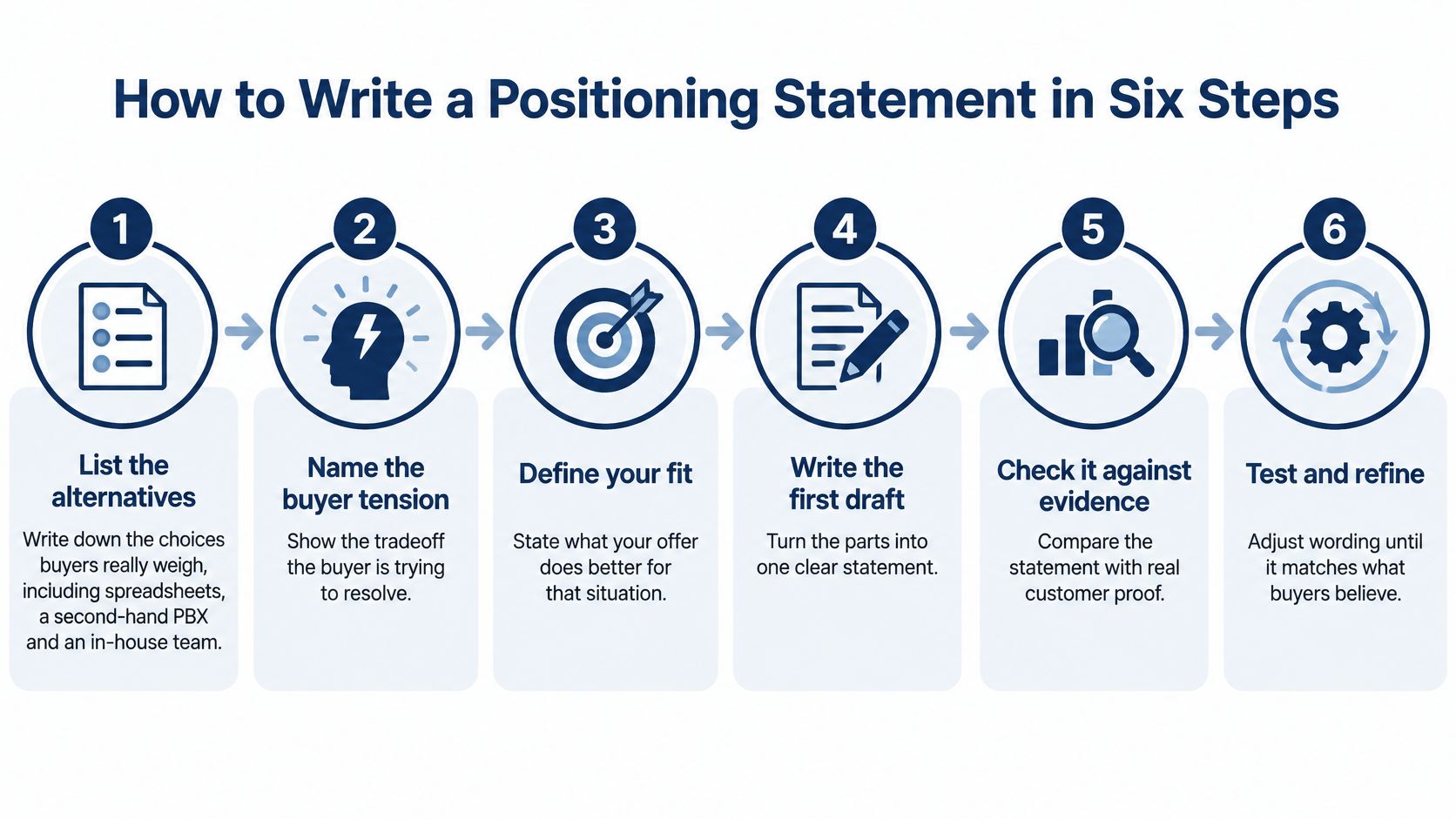
Use this sequence to turn a broad description into a commercial choice.
Build the claim from buyer evidence
List the alternatives buyers really weigh. Include spreadsheets for tracking callbacks, a second-hand PBX, an in-house IT patch, and keeping the existing setup. Named competitors matter only when buyers consider them. Add the switching cost that keeps buyers where they are; if moving means retraining staff and reconnecting CRM records, the status quo is a real competitor.
Choose the attributes you can prove. Pick capabilities that separate you from those alternatives, then attach evidence: provisioning records, documented support coverage, a demonstrated routing workflow, or a working integration with the buyer's CRM. A familiar feature becomes meaningful when its implementation removes a difficult handoff.
Connect each attribute to a tracked outcome. Translate centralized routing into fewer misdirected calls or easier administration, not just unified communications. Keep the chain specific enough for an operations manager to check. If a claim cannot be measured before and after cutover, it is probably a slogan.
Name the best-fit buyer narrowly. A multi-location firm with a small IT team and hybrid staff presents a clearer situation than businesses of every size. Include the constraint that makes your approach valuable: limited admin capacity, inconsistent call handling across sites, or a CRM the buyer will not replace.
Choose a recognizable category. Hosted VoIP, cloud PBX, and cloud contact center create different expectations. Choose the category that helps buyers understand the purchase without a lesson in invented terminology. The category should also set the integration questions buyers will ask.
Write the statement and challenge its proof. Use the template, then have sales and implementation review it together. If the delivery team objects to the promise, resolve that objection before publishing.
For [buyer] who [need], [product] is the [category] that [outcome], unlike [alternative], because [proof].
Apply it to hybrid operations
A 2025 systematic review of remote and hybrid work in SMEs found that flexible work generally improves productivity, while inadequate digital infrastructure and communication problems remain persistent constraints. That makes reliable access to business identities, routing, and voicemail an operational requirement, not a decorative feature bundle.
A hypothetical statement could read:
For hybrid operations teams that need staff reachable across locations, Acme Voice is a hosted VoIP service that preserves business calling across devices, unlike a site-bound PBX, because its deployment includes tested user access, routing checks, and documented handover.
The proof sits in whether employees can receive the right calls under the right business identity and whether administrators can change access without escalation. Test that claim with the CRM connection the buyer already uses and the call flows they depend on.
Make the handover tangible with activation checks, named responsibilities, and an orientation agenda. Agree the agenda with your provider before cutover and record who attends and what each person must confirm; a customer care orientation checklist can structure that review.
A strong statement excludes some buyers. If it comfortably describes every company, it makes no useful positioning choice and gives sales no reason to qualify.
Testing a Positioning Before You Commit Budget
Asking whether someone would buy your product invites polite agreement. It doesn't reveal what they understood, which alternative they prefer, or whether they believe you can deliver.
Test what buyers say and do instead. Keep the first round small enough to run this week, and treat the results as qualitative direction rather than a market-wide estimate.
Replace approval with observable signals
Buyer explanation test. Interview recent buyers and ask them to explain your product to a colleague. Record their wording with permission; pass when they independently name the intended category and advantage, and investigate when they describe something else.
Blind comparison test. Show your draft beside competing statements with brand names hidden. Ask which fits their situation and why; generic praise is weak evidence, while a specific explanation of fit is useful.
Landing-page test. Compare alternative headlines with the same audience and offer. Define the conversion event before launch, and don't call a winner because an early handful of visitors behaved differently.
Sales-language audit. Review recent call recordings for the category words reps and prospects use. If every rep needs a different explanation, the positioning hasn't become a shared operating decision.
Lost-deal review. Record what the buyer chose, including the status quo, and why. Separate a misunderstood claim from a genuine product gap or an unaffordable transition.
For survey-based testing, Statlyst's guide to survey figures is a useful companion when checking how a result should be interpreted. Don't turn a small interview exercise into a precise claim about the whole market.
Move forward when buyers repeat the intended category and differentiator without coaching, and can connect both to their own situation.
Revisit the statement when participants recite features, place you in an unintended category, or choose you for a benefit you can't substantiate. Agreement inside the company isn't the pass condition.
Metrics That Show Your Positioning Is Working
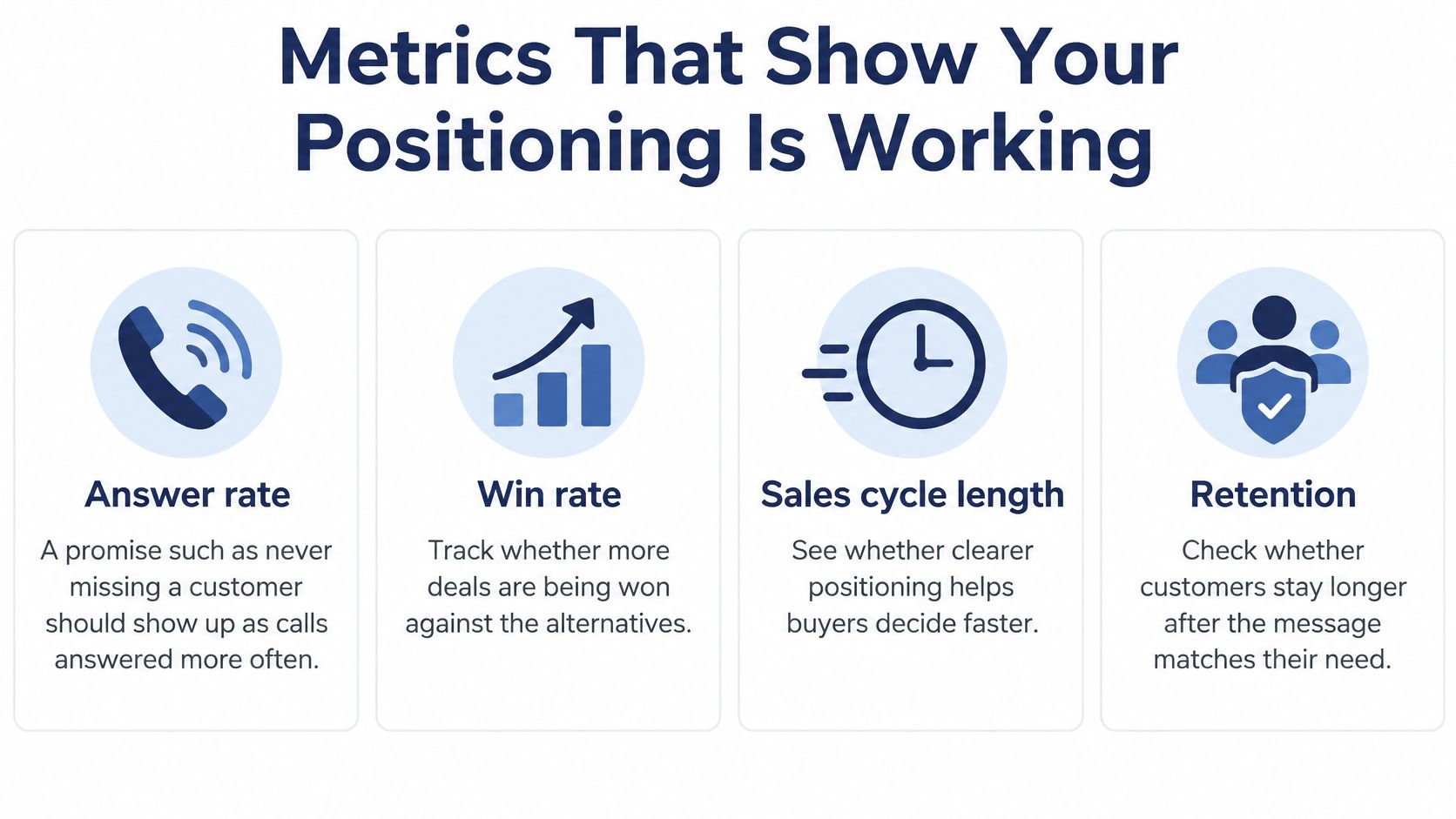
Track answer rate, win rate against the named alternative, unprompted category recall, and time to first value. Together, they test whether buyers understand the promise, select your offer, and experience the intended result.
For a communications vendor, answer rate is especially useful when positioning centers on customer reachability. It measures delivery, though it can't by itself prove that positioning caused a commercial improvement.
Use this visual as a broader dashboard prompt, then define the operational measures precisely.
Keep benchmarks separate from targets
Invoca's analysis of business phone conversations provides the directional answer-rate reference points below. Because a commercial analytics provider published the dataset, validate its relevance against your own call mix before setting targets or making customer promises.
Positioning success metrics and reference points
| Metric | What it signals | How to measure | Reference point | Review cadence |
|---|---|---|---|---|
| Answer rate on all inbound calls | Whether demand reaches a person | Human-answered calls divided by total inbound calls | 56% across industries, directional | Monthly |
| Answer rate on calls over 15 seconds | Whether higher-intent calls reach a person | Filter calls over 15 seconds, then compute human answer rate | 65%, directional | Monthly |
| Answer rate on calls over 30 seconds | Whether longer caller attempts get through | Filter calls over 30 seconds, then compute human answer rate | 71%, directional | Monthly |
| Win rate against the named alternative | Whether buyers choose you over that alternative | Wins divided by closed deals against that alternative in your CRM | Your own baseline | Monthly |
| Unprompted category recall | Whether prospects repeat your frame | Share of reviewed calls where the buyer names your category before the rep | Your pre-change baseline | Quarterly |
| Time to first value for new users | Whether delivery supports the promise | Days from signup to first successful routed call | Your pre-change baseline | Monthly |
Keep voicemail and automated pickup separate from human answers. Otherwise, a routing change can make the dashboard look healthier without improving access to staff.
Longer call duration is a useful filter, not proof that every call represents a valuable opportunity. Compare consistent queues and locations, and annotate changes in staffing, opening hours, and acquisition channels.
Use your CRM to distinguish cheap alternatives from difficult migrations. Those losses require different responses: the first may expose weak value communication, while the second may expose inadequate transition support.
Our customer engagement software overview is a useful context for connecting communication workflows to the outcomes you choose to measure.
If answer rate rises but win rate doesn't, investigate whether you're attracting the wrong buyers or presenting an offer that doesn't match the promise. Also check pricing and sales execution before blaming positioning alone.
Common Positioning Mistakes and How to Fix Them
Positioning rarely fails because the headline lacks energy. It fails because the promise is untestable, the audience is too broad, or the claim ignores what the buyer must do to adopt the product.
The 2025 OECD D4SME survey found that only about half of SMEs reached the competent or higher level on its digital-maturity index, with maintenance costs at 40% and lack of time for training at 39% among the leading barriers. A longer feature list doesn't remove either obstacle.
Diagnose the commercial problem
Positioning symptoms, causes and fixes
| Symptom | Likely cause | Fix |
|---|---|---|
| Prospects cannot tell you apart from competitors | Attributes listed without a buyer outcome | Rewrite the claim around one outcome the buyer already tracks |
| Sales reps pitch features nobody asked for | Positioning built on feature volume | Lead with the adoption or continuity question buyers actually ask |
| Trials stall during migration | Buyers fear the admin burden | Publish a role-based first-30-days plan with success criteria |
| Win rate drops against cheap alternatives | A price-led claim that hides total cost | Show remaining costs such as porting, devices, training and recording storage |
| Positioning drifts across pages | Each team writes its own version | Use one statement owned by product marketing and reviewed quarterly |
A migration plan should identify who supplies the number inventory, who approves call flows, who checks devices, and who signs off on the cutover. Distinguish provider work from customer work so that managed deployment doesn't sound like an invitation to discover hidden responsibilities later.
For continuity-led positioning, document what happens to customer history, recordings, fax workflows, and emergency calling arrangements. A successful test call doesn't establish that every business process survived the transition.
Make simplicity verifiable
Apply a copyability check: could a competitor replace your logo and credibly publish the same claim? If so, strengthen the proof with a documented support model, a migration deliverable, or acceptance criteria that reflect how you operate.
Then apply a buyer-verification check. Every major promise should have evidence the prospect can inspect before signing, not a reassurance they must accept on trust.
A simple interface may still require difficult preparation. Position simplicity as work that someone takes responsibility for removing, not work that magically disappears.
If you can't name the costs that remain after switching, your positioning isn't credible yet.
Worked Examples and Your Next Move
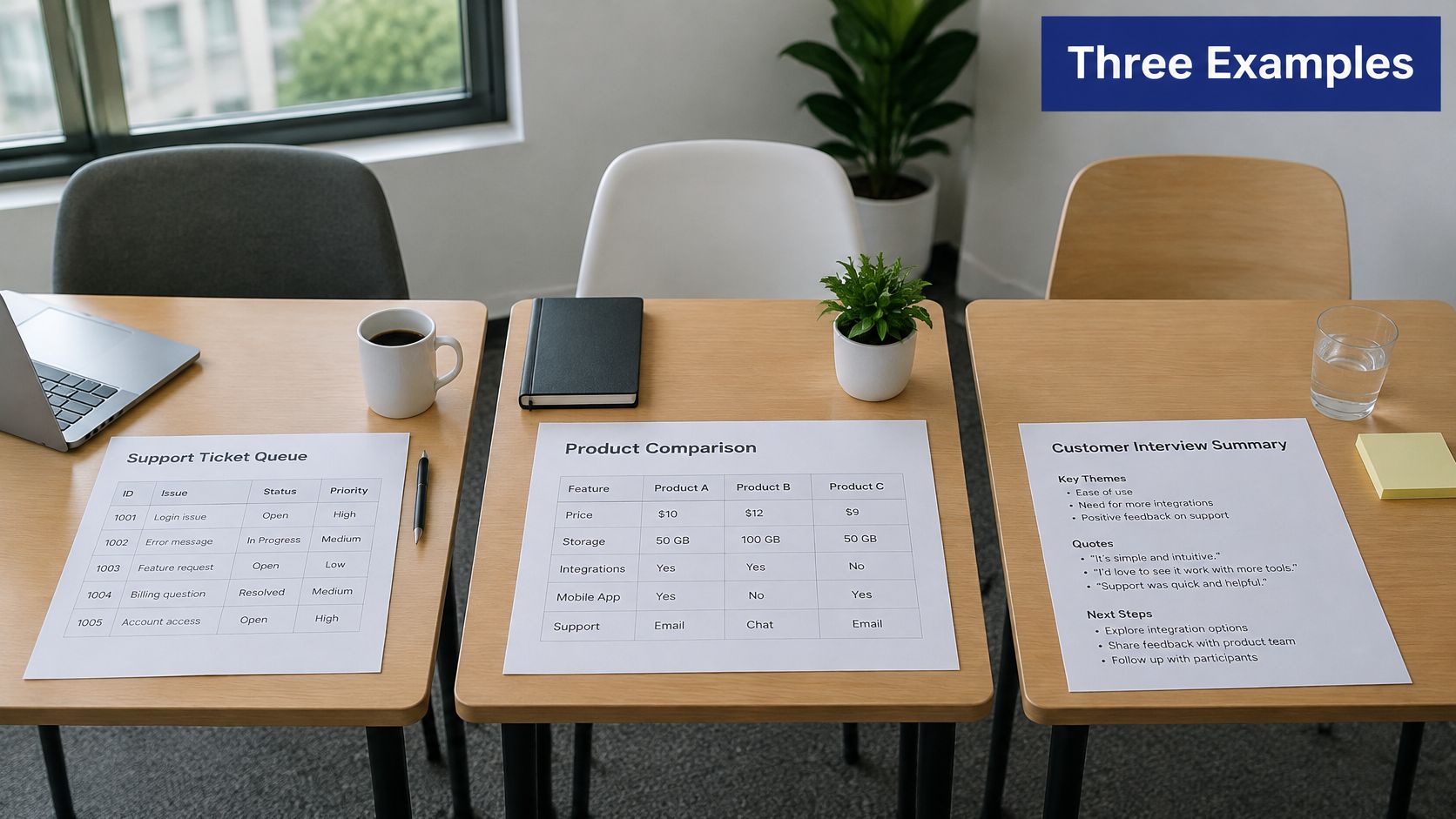
The strongest statement changes with the buyer's constraint. A support manager protecting customer access, a founder reviewing costs, and an IT lead planning a cutover shouldn't receive the same opening pitch.
Treat these as draft claims to validate, not ready-made promises.
A support team with a queue problem
For support teams whose callers abandon busy queues, Acme Voice is a cloud contact center designed to preserve customer conversations, unlike a basic ring group, because it combines queue callback and wait-time announcements with queue-level reporting.
Validate the statement with abandonment, callback completion, and human answer rate on longer calls. Our contact center experience overview offers context for evaluating the workflow rather than just the feature names.
A small business comparing total cost
For a small business struggling to forecast phone expenses, Acme Voice is a hosted phone service designed for predictable total cost, unlike an aging PBX, because its proposal separates recurring charges from remaining transition and operating expenses.
A., in SnapDial website reviews, wrote: “This system will be able to do everything that our business needs and at a much lower price than we are currently paying.” That expresses a customer's expectation, not a universal savings guarantee.
We use an all-inclusive pricing model and offer integrations with more than 30 popular CRM platforms. For a specific proposal, verify included scope against the current price list and the required CRM workflow against the integration catalogue.
An IT lead protecting adoption capacity
For multi-location IT leads with limited migration capacity, Acme Voice is a managed cloud PBX designed to reduce internal transition work, unlike an in-house replacement, because its role-based launch plan names owners and tracks user activation and routing-change resolution.
Use the video as a discussion prompt, then put the proposed claim beside your own delivery evidence.
This week, write your statement using the six steps, schedule buyer interviews, and baseline an operational metric before changing copy. Keep the claim that buyers understand and your team can deliver.
SnapDial offers cloud business calling with white-glove setup and human support, so your evaluation can focus on adoption and continuity rather than feature volume alone. Visit SnapDial to discuss your current phone environment, the workflows you need to preserve, and the evidence that would make a transition worthwhile.