
Maria has been listening to hold music while her lunch break disappears. An automated voice offers her a choice, press 2 for a callback or stay on the line. She wants help, but she also wants her afternoon back. The decision looks simple, yet it exposes the central question behind every callback queue: can the contact center keep its promise after the caller hangs up?
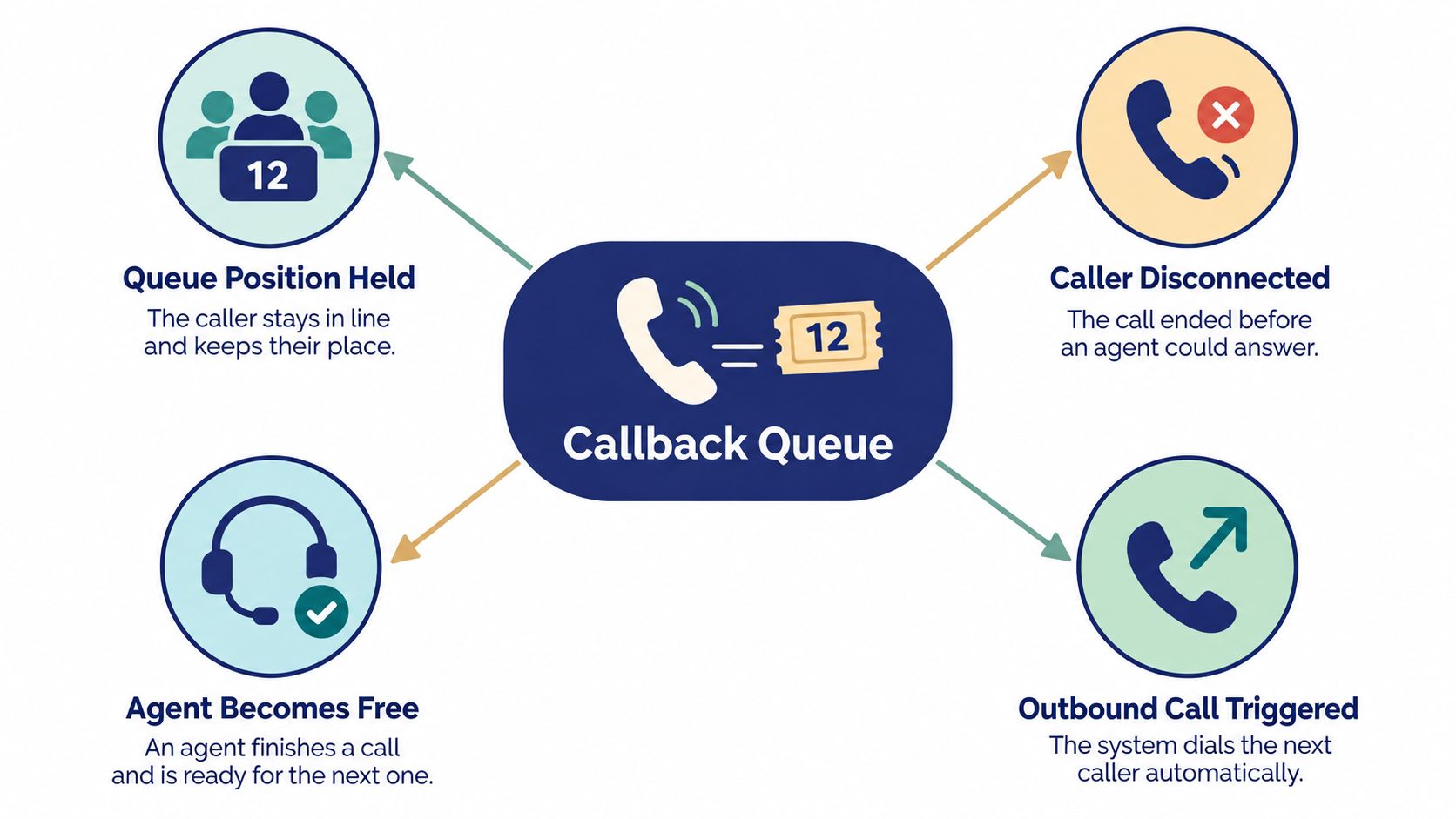
A callback queue captures the caller's number, ends the live wait, and places the request into a virtual line. When the routing system determines that an appropriate agent can handle the interaction, it places an outbound call and reconnects the caller to service. The caller trades continuous hold time for a deferred task with an expected outcome.
That promise works only when the queue has clear rules, suitable staffing, reliable identity data, and honest timing. The mechanics matter, but so do the failure points. An IT manager evaluating a cloud PBX should ask how the platform preserves position, routes skills, limits backlog, retries unanswered calls, and reports deferred work before enabling the feature.
A Caller Stuck on Hold and the Promise of a Callback
Maria has already spent part of her lunch break listening to hold music. The support queue is full, agents are busy, and she must choose between continuing to wait or ending the call without knowing when help will arrive. A callback changes the work from an active phone conversation into a deferred service request: the caller leaves the line, while the contact center retains responsibility for completing the interaction.
A callback queue records that request for later outbound contact. It normally stores the caller's number and may retain IVR details such as an account identifier, department, language, or reason for calling. In a voice-only PBX, this record may be little more than a phone number and queue position. In an omnichannel contact center, it can also carry skill, priority, customer, and conversation context. A lean SMB team may use the same feature with simpler rules, but its limited staffing can make delays and retries more visible.
Callback is different from voicemail. Voicemail creates an audio message for later review. A callback queue creates managed deferred work, with rules for eligibility, routing, business hours, agent capacity, and retry handling. An after-hours announcement may only state when the office reopens; it does not necessarily create a tracked return-call task.
Practical rule: Treat every callback offer as a service commitment, not as a convenient escape from hold music.
The commitment has three operating requirements. The platform must capture and preserve the request accurately. The contact center must decide when the request enters the agent workload and which team receives it. The system must also handle unanswered callbacks, expired requests, duplicate submissions, and staffing changes without hiding unfinished work in a backlog.
A large empirical study of 1,215,776 calls found that 50.1% of callers were offered a callback, 37.5% of those offered accepted, and 93% of accepters answered when the callback arrived, according to the University of North Carolina Kenan Institute study of callback behavior. The findings show why the feature matters operationally: it moves waiting out of the live voice channel while retaining a strong chance of eventual contact.
For an IT manager, the buying question is whether the PBX can manage deferred work under pressure. Ask how it preserves requests when demand exceeds capacity, handles a caller who does not answer, and responds when the selected skill group is unavailable.
What a Callback Queue Does
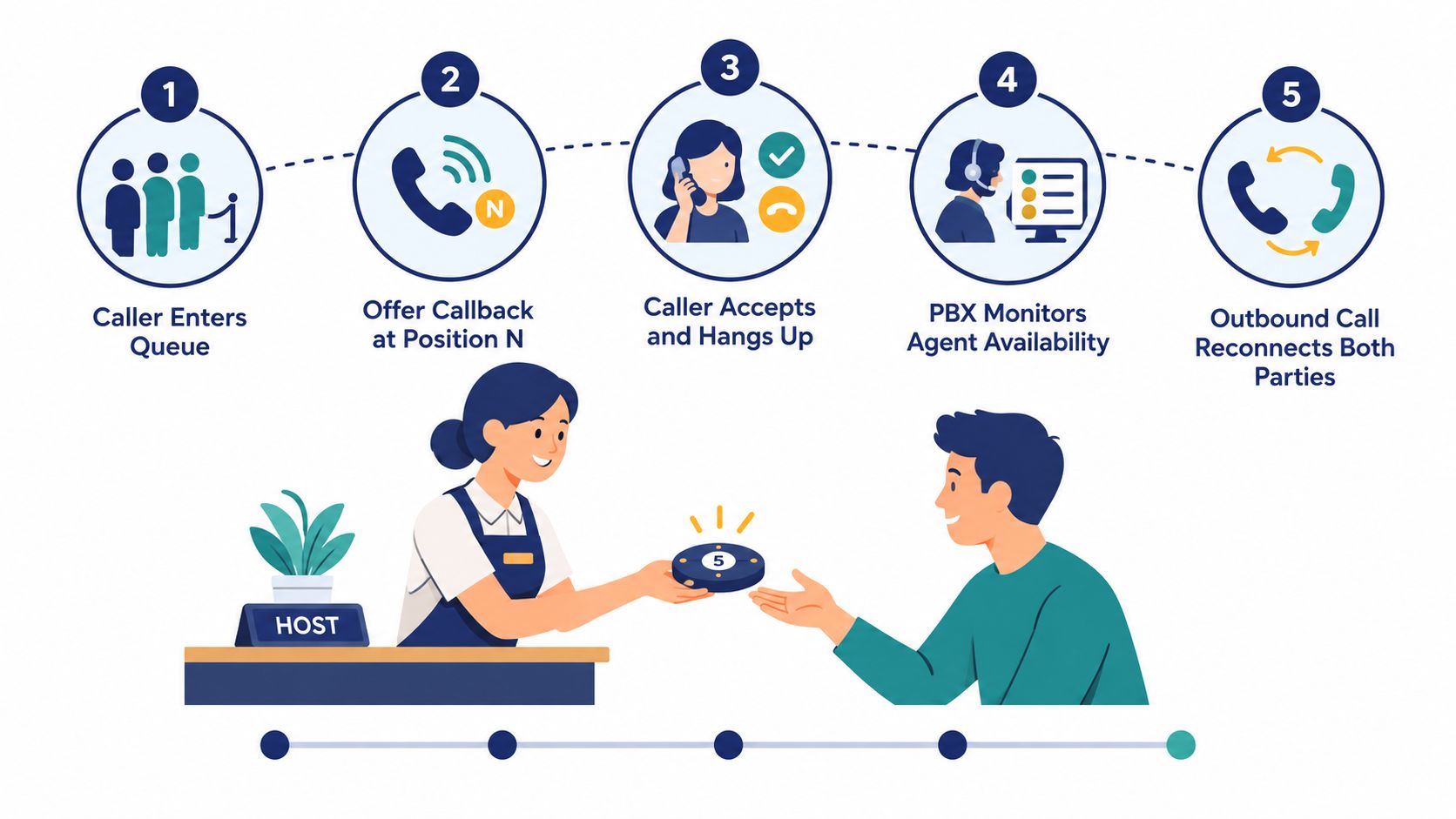
A restaurant host with a crowded dining room hands you a numbered buzzer, records your party details, and lets you leave the entrance. Your place remains visible to the host while you wait elsewhere. A callback queue applies that deferred-work idea to a contact center, turning a caller's wait into a tracked request rather than an open voice connection.
The process has five parts:
- Capture the request. The platform stores the called number, the caller's automatic number identification, or ANI, and information collected through the IVR.
- Release the live channel. The inbound call ends, so the caller no longer occupies a voice path during the wait.
- Create a deferred record. The system preserves queue position or eligibility time, plus priority and routing context.
- Monitor service capacity. The queue checks when an eligible agent or skill group can handle the request.
- Place and connect the callback. The dialer calls the customer, confirms the interaction, and bridges the answered call to an agent.
A caller may hear an estimated wait or choose a callback window. Those messages set expectations. The stored data gives the routing system enough context to deliver the request to the right team. A weak design captures only a phone number, forcing the customer to repeat details or sending a specialized issue to an unqualified agent.
This matters differently across deployments. In a voice-only PBX, the callback record usually represents one phone interaction tied to a queue. An omnichannel queue may need to preserve channel, language, department, and conversation context so the return call fits the broader case. A lean SMB team may have fewer skills and less spare capacity, so a callback can reduce hold occupancy while still creating work that someone must own.
Holding consumes telephony resources and keeps the caller tied to the live queue. Uncertain waits can add frustration. An Interactive Northwest callback benefits white paper reported callback adoption figures and described triggers based on time in queue, estimated wait, or both.
A cloud PBX buyer should separate a tracked callback from a promise that an agent will “try later.” The IT Cloud Global phone system guide provides broader PBX context. Teams assessing call-center callback software should verify record ownership, routing context, retry handling, and supervisor visibility.
How the Queue Mechanics Work Step by Step
The restaurant buzzer analogy becomes more precise when translated into contact-center objects. A caller enters the queue, receives an offer at position N or after a specified wait, and accepts. The PBX then releases the inbound channel while writing a callback record that can include the original queue timestamp, eligibility window, priority flags, phone number, and IVR context.
The matching outbound process monitors agent availability. When a qualified agent becomes eligible, the system dials the recorded number, detects whether the customer answers according to the platform's design, and bridges the answered call to the agent. If the number is unreachable, the platform follows its retry or expiry policy instead of assuming that the work has disappeared.
Position and time are different promises
A position-based callback says the request will be handled according to its place in the queue. A time-based callback uses an estimated or selected window. The first model can feel fairer during shifting demand, while the second can be easier for customers to plan around. Neither is automatically accurate. Both depend on staffing, handle time, skill availability, and the volume of new requests.
The queue record should carry language, department, and skill metadata. Otherwise, a callback can preserve a place in line but lose the reason the caller contacted the business. That creates avoidable transfers and may force the customer to restart authentication.
Choosing the queue architecture
Cloud platforms commonly support two patterns. A callback can remain in the same queue as the inbound call, or it can move to a dedicated callback queue. AWS documentation describes both options and notes that queued callbacks can remain for up to 7 days before automatic removal. It also explains that callbacks count toward the queue size limit and that supervisors can view real-time callback waiting metrics in the queue documentation for Amazon Connect queued callbacks.
A same-queue design gives agents one workload view. A dedicated queue gives supervisors separate staffing, priority, and service-level controls. The choice changes what “available” means, which report receives the work, and how quickly the system exposes a growing deferred backlog.
The same underlying model can support a web callback form or an SMS-triggered request. The channel changes the intake experience, but the platform still needs an identity, routing context, eligibility rule, and completion state.
Same Queue or Dedicated Callback Queue
The architectural choice affects fairness, staffing, and reporting more than the button label suggests. In a same-queue model, deferred callers remain part of the original workload. The platform can preserve their timestamp or assign a queue priority, allowing supervisors to view live calls and callbacks together.
A dedicated callback queue separates deferred work from callers still waiting on the inbound line. That separation can help a manager assign a callback team, define different retry rules, and inspect the backlog independently. It can also create a second place where demand accumulates, so the dashboard must reunite live and deferred work when measuring the customer journey.
| Dimension | Same Queue | Dedicated Callback Queue |
|---|---|---|
| Agent view | One blended workload | Separate callback workload |
| Prioritization | Shared queue rules and timestamps | Callback-specific priority and staffing |
| Reporting | Unified queue metrics | Split metrics that need reconciliation |
| Staffing | Simple for a blended team | More control for specialist teams |
| Main risk | Callback bursts compete with live contacts | Deferred backlog can become less visible |
Same-queue routing often suits an SMB with one agent group and limited scheduling complexity. The team can avoid maintaining parallel dashboards and still use IVR context to send callers to the correct department. The drawback is that a concentrated batch of callbacks can arrive alongside fresh inbound calls, creating a sudden workload spike.
Dedicated queues make more sense when the operation has distinct skills, service levels, or coverage windows. A callback for billing may need different authorization and training from a callback for technical support. The supervisor can then staff each workload deliberately, but must watch for overflow, stale requests, and inconsistent customer treatment.
IVR design determines what enters either model. A caller who selects sales shouldn't become a generic callback, and a language selection shouldn't vanish when the call disconnects. IT managers comparing Dallas phone system vendor options should ask vendors to demonstrate queue assignment, callback prioritization, and consolidated reporting. Teams can also review call queue management software requirements before deciding whether their existing PBX can support a clean blended design.
Decision principle: Choose the simplest architecture that makes deferred work visible, correctly prioritized, and properly staffed.
Connecting Callback Queues to IVR and Skill Routing
A callback queue is the final stage of a routing decision, not an isolated feature in the hold message. The IVR first gathers intent through keypad selections, speech input, or a CRM lookup. That information can attach a skill, language, priority, account context, and consent state to the callback record.
Suppose a caller selects technical support and chooses Spanish. The queue should preserve both attributes after the caller disconnects. When the callback becomes eligible, skill-based routing should seek a qualified Spanish-speaking technical agent rather than connect the request to the first person who happens to become free.
The routing pipeline
A dependable workflow usually follows this order:
- Identify the caller: Capture the number and verify whether the customer can be reached through the selected channel.
- Understand intent: Use IVR choices, speech recognition, or a CRM lookup to classify the request.
- Apply routing data: Store department, skill, language, priority, and relevant authentication status.
- Set the promise: Combine queue conditions, business hours, agent schedules, and callback windows into a customer-facing expectation.
- Complete the handoff: Present the CRM record, create or update a ticket, capture outbound consent where required, and connect the answered callback to the right agent.
The operational evidence supports treating this as a capacity control. A peer-reviewed field study in Management Science found that callers experienced 3 to 6 times less discomfort per unit time while waiting for callbacks than while waiting in queue. Offering a callback window reduced average online waiting time by up to 71% and average incurred waiting cost by up to 46% in the study's setting.
Under temporary congestion, the same study found that callbacks reduced average online waiting time by up to 86%, improved service quality by up to 54%, and increased system throughput by up to 2.1%. For an SMB, that can mean fewer customers trapped in a live queue. For a mid-market center, it can mean a more adaptable agent pool during demand spikes.
The integration details decide whether those gains survive production. A callback that reaches the wrong device, loses CRM context, or connects outside the promised window still damages trust. Guidance on telephone and intercom systems can help frame the broader communication environment, while teams planning skills-based call routing should verify that deferred records retain the same routing attributes as live calls.
Proven Benefits for Abandon Rates and Customer Experience
A callback queue changes the unit of work. Instead of keeping a caller attached to a live phone session, the PBX records a deferred task that still needs an agent, a time window, and the right customer context. The caller can leave the hold line, while the contact center continues working through demand.
The large call-center study cited earlier found that callers offered a callback often waited longer in total than the full call population. That result is not a contradiction. Callback offers tend to appear when demand is already creating friction. The feature does not erase congestion. It gives supervisors another way to schedule it and gives callers control over where the waiting happens.
What the evidence means operationally
The practical benefit depends on how the team measures deferred work. A supervisor can compare the live queue before and after callback offers, then check whether the outbound backlog is cleared within the promised window. In a PBX report, useful fields include callback requests created, accepted requests, completed attempts, expired requests, and the time from request to connection.
- Lower live-queue pressure: Callers who accept the option leave the inbound waiting path, reducing the number of people listening to hold music at once.
- More tolerable waiting: The customer can return to work instead of monitoring a phone. The waiting still exists, but it no longer occupies the entire interaction.
- Better capacity control: Supervisors can assign outbound callbacks during available periods rather than allowing every deferred request to compete with live calls.
- More complete contact: The cited call study found a high answer rate among callback accepters. That supports clear caller identification, a reasonable retry policy, and a promised window the team can meet.
A voice-only PBX usually delivers the simplest version. It stores the number and places an outbound call when an agent becomes available. An omnichannel queue can carry the same deferred task alongside chat, email, or messaging work, but it must preserve priority, consent, and routing context. A lean SMB may gain value from a basic callback list alone, replacing sticky notes and personal reminders with one shared work queue.
Callback can protect a sales opportunity after the caller leaves and reduce repeated hold periods in support. It also exposes a capacity problem sooner. If requests accumulate faster than agents can complete them, the live queue may improve while the deferred queue becomes the new source of delay.
Acceptance depends on trust, caller expectations, outbound number presentation, identity verification, and the accuracy of the promised window. Review both queues together in weekly reporting. A healthier live queue means little if callbacks remain open, miss their time windows, or reach agents without the information needed to resolve the request.
Failure Modes Most Buyers Overlook
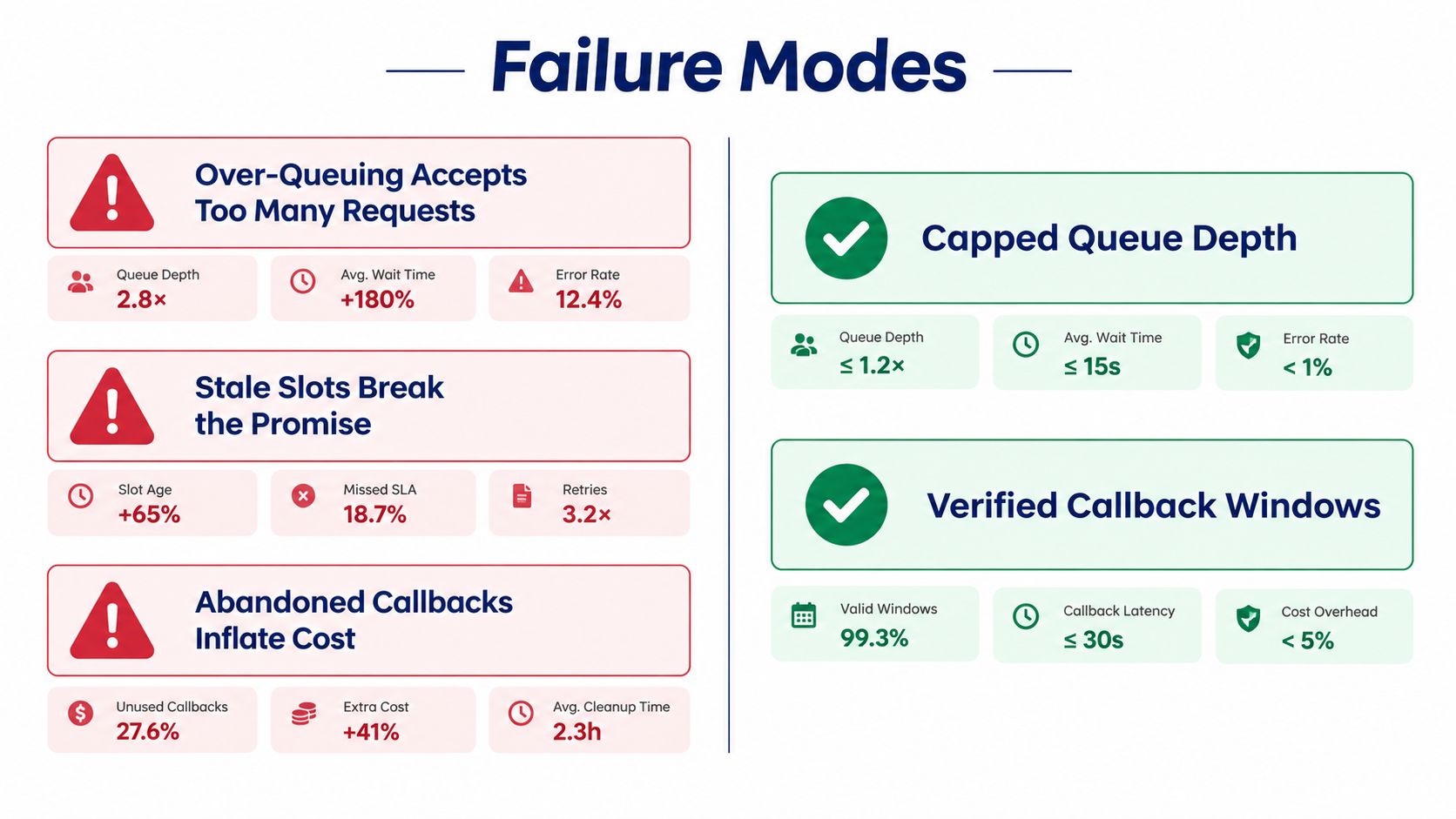
A callback queue fails when the organization treats it as an unlimited escape hatch. If the system accepts deferred requests without matching them to staffing, the live queue may look healthier while the underlying backlog grows out of sight.
Four decisions prevent most avoidable problems
Over-queuing occurs when the platform accepts more requests than agents can service within the stated window. Set a queue-depth limit, define what happens when the limit is reached, and make the message honest. AWS documentation says queued callbacks count toward the queue size limit and can remain for up to 7 days before automatic removal, so retention isn't merely a technical detail.
Duplicate requests appear when a caller submits a callback, hangs up, and calls again, or uses different numbers across devices. Deduplication rules should identify whether a phone number already has an active request. An 8×8 update described in the supplied research added a rule allowing only one callback request per phone number in a callback queue. That kind of rule can prevent repeated agent work, but the buyer should confirm how exceptions are handled.
Unreachable callers create another trap. A mobile device may block unknown numbers, send the call directly to voicemail, or become unavailable after the request. Configure retry counts, spacing, voicemail handling, and a final status such as unreachable or expired. Don't let unanswered callbacks re-enter indefinitely.
Poor menu placement can distort demand. Offer the feature after the caller has received enough information to understand the service path, but before frustration becomes abandonment. A callback option that appears too early may divert callers who could have been answered quickly. One offered too late may miss the customers most likely to leave.
Before rollout, verify four areas:
- Policy settings: Define thresholds, queue limits, windows, retries, time zones, and deduplication.
- Staffing alignment: Decide whether agents handle callbacks in a blended queue or through a scheduled group.
- Reporting: Track offered, accepted, attempted, answered, completed, expired, duplicate, and unreachable requests.
- Controlled launch: Start with one queue, test scripts and routing, review agent feedback, and expand only after the records match customer outcomes.
A callback queue should make deferred work more visible than live hold work, not less.
Implementation Checklist and Final Recommendations
Start with policy, because the customer hears the policy before an agent touches the request. Decide when the IVR offers a callback, what wait estimate or window it communicates, and whether the system uses position, time, or a hybrid rule. Include business hours, holidays, time zones, retry behavior, caller consent, and the final disposition for an unanswered request.
Configure the operating model
Staffing determines whether the feature reduces pressure or creates another queue to supervise. A blended model can work for an SMB with one skill group and a small agent roster. A dedicated callback group can suit a larger operation with separate service levels, specialist skills, or scheduled outbound coverage.
Reporting should connect the callback journey to the original inbound event. At minimum, compare live and deferred work by:
- Abandonment: Separate callers who leave without a request from callers who accept a callback.
- Callback service level: Measure whether the team meets the promised window.
- Answer and completion: Distinguish dial attempts, answered calls, voicemail outcomes, and completed conversations.
- Routing quality: Check transfers, repeat contacts, authentication failures, and first-contact resolution.
- Speed comparisons: Compare average speed of answer and wait experience for live callers and callback users.
Pilot the feature in a queue with a clear purpose and predictable staffing. Test ordinary calls, duplicate submissions, wrong numbers, blocked caller ID, after-hours requests, language routing, agent absence, and queue saturation. Have agents explain that the customer is receiving the requested callback, rather than forcing the caller to repeat why they contacted the business.
The supplied evidence supports callback when congestion is meaningful and the organization can manage deferred work deliberately. It doesn't support a universal threshold based on wait time or abandonment, because the verified data doesn't establish a single buyer cutoff. Instead, use your own queue history to decide whether customers are waiting long enough, abandoning often enough, or encountering peaks that staffing can't absorb.
A cloud PBX evaluation should therefore ask five direct questions:
- Can the platform preserve queue position or explain its alternative?
- Can it route callbacks by the same skills and IVR context as live calls?
- Can supervisors see callback backlog, age, attempts, and outcomes?
- Can the system cap, deduplicate, expire, and retry requests predictably?
- Can reports combine live and deferred demand without hiding either one?
Callback queue is a good fit when your team has a clear workload policy and enough operational visibility to keep the promise. If your staff can't monitor the deferred queue, a simpler IVR message or voicemail workflow may be safer than creating an invisible backlog.
SnapDial provides cloud PBX and call-center capabilities that include queue callback, estimated wait-time prompts, queue management, and reporting for organizations replacing legacy phone systems. Visit SnapDial to review how its platform could support a controlled callback rollout, then ask for a configuration discussion based on your queues, skills, staffing, and service windows.