
A light-use physical fax machine runs about $740 to $1,725 a year all-in, while published analysis of business fax economics puts an internally managed page at about $0.20 to $0.25 and cloud infrastructure faxing under $0.10 a page. Only one of those three numbers is an annual figure, and that mismatch is where most fax budget comparisons fall apart.
Buyers hold a subscription quote next to a machine they already own and call the difference a saving. The line rental, the toner, the service contract and the ten minutes someone spends at the tray on a busy Tuesday never land in the same column. Neither do the pages that failed to transmit and had to be resent.
Price fax service cost properly and you get one number: cost per successfully completed transaction, counting only pages that arrived at the other end. Get that arithmetic right and the choice between a machine, a metered plan and a bundled phone feature stops being a marketing argument.
Fax Service Cost at a Glance
Vendors quote pages, machines quote nothing at all, so start with benchmarks that put both on the same footing. Every figure below is a total-cost estimate from published analysis, not a live rate card.
| Fax setup | Per-page cost | What dominates the bill |
|---|---|---|
| Manual send, 1980s–2000 | About $3.00 | Staff time more than the phone call |
| Centralized fax server | About $0.20 | Hardware, telecom, admin, support, and upgrades |
| Fully loaded enterprise page | $0.20–$0.25 | All-in managed operation |
| Cloud infrastructure fax | Under $0.10 | Usage with far less internal labor |
| Light-use physical machine (annual, not per page) | $740–$1,725 per year | Line, supplies, maintenance, and staff time |
The top row explains a lot of old budget arguments. A 2015 analysis of business fax economics estimated that manually sending a fax between the 1980s and 2000 cost about $3.00 per page, and labor rather than the phone call accounted for most of it. Someone printed the document, walked it to the machine, dialed, waited, redialed a busy number and refiled the confirmation. The transmission was the cheap part.
Centralizing the machine changed the arithmetic. The same analysis put fax-server infrastructure at roughly $0.20 per page, a reduction of about 93%, and a fully loaded enterprise-managed page at $0.20 to $0.25 once hardware, telecom charges, maintenance, administration, support and upgrades were counted. Cloud-based infrastructure faxing came in at under $0.10 per page, with potential savings of as much as 90% against an internally managed operation.
Benchmark, not rate card: use these to sense-check a proposal in the first meeting. Then replace every one of them with your own invoice data before you sign anything.
The bottom row is the one that gets misused most. It's the only annual figure in the set, and it bundles a year of line rental, consumables, maintenance and staff minutes into a single total. Comparing it to a per-page cloud rate is comparing a year of car ownership to a taxi fare per mile.
Read the table as a ladder of automation. Each step down moves cost out of labor and infrastructure and into metered usage, and the further down you go, the less the bill depends on who happens to be standing near the machine.
An advertised monthly plan is one line in that stack. It's usually the smallest one, and it's the only one your quote will show you.
What Actually Drives the Bill
A fax subscription is the fare. Labor, retries, paper, the phone line, storage and compliance work are the rest of the trip, and on most small-business invoices the trip costs more than the fare.
Here's how the stack breaks down before you get to any provider's price list.
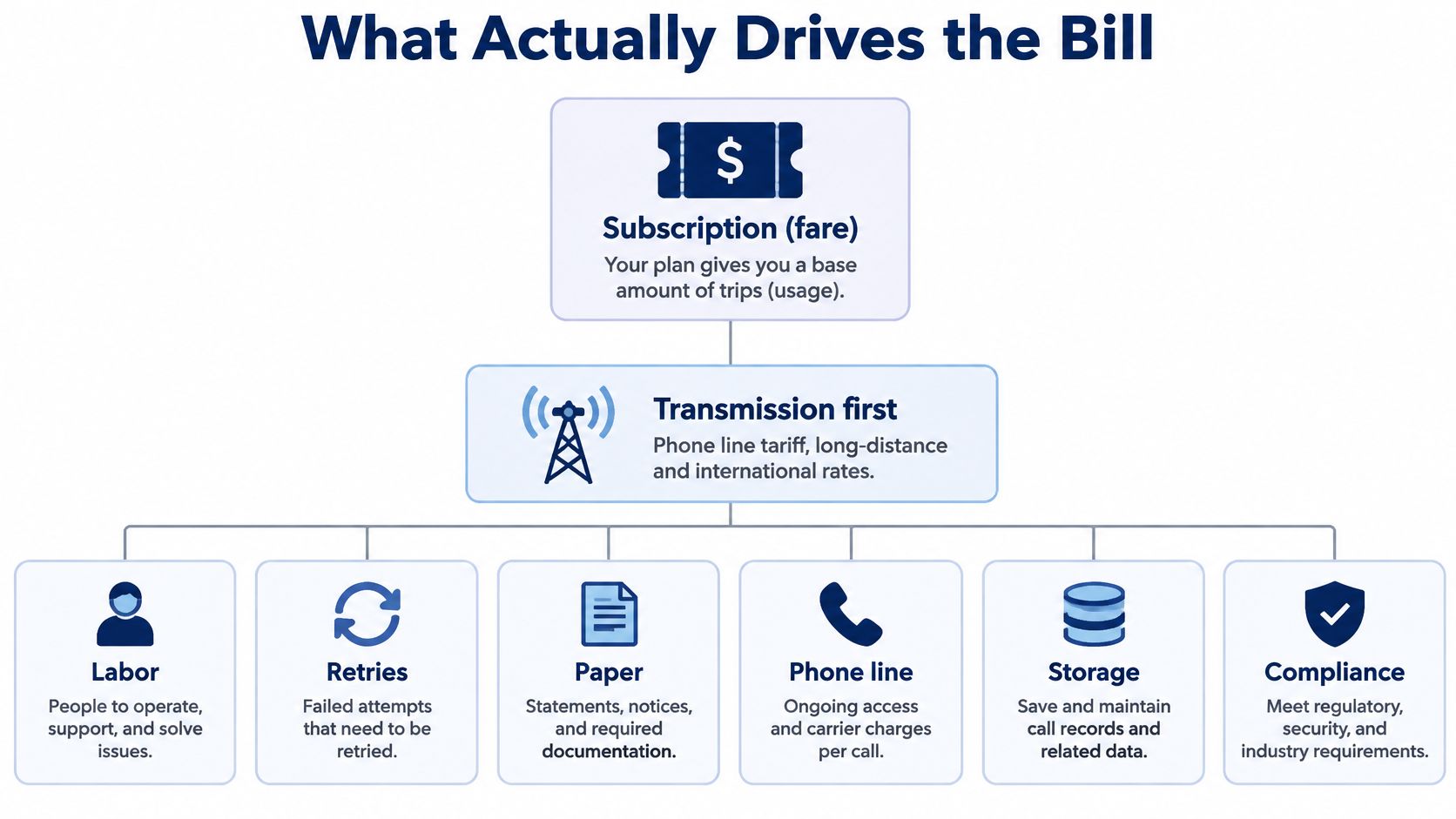
Transmission first
A blended per-page average hides the expensive sends. Split the traffic before you compare anything:
- Outbound domestic: the cheapest line on the bill, and the one most quotes are built around.
- Inbound: often priced differently, and often the traffic you can't predict. A clinic can't tell a referral partner to send fewer records.
- Long-distance: still varies by plan, and still surprises buyers who assumed distance stopped mattering.
- International: the line item that turns a comfortable allowance into an overage. One overseas counterparty can outspend a month of domestic traffic.
Labor is the number nobody quotes
Someone loads paper, dials, notices the busy signal, redials, staples the confirmation and walks the original to a file. That sequence is short, but it repeats. Independent estimates put a light-use physical fax machine at roughly $740 to $1,725 annually once hardware amortization, a dedicated line, supplies, maintenance and staff time are counted, according to a Stacker analysis of outdated small-business technology. A dedicated line alone can run into hundreds of dollars a year before a single page moves.
The honest version: a fax machine that sits idle still bills you every month for the privilege of being reachable.
Failure costs get paid twice
A page that doesn't go through is paid for in phone time and again in staff time. Retries inflate your attempt count without adding a single delivered document, which is why the only denominator that matters is completed transactions. Track attempts and completions separately for one month and the gap will tell you more than any vendor comparison.
Compliance is a real cost line
Audit trails, secure routing, retention schedules and misroute prevention aren't features you add after choosing on price. In healthcare, legal and finance workflows, one document delivered to the wrong number costs more than a year of the difference between two plans.
That's the metric to carry through everything else: cost per successfully completed transaction. Not per page, not per month, not per user.
The practical question that decides most of these projects is volume. At what monthly count does replacing the machine pay for itself after migration, setup, number porting, user training and any line you keep alive during cutover? Answer that with your own numbers and the rest is administration.
How Common Fax Pricing Models Bill You
Two quotes can look identical on the first invoice and diverge by thousands over a year, because providers bill five different shapes of usage. Learn the shape before you compare the number.
| Pricing model | How the bill is built | Fits best when | Where it gets expensive |
|---|---|---|---|
| Per page or per minute | Each send or minute is metered | Uneven, low volume | International pages and retries |
| Monthly page allowance | Flat fee, then overage | Predictable domestic volume | Months that break the cap |
| Per user or per number | A charge for each fax identity | Many people sending lightly | Idle numbers left active |
| Bundled with the phone system | Fax sits inside the voice plan | Teams replacing a PBX | International or premium extras |
| Machine plus dedicated line | Line, supplies, and service contracts | A partner still requires paper | The line costs money before any fax |
Metered billing puts a price on every send or every minute and tracks the old telephone tariff logic. It rewards teams with uneven traffic and punishes anyone who discovers a heavy month. When fax usage shares a meter with voice, a rate that looks cheap in a quiet quarter can turn expensive during a filing rush, so it pays to understand how metered billing is calculated before signing.
Allowances and identity charges
A page allowance is a flat fee with a cap, and the cap is where the argument happens. Steady domestic volume fits it well. A month with a filing deadline or an audit does not.
Per-user and per-number pricing bills each fax identity whether it sends anything or not, which suits departments where many people send rarely. The catch is drift: the line item grows every time someone adds a number and shrinks only when someone removes one. Idle identities keep billing until an audit clears them.
Bundled fax inside a voice subscription is the shape multi-site firms usually end up wanting, because there's no separate contract to renew and no second place to look when a number stops working. Machine-plus-line pricing runs on an annual stack of line rental, toner, paper and a service agreement rather than a page rate. Those fixed costs keep billing whether or not a single page moves, which is the same idle-month exposure per-number plans carry, just larger.
Match the model to your volume shape before you compare two quotes. Comparing a per-minute plan to a bundled one on sticker price is comparing a taxi meter to a lease.
Traditional Machines Versus Cloud Fax
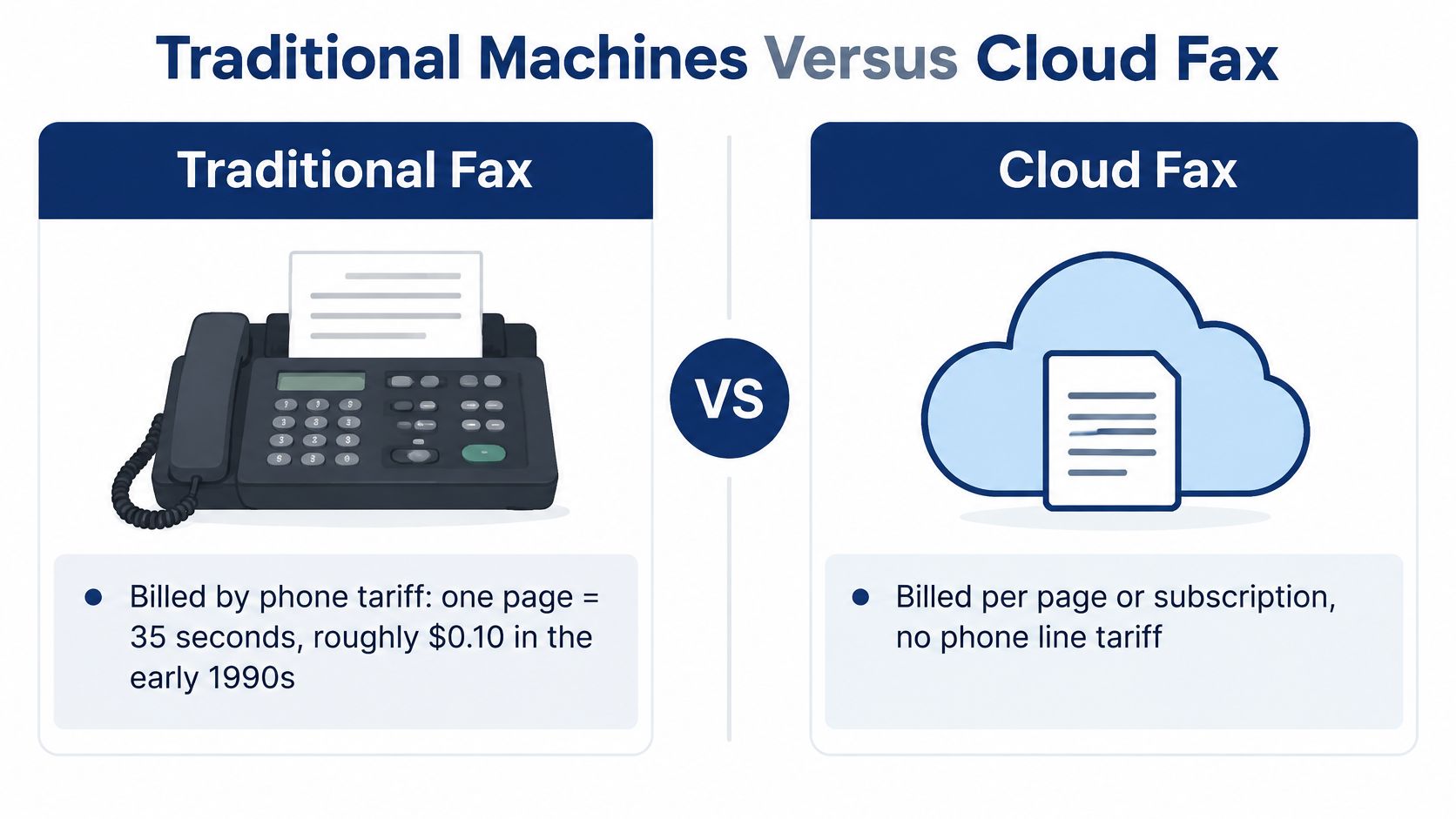
Old fax billing tracked the clock, not the page. A 1993 comparison in the Tampa Bay Times timed and priced real sends: one page across the United States took about 35 seconds and cost roughly $0.10 during the lowest night and weekend rates, rising to as much as $0.25 on a weekday daytime call. A three-page fax ran about 82 seconds and cost $0.23 at the cheapest times or $0.50 at the highest.
That comparison priced a four-page fax at prime-hour rates around $0.50, nearly the $0.52 postage to mail the same material. The machine won on speed, not on cost per document.
Why document density used to matter
A sparse page transmitted fast. A dense page held the line longer, and the line was the bill. Legal teams learned to send clean, tight documents for reasons that had nothing to do with readability, because every second of connect time was a charge.
Cloud transport severs that link. Domestic distance and time of day stop moving the price, so the bill no longer swings because someone sent at 9 a.m. instead of 9 p.m. What remains is a plan or per-page rate, international surcharges, number porting, and whatever analog line you keep alive during cutover.
The residual costs each side hides
Traditional setups hide the line rental and the service contract. Cloud setups hide the one-time work: porting numbers, retraining staff who are used to a tray, and running both systems in parallel for a few weeks. Neither shows up on the sticker, and both land after the first invoice.
The bigger hidden number is retries. A machine that hits a busy signal burns someone's afternoon redialing, and every failed send is a transaction you paid labor for without completing. That is the unit worth costing: cost per completed delivery, not cost per page. SnapDial's cloud fax service with collision avoidance handles the busy far end automatically, so a redial loop stays in software instead of standing at a machine.
Small practices feel the residual side hardest. Where electronic claims run into clearinghouse limits for small practices, the overflow lands back on a fax number nobody planned to keep, and that number carries cost whether it sends or not.
When you price the move, compare the subscription against the line and the labor it replaces, not against the machine's purchase price, which was paid off years ago and was never the reason you still pay monthly.
Keep a standalone machine in three situations: volume so small it's a page a week, a counterparty that will only accept a fax to a physical device, and a desk where someone already works who can babysit it. Everyone else is paying for a line and a walk.
What Three Real Workflows Cost
The right unit of cost changes with the work. A vendor form and a prior authorization are both faxes, but they don't fail the same way or cost the same when they do.
The small office sending vendor forms
Say a twelve-person agency faxes three or four supplier forms a week. At that volume the machine's price per page is irrelevant. What they pay for is an idle line that exists so a partner can send to a number, plus the fifteen minutes someone loses walking to the machine, feeding it, and confirming it went.
The saving from moving those pages into email or a cloud inbox isn't a dramatic per-page discount. It's the line rental disappearing and the handling time collapsing into an attachment. Price the workflow, not the page.
The clinic moving authorizations
Regulated traffic is where cheap stops being cheap. Manual prior authorization processing is estimated at $12.95 per transaction versus $4.71 electronically, a difference of $8.24 per case, and the U.S. Centers for Medicare & Medicaid Services projects that national standards for electronic claims attachments and signatures will save the healthcare industry about $781 million annually, according to healthcare communications reporting from Stacker.
Fax hasn't vanished from that world. The same reporting found that 40% of hospitals often sent patient information by mail or fax in 2025, and the share was 22% among independent hospitals.
Price the event, not the page: for a clinic, the unit is the approval or the records exchange. Auditability, retention, misroute prevention and retries all belong in that number.
The multi-location firm replacing a PBX
Six offices, one legacy phone system, and a plan to move everything to a hosted platform. The instinct is to handle fax separately. The cheaper path is usually one shared fax number that lands in a monitored inbox, so no site needs its own hardware refresh, its own toner order or its own line.
Sending through email is the piece that makes this work for staff who already live in their inbox, and sending a fax by email removes the trip to a machine entirely.
The rule that holds across all three: count pages for light admin work, and count workflow events for regulated traffic. Mixing the two units is how organizations end up choosing the cheapest page rate for the most expensive process.
How to Calculate Your Own Fax Cost
Five steps, all of them finishable from last quarter's bills and a browser tab.
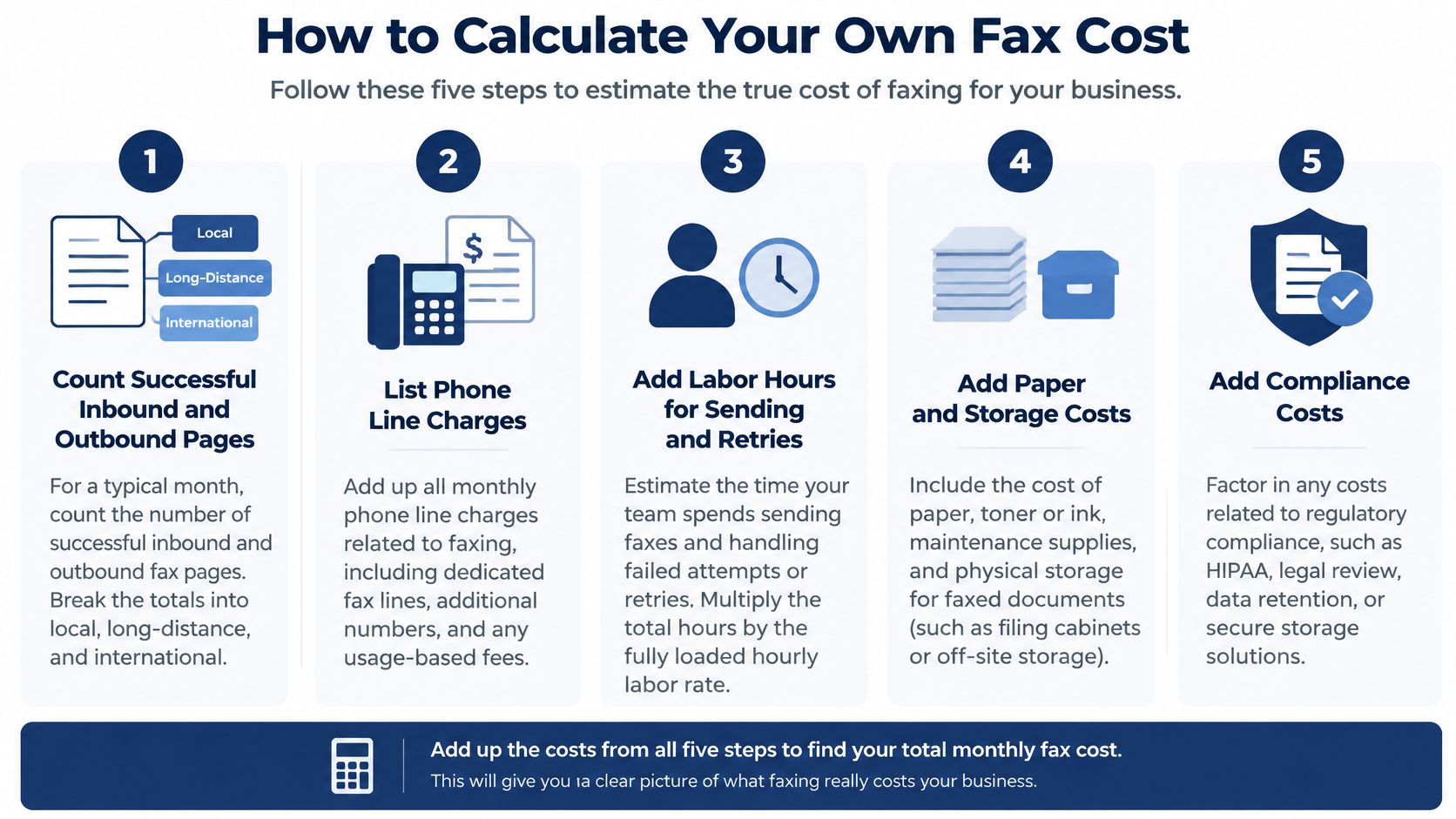
- Count completed pages for a typical month. Split them into inbound, outbound, local, long-distance and international. The mistake to avoid: counting attempts, which flatters a bad process and hides retries.
- Add the annual fixed stack. Line rental, toner, paper, maintenance and any service agreement, divided by twelve. The mistake: forgetting the line bills you in the quiet months too.
- Add labor in minutes per fax, retries included. Multiply by the loaded hourly rate of whoever does the work. The mistake: using salary instead of loaded cost, which understates it.
- Divide by completed transactions, not pages. Failures stay visible this way. A page that arrives twice or not at all still cost you the attempt.
- Price the alternative for twelve months. Allowance, overage rate, international rate, one-time porting and training, plus any analog line you keep until cutover ends. The mistake: comparing the first invoice instead of the full year.
A worked example
Say a firm completes 300 pages a month, averaging two pages per transmission, so 150 faxes. At six staff minutes each, retries included, that's 900 minutes, or 15 hours, and at a blended $30 an hour it costs $450. Add a line and supplies budget of $900 a year, or $75 a month. Total $525 for 300 pages, which is $1.75 per completed page.
Now run the same arithmetic at 60 pages a month. Labor drops to about $90, but the fixed $75 doesn't move, so the total is $165 for 60 pages, or $2.75 each. Volume alone doesn't rescue a labor-heavy process, because labor scales with volume while only the fixed stack dilutes.
The crossover test: if a cloud plan's fixed monthly fee is lower than your combined monthly line cost plus staff minutes, it wins at any volume. If it isn't, the decision comes down to international traffic and compliance features.
Sanity-check the result against the opening benchmarks. If your number comes out far below $0.20 a page, you're probably leaving labor out. If it comes out far above $1.75, look at your retry rate before blaming the provider.
Pick the Fax Setup That Costs Less
The verdict depends on which line is draining the budget.
- Keep the machine when volume is a handful of pages a month, a counterparty insists on a physical device, and someone already works beside it.
- Move to cloud or bundled fax when the dedicated line, toner and retries are the actual bill, or when several sites want one shared number.
- Pay more per page for regulated traffic if that plan includes delivery confirmation, retention and collision avoidance. One misdirected record costs more than the page rate ever will.
- Fold fax into the phone plan when you're already replacing a legacy PBX. A separate fax contract at that moment is an extra renewal for no extra capability.
SnapDial prices its platform all-inclusive, and cloud faxing with collision avoidance is part of that package rather than a bolt-on. Our team of techs handles setup, configuration and replacement of your existing VoIP phone system from start to finish at no cost, so fax moves across in the same cutover as calling.
The deciding fact isn't the headline rate on either proposal. It's the twelve-month total from the worksheet above, with your own minutes and your own international split in it.
Total last quarter's fax line, supplies and staff minutes, then put those pages beside your voice plan. If the numbers land close, the bundled option usually wins on administration alone.
SnapDial gives you cloud faxing with collision avoidance inside an all-inclusive communications platform, so your fax line stops being a separate invoice, a separate renewal and a separate thing to troubleshoot. Our techs handle setup, configuration and replacement of your existing phone system from start to finish at no cost, and our 24/7 Texas support center is there when a page has to arrive. Visit SnapDial to request a quote or schedule a call, and bring last quarter's fax bills with you.