
A call queue is a virtual waiting line that holds inbound callers when assigned agents or lines are busy, then distributes those callers as capacity becomes available. It also reveals demand and waiting patterns that help businesses adjust staffing and routing.
You may be dealing with this already: the phones keep ringing, your team is working, and customers still say they can't get through. The useful question isn't just how to put callers on hold. It's how to give them a dependable path to help without asking your staff to handle more work than they can reasonably complete.
Why Call Queues Matter
A sales representative is explaining a proposal. A support colleague is finishing a customer issue. Someone else is away from their desk when another call arrives.
Without a planned waiting path, that caller might hear a busy signal or reach a destination nobody is watching. In this illustrative office scenario, everyone is doing legitimate work, but nobody owns the incoming call.
The familiar busy-office problem looks like this:

From an interruption to managed demand
A queue gives the waiting caller an assigned place rather than requiring employees to improvise. Managers can then examine whether calls were answered, how long callers waited, and when people disconnected. These are established measurements in telephone queueing operations.
For the office manager, that changes the conversation. Instead of asking whether the phones felt busy, they can ask whether the afternoon support queue needs additional coverage or whether callers are reaching the wrong team.
Practical rule: Treat a queue as a place where someone is waiting for a business promise to be fulfilled, not as somewhere to park an inconvenient call.
What a queue can't fix
Putting callers in line doesn't create additional staff. If every representative stays occupied, customers still have to wait, accept another contact option, or leave.
That trade-off matters for smaller businesses. A queue may be appropriate for a temporary overlap in conversations, but persistent congestion calls for a different decision: change coverage, reduce unnecessary transfers, or redesign how customers obtain help.
The operational value is visibility. A manager can use the waiting experience and its results to investigate where service breaks down. The queue becomes part of a feedback loop rather than an audio recording customers endure.
What Is a Call Queue
Think of a staffed service desk with a checkpoint at the entrance. The checkpoint establishes what help someone needs, checks whether an appropriate employee is available, and directs the person to wait if that employee is occupied.
A telephone queue applies that logic to inbound calls. Callers are the people seeking service, agents or lines provide service capacity, and the queue holds calls that can't yet connect.
This overview shows how those pieces fit together:
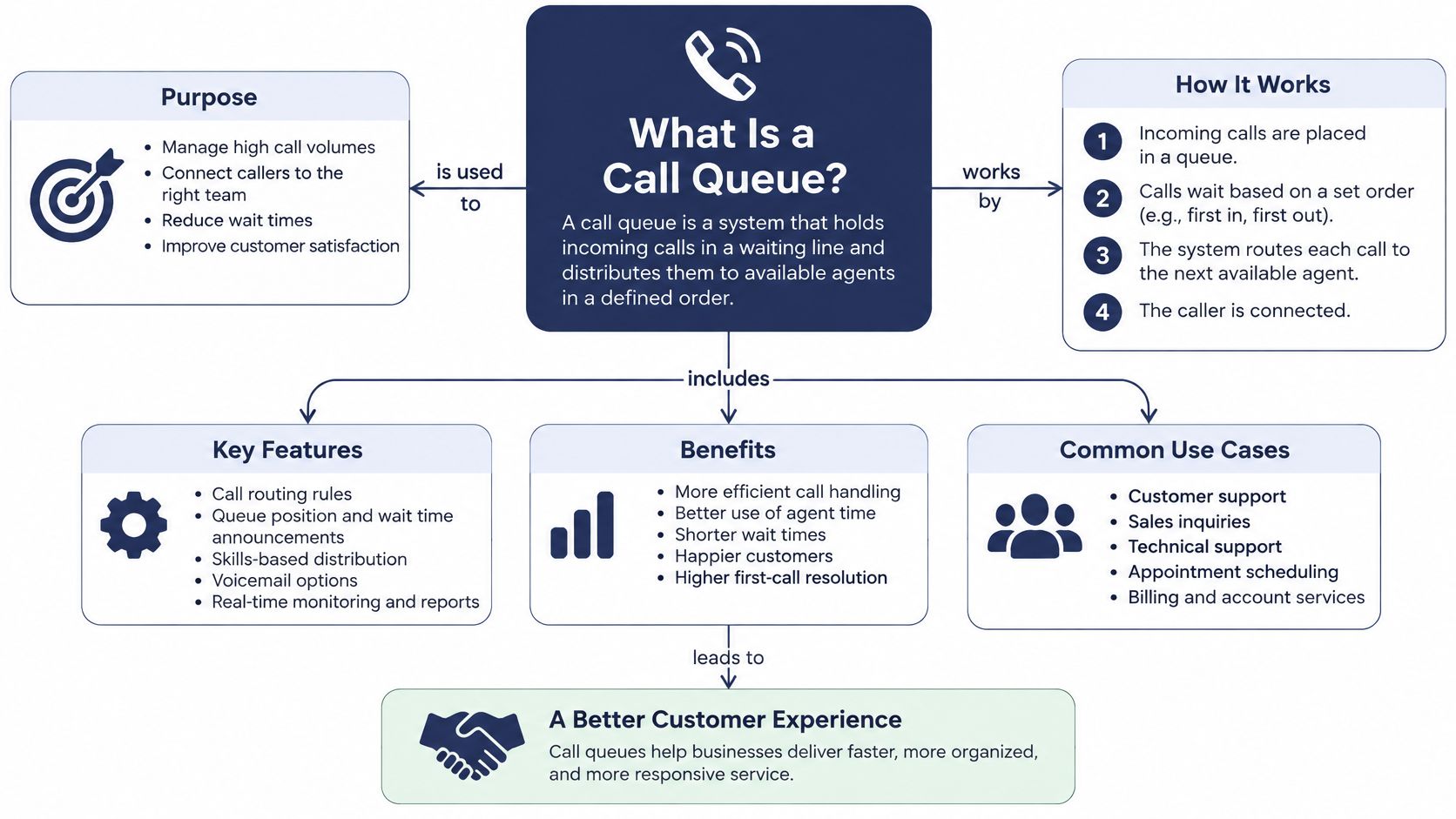
Follow the call from arrival to exit
A practical call flow has several possible outcomes:
- Arrival: A customer calls and reaches the relevant service destination.
- Availability check: The routing system identifies whether an assigned resource can accept the call.
- Waiting: If the appropriate resources are busy, the caller enters the managed waiting line.
- Connection: When capacity becomes available, the system distributes the waiting call according to its rules.
- Another outcome: The caller may disconnect before an answer, accept a callback where offered, or reach an alternate destination.
The distinction between connection and disconnection is important. A call that entered the queue wasn't necessarily answered, and a caller who heard a greeting hasn't necessarily received help.
Software and people have different responsibilities
The queue manages waiting and distribution. A person still needs to understand the request, resolve it, or arrange a useful next step.
Businesses assessing front-desk coverage can use Virtustant's virtual receptionist role description as a starting point for deciding which responsibilities require a person. That staffing decision is separate from deciding how the phone system should handle calls while that person is occupied.
A queue isn't a service guarantee. It provides an orderly process, but the business must supply appropriate coverage and realistic rules. When evaluating a phone system, ask what happens at every exit, not merely whether callers can enter a waiting line.
How Call Queue Strategies Work
Queue design involves separate choices: who waits first, who receives the call, and what happens when the primary team can't help soon enough. Keeping those choices separate makes the trade-offs easier to judge.
Choose the service order deliberately
First-in, first-out, often shortened to FIFO, connects the oldest waiting caller first. It's a sensible starting point for routine requests with similar urgency because employees can explain the rule plainly.
A priority queue changes that order. A business might give an urgent service interruption precedence over a routine account question, or define a separate service commitment for particular customers. The sacrifice is longer waiting for other callers, so priority needs an explicit reason and a review process.
Caller order isn't agent selection. Selecting the next caller and choosing an appropriately skilled employee are different decisions. A fair waiting order won't help if the selected employee can't handle the request.
Call Queue Strategy Trade-offs
| Strategy | Best suited situation | What it improves | Trade-off to watch |
|---|---|---|---|
| FIFO | Routine requests with comparable urgency | Predictable waiting order | Urgent needs receive no special treatment |
| Priority | Clearly defined urgent or contractual needs | Access for designated requests | Routine callers may wait longer |
| Overflow | Primary team temporarily unavailable | Access to another staffed destination | Backup team may lack capacity or expertise |
| Maximum-wait handling | Calls approaching an unacceptable delay | A defined next action | An alternate destination may still require waiting |
| Callback | Callers who can receive a later call | Freedom from remaining on hold | Outbound work still needs agent time |
Plan what happens when capacity runs out
Overflow should lead somewhere useful: another trained department, a shared service team, or an approved after-hours path. Sending callers to an equally busy group moves the bottleneck.
A maximum-wait rule sets a boundary for the live waiting experience. Callback offers a different way to wait, but neither choice removes the underlying work.
Staffing models help explain why this matters. Erlang C, commonly expressed as an M/M/c system, estimates the probability that a caller must wait when all parallel agents are occupied; it uses call demand, handling time, and agent capacity for planning, as described in this Erlang C explanation.
Moving a caller elsewhere is only an improvement if someone can take responsibility there.
Choose the strategy according to the constraint. Use an orderly queue for short-lived contention, callback when callers can wait away from the phone, and overflow when another qualified destination has capacity.
Call Queues Compared With IVR and ACD
A caller hears a menu, selects billing, waits, and eventually speaks with an account specialist. That feels like a single phone-system experience, but different components perform different jobs.
The comparison below separates those responsibilities:
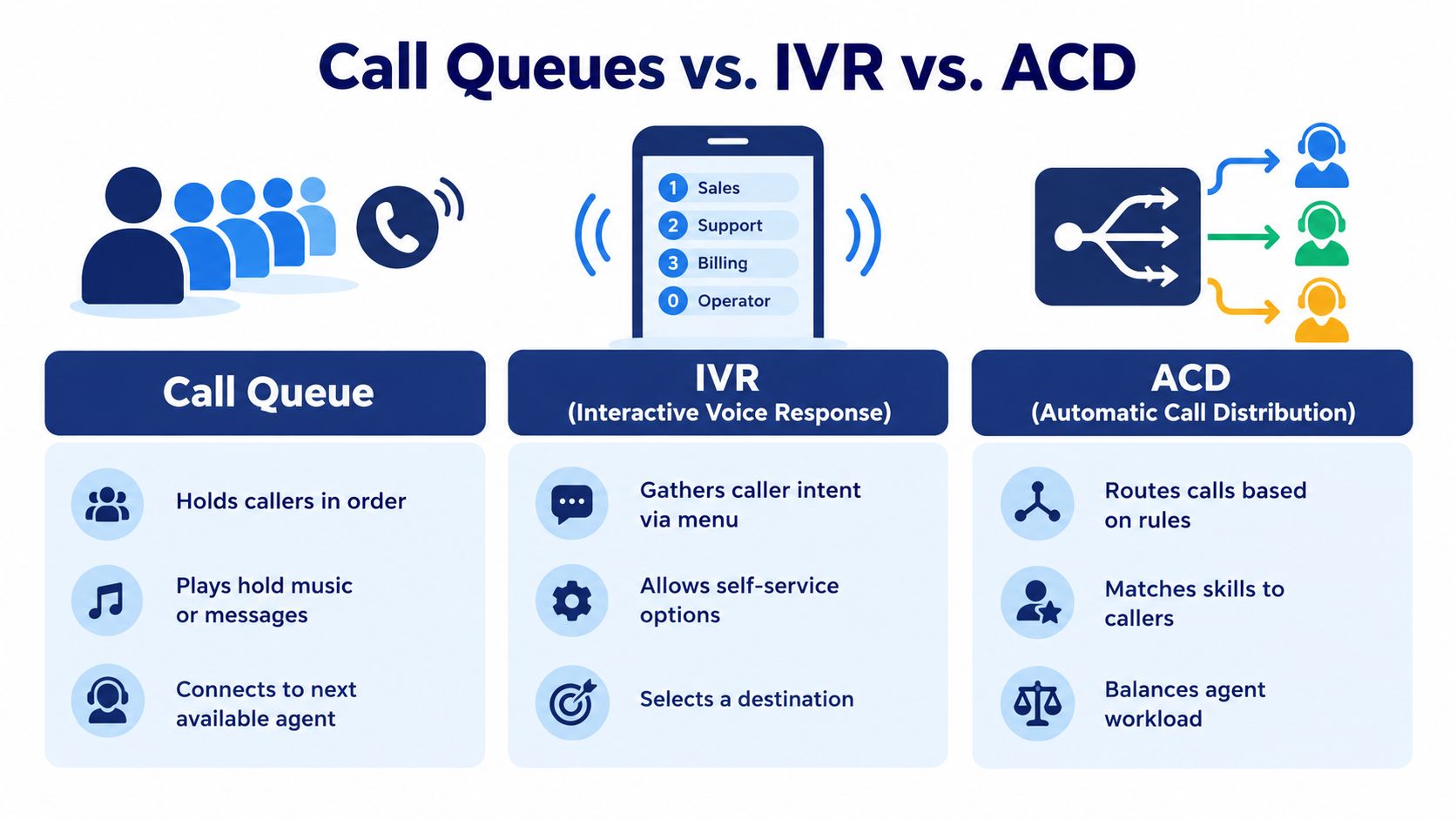
Identify the job each component performs
IVR, or interactive voice response, is the menu or interaction through which a caller provides input. For a closer look at that front-door function, see how an IVR system works.
ACD, or automatic call distribution, manages routing to suitable available resources. A call queue is the virtual waiting line it manages when an appropriately skilled agent can't yet accept the interaction, as described in this review of call-center operations.
A cloud PBX is the broader hosted business-phone platform in which these functions may operate. It's the system and administration layer, not another name for the waiting line.
- IVR asks: What does the caller need?
- ACD determines: Which suitable resource should receive the interaction?
- The queue handles: Where does the caller wait until connection?
- The cloud PBX provides: The broader calling environment and its administration.
Follow a billing request
Consider an illustrative customer calling about an invoice. The menu collects the billing selection, the routing logic identifies the billing group, and the queue holds the call if that group is occupied.
The platform administrator manages the relevant users, destinations, and calling configuration through the broader phone system. Buying a menu feature alone doesn't establish the coverage or waiting policies for billing.
For another explanation of these phone-system concepts, watch the following video:
When comparing proposals, ask vendors to demonstrate that complete billing journey. A feature checklist isn't a call-flow test. You need to see what the caller experiences when the destination is available, occupied, and closed.
Configure Routing and Hold Strategies
Start with the destination the caller needs, not the greeting you want to record. A polished announcement won't compensate for sending an invoice dispute to an employee who can only take sales inquiries.
Use this sequence to organize the configuration:
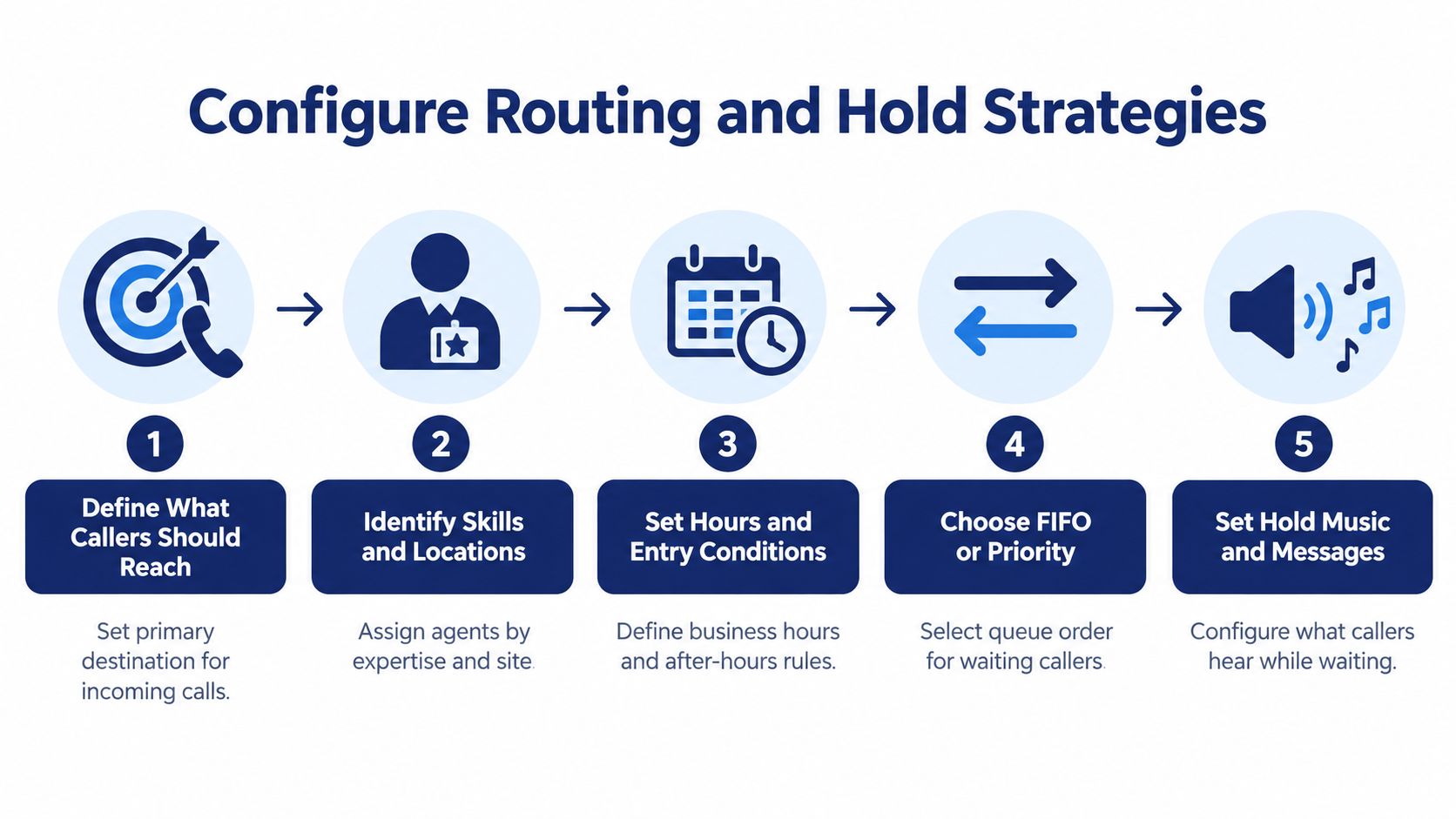
Build the destination and coverage rules
- Define the purpose: State which requests belong in the queue and which should bypass it.
- Assign skills and locations: Identify who can resolve billing, technical, general, or site-specific requests.
- Set operating hours: Specify regular coverage, closures, and the destination outside those hours.
- Choose the entry conditions: Decide which callers enter and what happens when the intended team is unavailable.
- Document responsibility: Name the person accountable for maintaining each route.
For a multi-location organization, don't assume the nearest office is always the right destination. A central billing team may be appropriate for account questions, while a site-specific issue may require local knowledge. The broader principles of business call routing help connect these destinations into a coherent flow.
Design the waiting experience and test it
Hold music, position announcements, and wait estimates should serve different purposes. Music indicates that the connection remains active; position information describes order; an estimate sets an expectation about time.
Don't treat those messages as interchangeable. A position announcement doesn't tell someone how long a complicated conversation ahead of them will take.
Set callback eligibility, number confirmation, retry handling, and business-hours boundaries before offering callback. For overflow, confirm that the receiving team knows which calls it owns and what context it needs.
Test from the caller's side: Place calls under busy, closed, unanswered, and alternate-route conditions before relying on the configuration.
Keep a simple test record with the intended destination, actual destination, message heard, and final outcome. Include a caller who can't accept a callback and someone who needs a language or accessible contact alternative.
Avoid routing everyone into a single general queue merely because it's easier to administer. Equally, don't create specialized queues that nobody can cover. Configure around actual service capability, then verify the experience.
Call Queue Examples for Growing Teams
These illustrative deployments show how different operating needs lead to different queue choices. They aren't customer case studies or promised results.
A small support team with mixed expertise
Suppose a small support team handles both billing questions and technical problems. A shared entry point can collect the reason for contact, while the routing rules direct each request toward employees with the relevant training.
Routine callers can follow FIFO within the appropriate service group. A trained backup should receive overflow only when available, rather than becoming the automatic destination for every difficult period.
For customers who can receive a later call, callback changes the waiting arrangement. It converts the live inbound wait into a scheduled outbound interaction while preserving queue position or a promised service window, as defined in research on callback policies.
A multi-location sales desk
A company with several offices should ask whether callers need a particular site or an available salesperson. Separate site queues make sense when inventory, service territory, or local knowledge changes who can help.
If representatives serve the same customers and offer the same service, a shared queue may be a more practical starting point. Administrators should test whether site divisions reflect meaningful service differences or merely reproduce the organization chart.
The implementation requirements might include:
- Shared visibility: Real-time statistics for supervisors responsible for coverage.
- Historical review: Detailed reporting to examine site and function differences.
- Flexible access: Mobile calling for employees whose assigned work takes them away from desks.
- Managed entry: IVR and queue announcements that match the intended destination.
An after-hours service line
For a closed office, a daytime queue with nobody assigned is the wrong destination. Use a clear closure message and an approved next action, such as a monitored service path or a callback request within stated operating hours.
Keep an alternative for callers who can't receive return calls. Where appropriate, provide a text-based or other accessible route with a named owner.
The same feature can support different service promises. What matters is whether the business has assigned someone to complete the work.
Measure Queue Performance
A dashboard should help a manager decide what to change. Start by distinguishing demand, waiting, capacity use, and resolution, rather than treating every metric as another score to improve.
Read related measures together
Queue Metrics and Questions They Answer
| Metric | What it indicates | Question to ask |
|---|---|---|
| Calls offered | Calls presented to the queue | When does demand arrive? |
| Calls answered | Calls connected to service | How much offered demand reached an agent? |
| Average speed of answer | Average delay before answer | Does the average conceal difficult periods? |
| Maximum wait | Longest recorded waiting experience | Who encountered an exceptional delay? |
| Service level | Share answered within a defined target | Are we meeting our stated response objective? |
| Abandonment rate | Share disconnecting before answer | Did these callers try again? |
| Occupancy | Agent handling workload relative to available working capacity | Is staffing under sustained pressure? |
| Repeat attempts | Additional attempts by callers | Are repeated calls inflating apparent demand? |
| First-contact resolution | Requests resolved without another contact | Did the conversation actually finish the job? |
Agree on reporting definitions before comparing teams. For example, specify which calls enter a service-level calculation and how the system treats calls that exit quickly. Otherwise, managers may compare figures that represent different experiences.
An average can also conceal uneven service. Review the longest waits and the distribution across operating periods rather than assuming the typical answered call represents everyone.
Turn the dashboard into a review routine
Queue performance should be assessed through related measures, with results segmented by time, queue, caller type, and contact reason, then abandoned calls compared with later redials, as discussed in healthcare call-center demand research.
Don't interpret a hang-up as proof that the customer no longer needs help. They may retry, choose another channel, or go elsewhere. Use a consistent definition of call abandonment rate and investigate the subsequent contact pattern where your records allow it.
- Isolate the problem: Find the affected period, location, request type, or queue.
- Check the explanation: Compare staffing availability, handling duration, routing, and repeat attempts.
- Choose a targeted adjustment: Change coverage or a specific rule rather than every setting.
- Review the outcome: Check both connection speed and resolution after the change.
The staffing model discussed earlier remains a planning aid, not a complete representation of caller behavior. Actual abandonment and changing demand make observed results essential.
Don't optimize occupancy alone. Keeping every employee continuously occupied leaves little room for an unexpected arrival or a difficult conversation.
Build a Queue That Balances Speed and Service
The best queue isn't necessarily the shortest. It's the one that matches the service promise without hiding delays or excluding people who need another way to make contact.
Decide what you're protecting: fair access, specialist help, shared coverage, or continuity outside office hours. Then assess whether the whole experience supports that purpose.
- Map the promise: Identify the request, responsible team, and realistic next action.
- Test every route: Include occupied destinations, closures, failed callbacks, and unanswered overflow.
- Check accessibility: Offer appropriate language, text, relay-compatible, or other contact alternatives.
- Review by segment: Look for differences across locations, periods, and reasons for calling.
- Adjust and retest: Verify that a change improves service rather than shifting work elsewhere.
Transparent wait information and accessible alternatives deserve attention alongside speed. The service-experience discussion of hold times and callback preferences also highlights why caller circumstances matter.
A workable queue gives callers a credible next step and gives employees a workload they can actually serve.
Keep the design understandable enough that an office administrator can explain what happens to a call. If the rules are difficult to describe, test them especially carefully.
SnapDial offers a cloud business phone system with smart queue management, queue callback, wait-time announcements, real-time statistics, and detailed reporting. Visit SnapDial to discuss your busiest call paths and how to connect queue rules, IVR, mobile calling, and overflow destinations to your team's actual coverage.