Your main business number is probably in more places than you realize. It's on your website, trucks, invoices, Google Business Profile, email signatures, yard signs, and the stack of cards sitting on a front desk. That's why a phone system replacement often stalls at the same objection: “We can't risk losing the number.”
That fear is understandable, but in practice, VoIP phone number porting is usually a controlled administrative process, not a leap of faith. The businesses that run into trouble usually don't fail because porting is dangerous by its nature. They fail because they start with bad account data, cancel service too early, or assume the address on the bill matches the address in the carrier's underlying system.
A clean port starts before the paperwork. The essential work is the pre-flight check: confirming exactly how the current carrier identifies the account, spotting hidden blockers, and making sure the new provider is set up to receive the number correctly. When that prep is done well, the port itself becomes predictable.
Why Porting Your Number Is Simpler Than You Think
If you're hesitating to replace an old phone system because your number feels too important to touch, that's normal. Most business owners treat that number like a core asset, and they should. The good news is that porting exists for exactly this reason. You're not asking for a special favor from a carrier. You're using an established transfer process designed to let businesses keep the numbers they've already built into their brand.
What throws people off is the way carriers talk about it. Terms like “losing carrier,” “FOC date,” and “LOA” make a routine move sound more exotic than it is. In reality, a standard port has a known workflow: verify the number can move, match the account details exactly, authorize the transfer, then let the new provider submit the request and coordinate the handoff.
The number is valuable, but it isn't trapped
Businesses often assume switching providers means changing numbers, retraining staff, updating marketing, and hoping customers catch up. That's outdated thinking. Modern cloud systems are built around portability, so you can upgrade the phone platform without throwing away the number customers already know.
That's one reason many teams start by reviewing their options for business VoIP phone numbers before touching the port itself. The number strategy and the phone system strategy should be decided together.
Practical rule: Treat your phone number like a business asset that can be transferred, not a utility line that's permanently attached to one carrier.
Most anxiety comes from not seeing the workflow
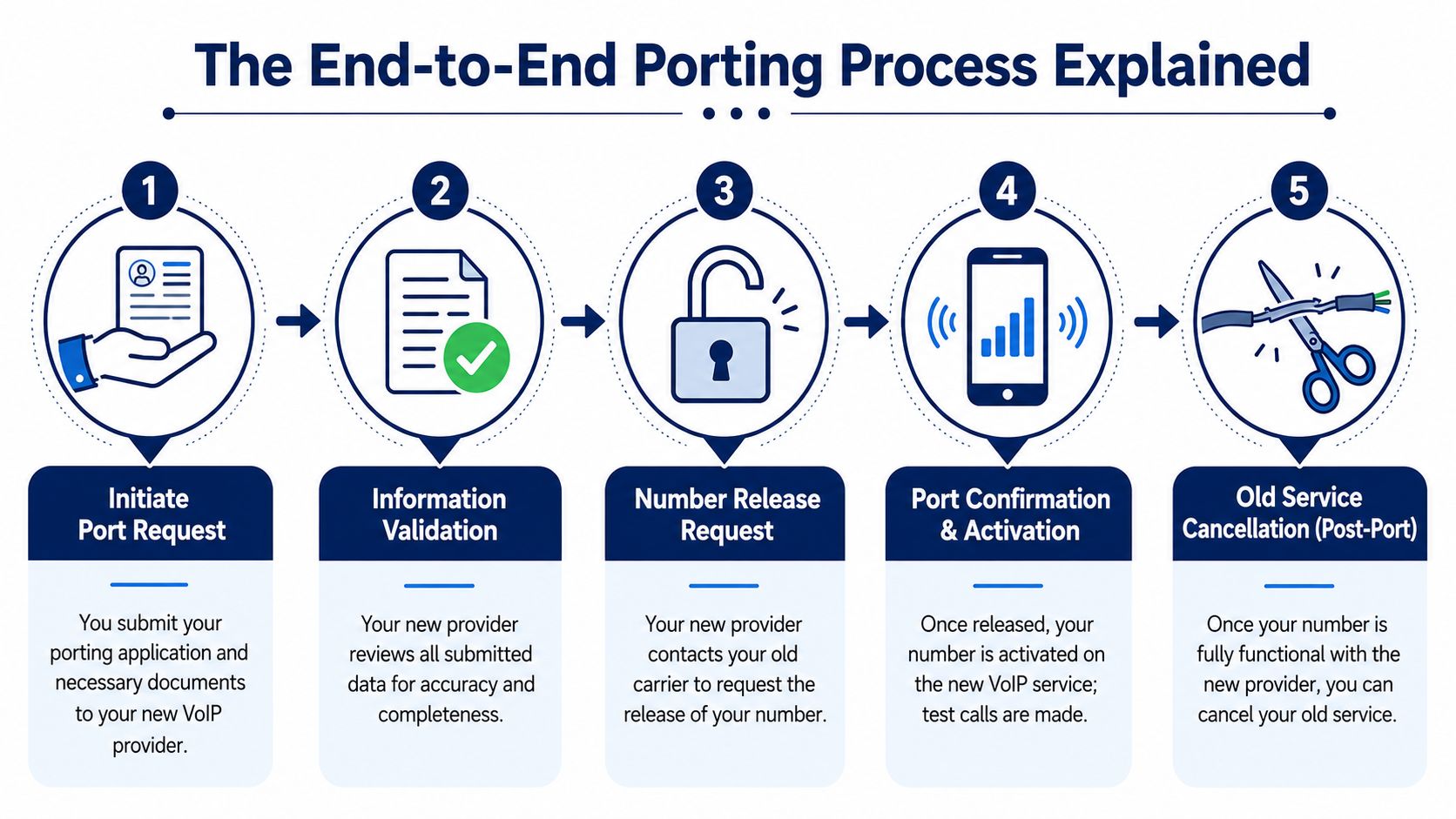
A well-run port is boring in the best possible way. You provide exact account information. The new provider initiates the request. The old carrier validates the data. The number moves. Calls start landing on the new system. Then, and only then, the old service is shut off.
The process gets messy when people skip validation and try to solve issues after a rejection comes back. That's why the smartest approach isn't to rush the port request. It's to remove the reasons it would fail before anyone clicks submit.
Your Pre-Porting Success Checklist
Most port problems are visible before the request is ever filed. The trick is knowing where to look. I tell clients to think like a flight crew, not a shopper. Before takeoff, nobody wants optimism. They want a checklist.
Gather the exact carrier identity data
Start with the current carrier, not the new one. Pull a recent bill and collect the account number, billing ZIP, authorized name, and any PIN or port-out password tied to the service. Also confirm whether the number has been active long enough to move. A key requirement in VoIP phone number porting is the 60-day account tenure rule, which many carriers enforce before they'll release a number.
That rule matters because an early request often gets rejected immediately. If the line is too new, no amount of follow-up will rescue the submission.
Use this short pre-flight list:
- Recent bill in hand: You need it for reference, even if the provider doesn't require it as an upload.
- Exact authorized business name: Not the nickname your staff uses. The formal account identity.
- Account number and PIN: These are common rejection points.
- Active service status: Suspended or disconnected numbers usually won't port cleanly.
- No open account changes: Pending moves, feature changes, or service orders can block release.
Verify the address on file, not the address you assume
This is the part most guides barely mention, and it causes more pain than it should. Experts warn that the most common cause of port rejection is LOA mismatch caused by address discrepancies, and if a user has moved or uses a PO Box, the losing carrier may still have an old physical address in its system. That can add 2 to 4 weeks of delay beyond the normal window, which is why you should call the current carrier and confirm the exact address on file before you submit anything, as noted in this address mismatch porting warning.
Your bill can mislead you here. The remittance address, mailing address, service address, and legacy database address are not always the same. The port request has to match the record the carrier uses for validation.
Call the losing carrier and ask a very specific question: “What exact service address is attached to this number in the porting system?” Don't settle for “it should be the address on your bill.”
Check for hidden entanglements
A single main number may be tied to more than voice service. Hunt groups, fax lines, alarm lines, rollover paths, and blocks of direct inward dial numbers can all be attached in ways that aren't obvious from the front desk.
A few practical checks help:
| Item to confirm | Why it matters |
|---|---|
| Main number dependencies | Prevents accidental disruption to call routing or related lines |
| Associated features | Voicemail, fax, and forwarding may need recreation on the new platform |
| Ownership authority | The signer on the LOA must be authorized on the account |
| Current provider type | Some ports from consumer-style services need extra handling |
If you're dealing with a number that originated in Google Voice or has passed through it, review what changes during porting a number out of Google Voice before starting. Those edge cases often look simple until the provider classification gets involved.
The End-to-End Porting Process Explained
Once your pre-flight check is done, the actual process is much less dramatic than people expect. The customer's job is mostly front-loaded. After that, the new provider carries the workload by submitting the transfer and working the request through carrier channels.
What you submit and what the provider does
You'll usually complete a Letter of Authorization (LOA) and provide the validated account details. The LOA gives the new provider permission to act on your behalf. That matters because the cleanest path is for the gaining provider to initiate the request directly with the current carrier, rather than sending the customer to negotiate the move themselves.
From there, the provider validates the data, confirms portability, and sends the port request to the losing carrier. If the information matches, the carriers coordinate a transfer date and time.
Here's the simple version of the workflow:
- You authorize the move with an LOA and exact account details.
- The new provider reviews the submission for obvious mismatch risks.
- The request goes to the current carrier for approval and scheduling.
- The number activates on the new service on the approved date.
- You test inbound and outbound calling before shutting down old service.
A visual walkthrough helps if you want to see the sequence in action.
How long it usually takes
For simple ports, the typical timeline is 5 to 7 business days once all documentation is submitted and validated, while complex or bulk ports can stretch to 2 to 4 weeks, according to this VoIP number porting process guide. The same source notes that an estimated 15 to 20% of initial requests are rejected due to account mismatches or because the customer canceled old service before completion.
That second point is the one I push hardest with business owners: don't cancel the old carrier early. The number must remain active while it's being moved. If someone in accounting sees duplicate bills and shuts off the old line before the port completes, the request can fail immediately.
Critical step: Keep the existing service active until you've confirmed the number is working on the new system for real calls, from real outside lines.
What the cutover feels like
A good cutover is brief and uneventful. Some businesses notice a short transition period while routes update, but the actual test is simple: place inbound and outbound calls from multiple carriers, check caller ID, verify ring groups and auto attendants, and confirm voicemail is landing where it should.
Most of the stress happens before port day. Port day itself should feel like validation, not chaos.
Common Porting Rejections and How to Avoid Them
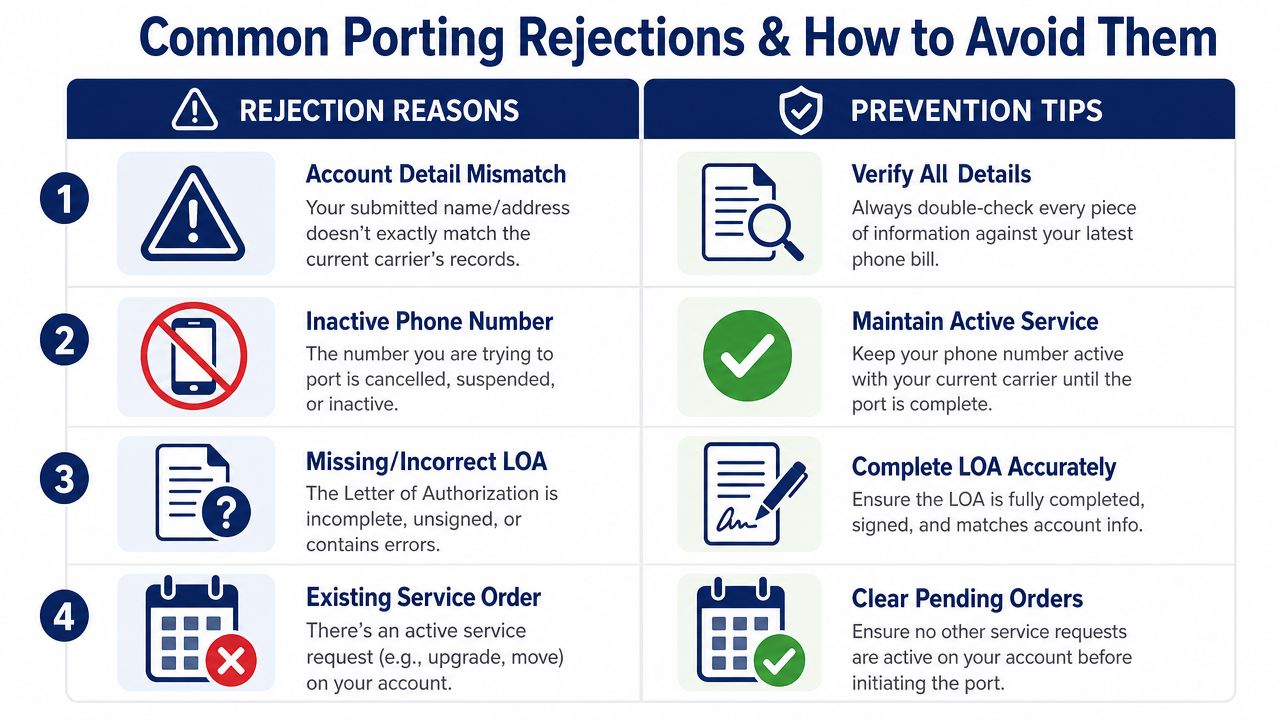
Rejections aren't rare because carriers are irrational. They happen because telecom records are rigid. The losing carrier isn't asking whether your submission is close. It's checking whether it matches the stored record exactly.
The rejection types that show up most often
A practical way to read a rejection is to split it into two buckets: administrative mismatch and technical impossibility. Administrative problems can usually be fixed with corrected data. Technical problems may require a different plan.
| Rejection type | What it usually means | Best fix |
|---|---|---|
| Account mismatch | Name, PIN, ZIP, or account number doesn't match carrier record | Re-verify every field against live carrier data |
| Unauthorized request | LOA signer isn't recognized as authorized | Use the official account owner or add authority first |
| Inactive number | Service was suspended or canceled | Restore active status if possible before reattempting |
| Pending order conflict | Another change is open on the account | Wait for the other order to close, then resubmit |
| Rate center mismatch | Receiving carrier lacks number blocks in that geography | Choose a provider with coverage in that rate center |
Rate center problems are different
A rate center mismatch isn't a typo. It's a network limitation. If the receiving carrier doesn't hold number blocks in the number's specific geographic rate center, the port will fail. This is a physical infrastructure issue, not an administrative one.
That distinction matters because businesses often waste days trying to “correct” a request that cannot succeed in its current form. The fix isn't a better LOA. The fix is a provider that can receive numbers in that rate center, or an alternate number strategy.
Some rejections are paperwork problems. A rate center rejection is a coverage problem. Treat those as two different classes of issue from the start.
What actually works when a rejection lands
The wrong move is to resubmit the same data and hope a different rep approves it. The right move is to identify the exact field or condition the carrier rejected.
When I troubleshoot these, I look in this order:
- Identity field errors: Business suffixes, suite numbers, old service addresses, and stale PINs.
- Authority issues: The office manager signs the LOA, but the carrier only lists the owner.
- Account status blockers: A recent move order, line change, or temporary suspension.
- Coverage limitations: The number can't land with the chosen provider in that geography.
Managed providers earn their keep here because they know how to read carrier responses and adjust fast. Instead of telling the customer “it was rejected,” they isolate the precise blocker, correct the submission, and rework the request before the delay expands.
Navigating Complex Ports for Toll-Free and Multi-Site Numbers
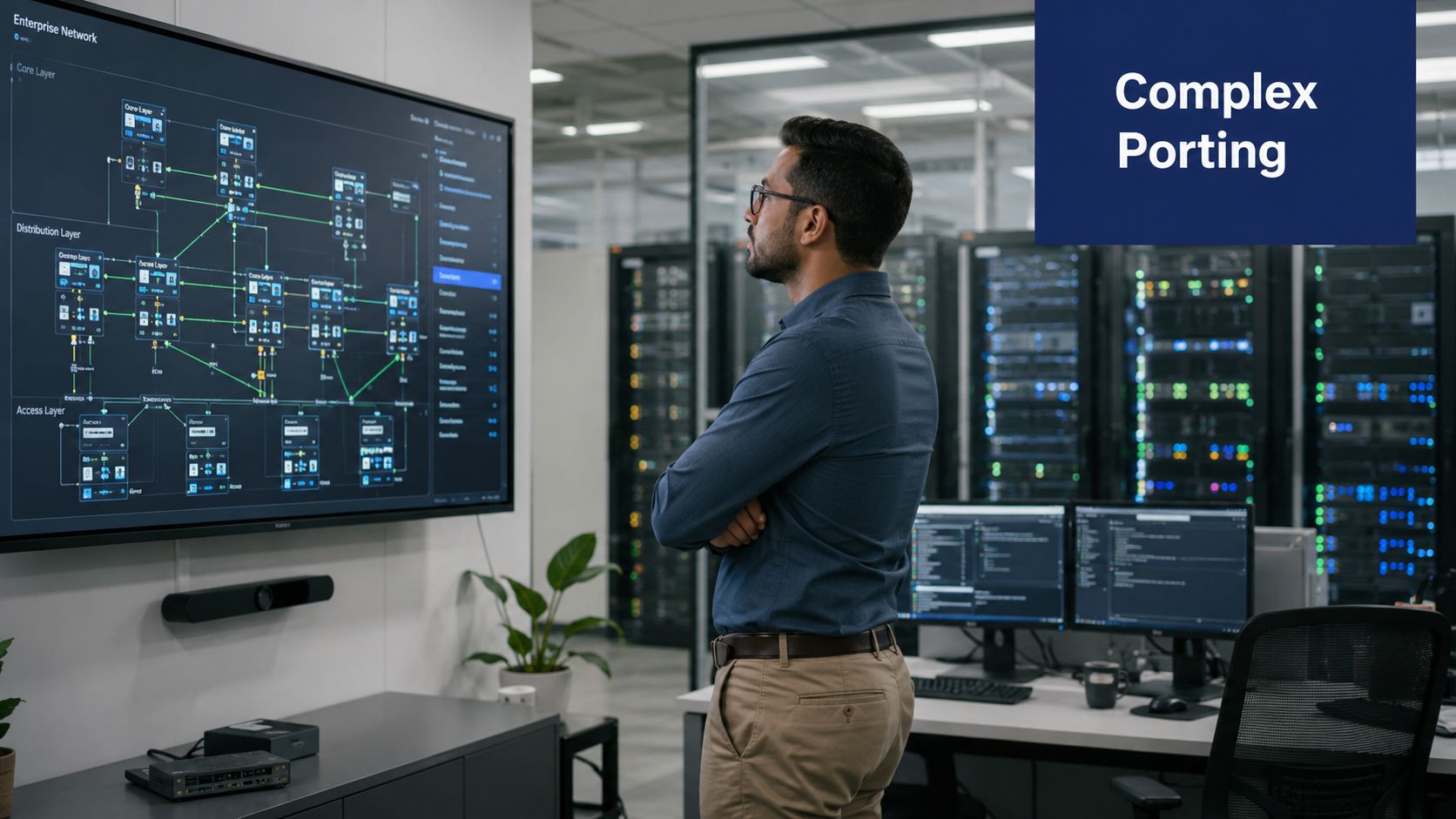
Single-number ports are the easy version. Real businesses often have toll-free numbers, direct inward dial ranges, branch offices, temporary call forwarding, and a few legacy lines that nobody wants to touch because they still “just work.” That's where VoIP phone number porting becomes a project, not a form.
Toll-free and number blocks need a different mindset
Toll-free numbers aren't the same as local business lines in how they're managed. The main operational point is planning the routing cut carefully and confirming where calls should land once the number moves. Businesses that use a toll-free line for ads, intake, or support should map those call flows before the port date, not after.
If you're evaluating a toll-free strategy alongside your migration, it helps to compare your options for getting a toll-free number at the same time you review local number transfers. The routing plan should match the customer journey, not just the telecom inventory.
For DID blocks and multi-site estates, the challenge is sequencing. One office may be on one carrier, another may use a different account structure, and a published main number may terminate somewhere else entirely. In those cases, I prefer to inventory every site separately first, then decide which numbers move together and which should be staged.
Multi-location ports break when assumptions spread
A common mistake is assuming all company numbers live under one clean account. They often don't. Acquisitions, office moves, old telecom contracts, and ad hoc local providers create a patchwork.
That's why complex ports need a matrix, not a generic checklist:
- By site: Which location owns which numbers and who has authority there.
- By carrier: Which current provider controls each local or toll-free asset.
- By function: Main line, fax, support queue, after-hours line, executive DID.
- By dependency: Which numbers feed IVRs, failovers, alarms, or call recording.
Without that map, teams end up porting what's visible and forgetting what's operationally critical.
The odd case of VoIP-to-VoIP hops
One of the least documented issues shows up when porting from one VoIP provider to another. In some cases, the destination provider rejects the number because it isn't recognized as mobile. That can force an undocumented intermediate step where the number is ported first to a major mobile carrier, then moved to its final VoIP destination. Google Voice users have reported exactly that type of issue in this discussion of VoIP-to-VoIP porting and the intermediate hop problem.
This is the kind of edge case that catches businesses off guard because the number is technically portable, but not in the direct path they expected. The takeaway isn't that the port is impossible. It's that some migrations need a staged route.
Achieving a Zero-Downtime Transition with a Managed Partner
Zero downtime starts with realism. No carrier process is perfect, and no serious telecom specialist promises magic. What you can build is a transition plan with enough validation, redundancy, and testing that customers never notice the switch.
The first step is scheduling. Don't cut over during your busiest call window if you can avoid it. If your phones drive intake, dispatch, scheduling, or support, pick a low-traffic period and make sure the internal owner, the provider team, and front-line staff all know the timing.
The cutover habits that reduce risk
A smooth transition usually comes from a few disciplined habits, not heroics.
- Stage the new system early: Build users, ring groups, auto attendants, and voicemail before the number moves.
- Use temporary call forwarding if needed: It gives you a safety net while routes settle.
- Test from outside carriers: One internal desk-to-desk test doesn't prove much.
- Confirm every business-critical path: Main line, sales queue, support queue, after-hours routing, and voicemail delivery.
- Cancel old service last: After verification, not before.
Reliability is more than a port date
Businesses sometimes focus only on whether the number moves. The better question is whether the full calling environment performs reliably once it does. If your team cares about uptime, call quality, and response handling after the migration, it's worth reviewing broader key metrics for infrastructure reliability so the phone cutover fits into a larger operational standard.
That matters most for customer-facing teams. A completed port with poor routing, weak failover planning, or untested queue behavior isn't a success. It's just a new version of the old problem.
The safest port is the one attached to a fully prepared phone system. The number transfer is only one checkpoint in the migration.
Why managed execution changes the outcome
The difference between a stressful port and a routine one usually isn't the carrier. It's the quality of preparation and who owns the follow-through. A managed partner can collect the right account details, catch mismatch risks before submission, coordinate the port date, and verify the call flow immediately after the transfer.
That's what de-risks the project for business owners. You don't want your office manager spending half a week translating telecom jargon, chasing account records, and guessing whether a rejection is minor or fatal. You want specialists handling the workflow while your team keeps running the business.
If you're planning a phone system upgrade and want the number transfer handled without the usual carrier chaos, SnapDial can help. Their team manages setup and porting end to end, coordinates the moving pieces, and keeps the transition focused on continuity instead of paperwork.