

A SIP trunk is a virtual bundle of phone lines that runs over the internet instead of physical copper wires, and it now underpins modern business calling at huge scale: over 350,000 VoIP calls are active worldwide every minute, and nearly 80% rely on SIP trunking as their signaling backbone (Didlogic on SIP trunk architecture). Think of it as a multi-lane digital highway for calls, replacing the old single-lane physical wires that used to limit how your phone system could grow.
If you're researching a SIP trunk definition, you're probably dealing with one of a few familiar problems. Your phone bills feel stuck in the past. Your old PBX works, but every change takes too long. Or your team is spread across offices, homes, and mobile devices, and your phone setup doesn't match how the business runs anymore.
Hearing terms like "channels," "protocol," "PBX," and "packet-switched" often leads to confusion, making the whole thing sound more complicated than it is. The business reality is simpler. SIP trunking is the method that lets your phone system use your internet connection to place and receive calls more flexibly, often at lower cost, and with better options for remote work, analytics, and customer handling.
What Is SIP Trunking Really
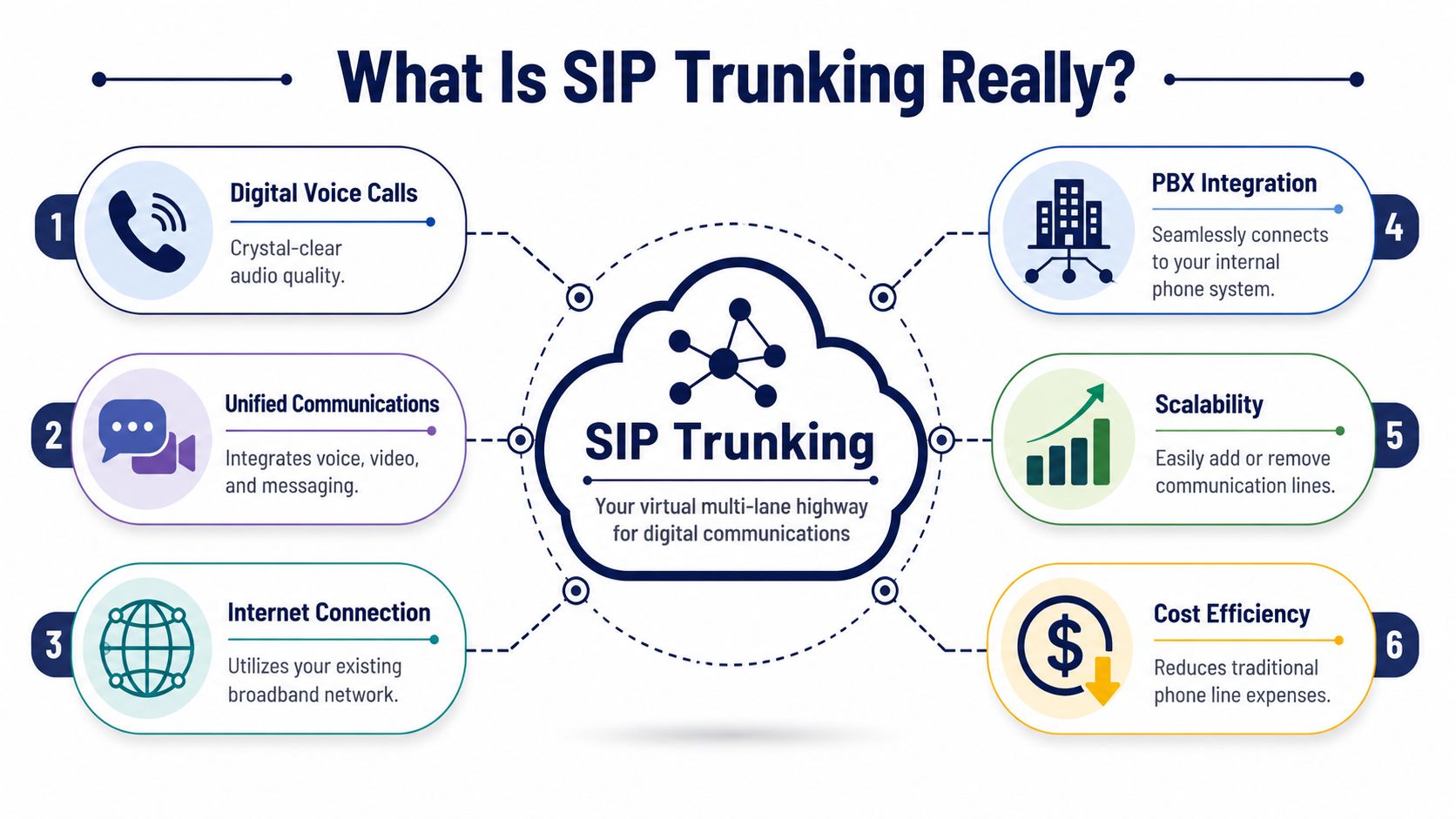
The clearest SIP trunk definition is this: it's the virtual connection between your business phone system and the outside phone world. Instead of renting fixed physical phone lines from a carrier, you use software-based call paths delivered over IP networks.
That "multi-lane highway" analogy matters. Traditional phone service was like assigning a separate strip of copper to carry calls. SIP trunking turns those rigid lanes into virtual capacity that can expand and contract much more easily.
Breaking down the two words
SIP stands for Session Initiation Protocol. That's the signaling language that starts, manages, and ends a call or other communications session. It handles the "setup conversation" between systems. Who's calling whom, what kind of session it is, and when it should end.
Trunk comes from older telecom language. It refers to the connection that carries multiple calls between systems. In the SIP world, that trunk isn't a cable in your wall. It's a virtual connection that can carry many call channels over your internet link.
Put those together and you get a practical definition: SIP trunking is the use of SIP to connect a PBX to outside phone networks through a virtual, internet-based trunk.
What it connects
A business phone system, whether on-premise or hosted, still needs a way to reach people on regular phone numbers. That's where the trunk comes in. According to Infobip's explanation of SIP trunking, a SIP trunk connects a corporate PBX directly to an Internet Telephony Service Provider, creating a virtual bridge to the Public Switched Telephone Network.
That bridge is the key idea. Your PBX handles the internal logic. The SIP trunk handles the route out.
Practical rule: If your PBX is your office switchboard, the SIP trunk is the digital road connecting that switchboard to customers, vendors, and partners outside your business.
This is also why SIP trunking gets discussed alongside cloud systems. Many businesses no longer want to manage old hardware at all, and the move toward hosted voice often starts with understanding what a cloud phone system is. In those setups, the "trunk" still matters technically, but the provider handles more of it behind the scenes.
Why business owners care
The technology matters because of the outcomes. SIP trunking replaces physical analog or ISDN connections with software-based telephony. That makes it easier to add capacity, support remote staff, roll out features like IVR and call recording, and avoid tying your phone strategy to one building.
It also supports more than plain voice. SIP can support voice, video, and messaging sessions over the same general framework, which is one reason it became the dominant protocol for modern business communications.
How SIP Trunking Works Behind the Scenes
A lot of confusion comes from treating a call like one single stream. It isn't. In SIP trunking, one part sets up the call and another part carries the voice.
That sounds technical, but the call flow is straightforward when you follow one example.
A call's path in plain English
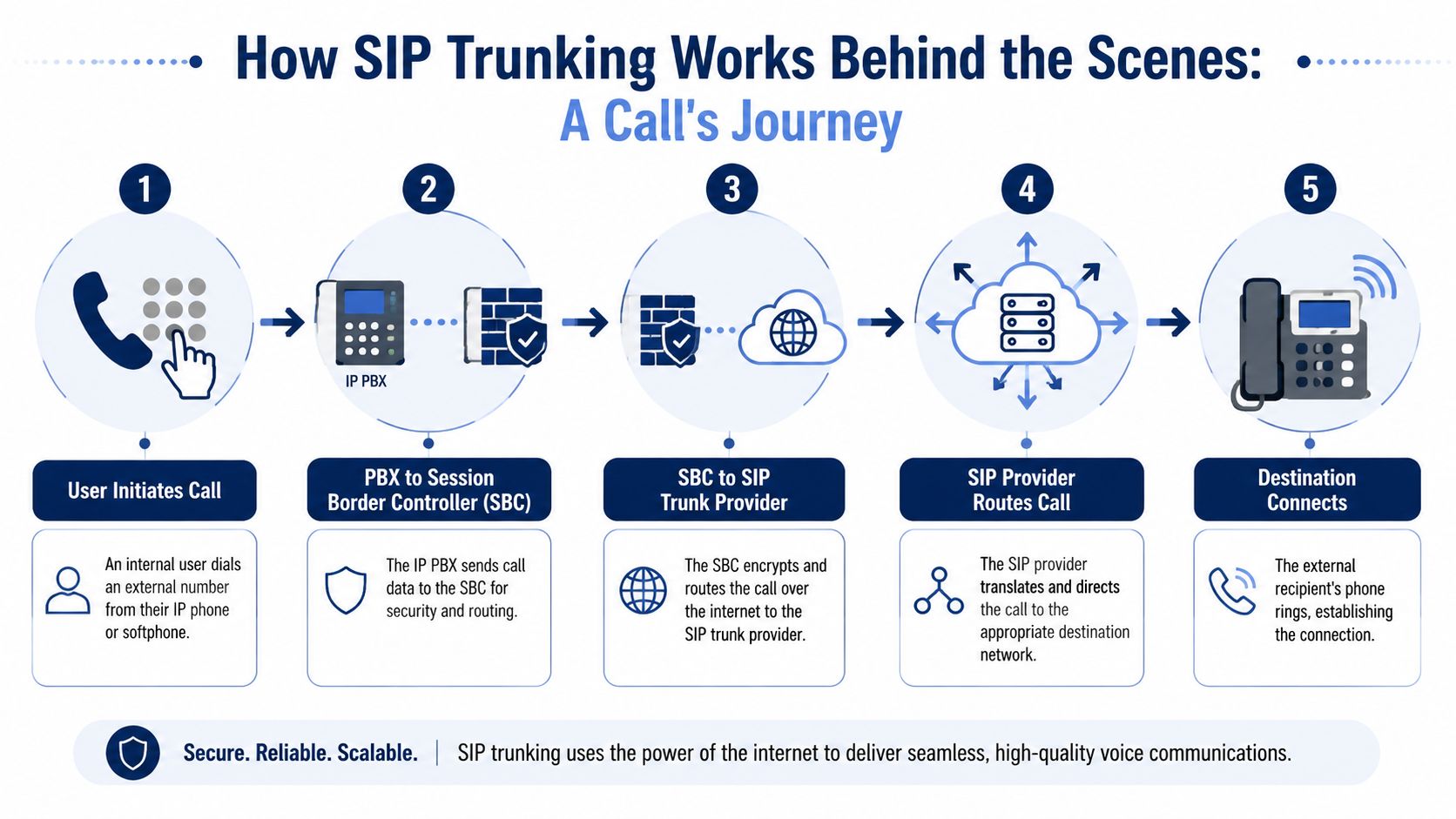
Say your sales manager dials a customer from a desk phone or softphone.
- The device sends the call request to your PBX.
- The PBX uses SIP signaling to request the session.
- The call moves through your SIP trunk provider, sometimes called an ITSP.
- If the destination is a standard phone number, the provider bridges the call to the PSTN.
- Once the session is established, the actual voice travels as media, commonly through RTP streams.
The easiest way to think about it is this:
- SIP handles the conversation about the call
- RTP carries the actual audio
- The provider connects your business system to the wider phone network
If you want a more hands-on explanation of the call path itself, this walkthrough on how calls work with SIP can help connect the dots.
Signaling versus media
This distinction matters because many business owners assume SIP "is the voice." Not exactly. SIP tells systems how to establish and manage the session. The media stream is separate.
That separation is useful. It allows the system to negotiate call details, route flexibly, and support different devices and features while the audio travels efficiently over the network.
A clean setup depends on both pieces working together. Good signaling won't rescue poor network conditions, and strong bandwidth won't help if the session isn't negotiated correctly.
Where codecs and bandwidth enter the picture
A codec determines how audio is encoded for transport. Common examples include G.711, G.729, and Opus. Different codecs use different amounts of bandwidth and can affect call quality and network efficiency.
Business theory faces the challenge of business reality. A provider can advertise large capacity, but your network still has to carry the traffic. Didlogic's hardware requirements guide gives a simple formula for sizing voice bandwidth:
| Item | Formula or example |
|---|---|
| Bandwidth formula | Concurrent Calls × Codec Bandwidth × 1.25 |
| Why 1.25 | It accounts for overhead from IP, UDP, and RTP headers |
| Example | 50 concurrent calls using G.711 need about 4.5 Mbps symmetrical bandwidth |
That last line is one of the most practical facts in this whole topic. "Unlimited" calling capacity on paper doesn't mean much if your internet connection can't support your real peak call load.
The moving parts that deserve attention
A reliable setup usually depends on a few technical checkpoints:
- PBX compatibility: Your phone system has to support SIP properly.
- Protocol support: Systems should align on SIP over UDP, TCP, or TLS, and on RTP or SRTP support.
- NAT traversal: If endpoints sit behind firewalls or private networks, tools like STUN, TURN, or ICE may be needed.
- Stable local network: Routers, switches, and firewalls all affect call quality.
That's why SIP trunking can feel deceptively simple from the outside. The calling experience is easy. The design underneath still needs care.
SIP Trunks Versus Traditional Phone Lines
A business outgrows traditional phone lines in a familiar way. The sales team adds staff, customer service gets busier, and suddenly the phone system hits a ceiling that was built into the circuit from day one.
That ceiling is the clearest difference between a SIP trunk and a traditional PRI line. A PRI is a physical pipe with a fixed number of call paths. A SIP trunk uses your IP network, so capacity is assigned in software and can be adjusted far more easily.
SIP Trunking vs. PRI at a Glance
| Feature | SIP Trunking | PRI (Traditional Lines) |
|---|---|---|
| Connection type | Virtual connection over IP | Physical circuit |
| Scalability | Capacity can be increased without adding another physical circuit in the same way | Fixed channels per circuit |
| DID numbers | Numbers are easier to provision and manage across users, teams, and locations | Usually tied more closely to carrier provisioning and physical service design |
| Geographic flexibility | Easy to support multiple locations and remote users | More location-bound |
| Feature set | Supports voice, video, messaging, and modern PBX features | Primarily traditional voice service |
| Hardware dependency | Fewer physical constraints | More dependent on installed circuits and telecom hardware |
If you want a simple analogy, PRI works like renting a set number of checkout lanes in a store. If all lanes are busy, the next customer waits. SIP works more like a digital queuing system where capacity is allocated across the whole operation, which is why it fits multi-site and changing businesses better.
That technical difference matters because of how calls are carried. Traditional phone service reserves dedicated capacity in a fixed circuit. SIP sends voice as data packets over an IP connection. In business terms, that means you are no longer planning growth around the size of a telecom circuit alone. You are planning around concurrent call demand, network readiness, and the service model your provider offers.
What that means in the real world
A company with a support team in one office, sales reps working remotely, and managers traveling between cities usually struggles with the rigidity of older line-based service. Adding capacity can involve carrier orders, installation windows, and hardware changes. Assigning numbers across teams can also feel tied to the physical office rather than to the person or function.
SIP changes that model. A business can add call paths and phone numbers with far less friction, and it can route calls across offices, home workers, and mobile staff more naturally. The practical result is not just flexibility for IT. It is faster response during busy periods, easier expansion into new markets, and fewer customer calls hitting a busy signal.
There is also an important shift happening in how companies buy phone service. Traditional SIP trunking often meant connecting a trunk to your own on-premises PBX and managing much of the call environment yourself. Many businesses now choose cloud PBX platforms where trunking is built in and managed behind the scenes. In that setup, you are not buying "trunks" as a separate technical component so much as buying calling capacity, numbers, routing, and administration as one service.
That is why the old comparison, SIP versus PRI, is still useful but no longer tells the whole story. For many organizations, the main decision is fixed physical lines versus software-based communications.
A practical comparison point comes up when companies review local provider options and replacement paths. For businesses evaluating regional systems and migration choices, this guide to the best business phone systems in Dallas shows how modern platforms now combine calling, administration, mobility, and support in one service.
If your headcount, office footprint, or call volume changes during the year, fixed circuits usually create cost and capacity limits long before a modern cloud voice platform does.
The Core Business Benefits of Adopting SIP
A business owner usually notices the need for SIP during a busy hour, not during a technical planning meeting. The front desk is juggling calls, a sales rep is working from home, a customer hears a busy signal, and the monthly phone bill still looks too high. SIP matters because it changes those day-to-day outcomes.

Lower communication costs
The cost advantage starts with how SIP carries calls. Traditional phone service ties capacity to fixed circuits, so businesses often pay for lines they rarely use or scramble when they need more. SIP uses packet-switching, which sends voice as data across an IP network. In business terms, that means capacity can be matched more closely to real demand instead of being locked to a rigid bundle of physical lines.
That shift often reduces spending in several places at once. Companies can cut legacy carrier charges, reduce maintenance tied to aging voice hardware, and avoid paying for unused capacity just to cover occasional peaks.
Analysts at TechTarget explain that SIP trunking can lower telecom costs by consolidating voice and data on the same network and reducing dependence on traditional phone circuits. For businesses comparing options, the savings usually come from a simpler idea: pay for calling capacity that behaves more like software and less like a utility meter bolted to the wall.
Faster scaling when demand changes
Growth rarely waits for a carrier install window.
If a retailer adds seasonal staff, a medical office opens another location, or a service company runs a short-term campaign that drives more inbound calls, SIP makes those changes easier to handle. New numbers, extra concurrent call capacity, and routing updates can often be provisioned through software instead of a truck roll and a long lead time.
That matters on the way down too. If call volume drops after a busy season, a company is not stuck carrying the same fixed voice setup just because the circuit was designed for a different stage of the business.
This is also where the gap between classic SIP trunking and newer cloud voice services becomes practical. With a traditional trunk, your team may still manage the PBX and call policies. With a cloud PBX, the provider often handles the trunking behind the scenes, so the business is really buying managed calling capacity, routing, and administration in one service.
Better customer handling
Customers feel the benefit before they know any telecom term. Calls reach the right person faster. Fewer callers hit a busy signal. Staff can answer from the office, a mobile app, or another location without forcing the customer to start over.
Common features include:
- Auto attendant and IVR: Direct callers to the right department without manual transfers.
- Call recording: Review service quality, confirm details, and train staff more effectively.
- Visual voicemail with transcription: Turn missed calls into searchable messages that teams can act on quickly.
- Mobile and remote call routing: Keep staff reachable even when they are away from a desk.
Those tools are not just technical add-ons. They shape response times, first-call resolution, and the overall impression a customer gets from calling your business.
If your team is planning call flows or troubleshooting reliability, it helps to understand which SIP and IP ports affect voice traffic, because routing and firewall behavior can directly affect the caller experience.
Stronger continuity for modern teams
A storm, office outage, or internet issue at one location should not shut down customer communication for the whole company. SIP-based systems make it easier to reroute calls to another site, another device, or another team. That flexibility is one of the clearest business advantages, especially for companies with hybrid staff or multiple offices.
The larger point is simple. SIP is not only a cheaper way to place calls. It gives a business a phone system that can adjust as quickly as the business itself. That is why many companies no longer evaluate trunking as a standalone telecom purchase. They evaluate whether their calling setup can support growth, control costs, and keep customer conversations moving when conditions change.
Implementation and Security Considerations
The limits of glossy marketing claims become clear. A SIP trunk can be sold as "unlimited," but call quality still depends on network design, bandwidth, and policy.
That gap between theory and reality catches a lot of teams off guard.
Why unlimited doesn't always feel unlimited
A key warning sign comes from a 2024 finding cited by Microsoft Tech Community's SIP trunking article: 68% of SMBs experienced "phantom latency" during peak hours despite having "unlimited" SIP trunks.
That phrase matters. It describes the frustrating situation where the service looks fine on paper, but calls still degrade when the network gets busy. The trunk isn't always the underlying bottleneck. The local internet connection, QoS rules, firewall behavior, and provider policies often define actual performance.
If you're troubleshooting voice quality, understanding which SIP and IP ports are involved can help your IT team verify whether traffic is being handled correctly across firewalls and routers.
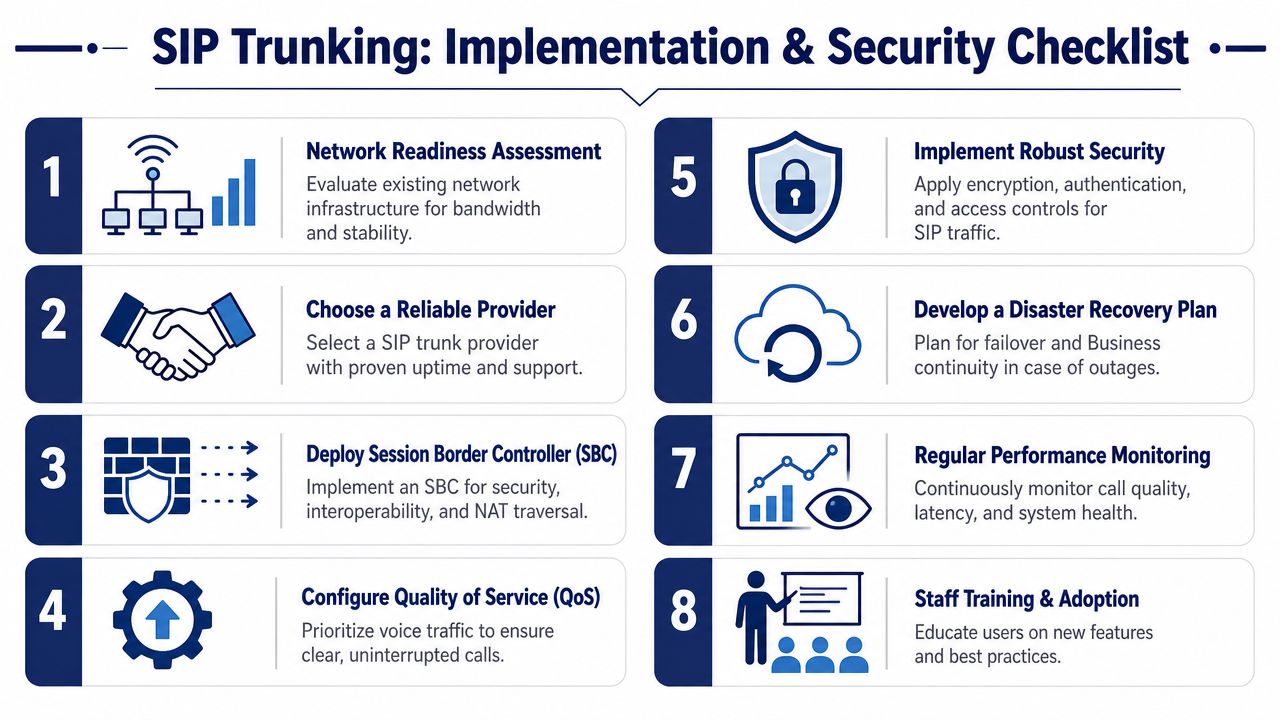
A practical pre-deployment checklist
Before switching, teams should pressure-test the environment in a few specific areas:
- Bandwidth sizing: Use real concurrency estimates, not average call counts.
- QoS settings: Voice packets should be prioritized over less time-sensitive traffic.
- Codec alignment: Confirm your PBX and provider support the same codecs cleanly.
- NAT traversal: Test whether devices behind firewalls pass media reliably.
- Failover planning: Decide where calls go if the office loses connectivity.
Security basics that shouldn't be skipped
SIP trunking itself isn't insecure, but it does require deliberate protection. At minimum, a business should ask how signaling is protected and whether voice media can be encrypted.
A few terms matter here:
| Security item | Why it matters |
|---|---|
| TLS | Protects SIP signaling so session data isn't exposed in transit |
| SRTP | Encrypts voice media carried over RTP-style streams |
| Session Border Controller | Helps with security, interoperability, and traffic control |
| Authentication controls | Reduces the risk of unauthorized usage and fraud |
Ask providers plain questions. Do you support TLS? Do you support SRTP? How do you detect fraud? What happens if our primary connection fails?
Provider questions worth asking
The sales conversation should move past "how many channels?" and into operational detail.
- Compatibility: Will this work with your PBX, phones, codecs, and routing model?
- Redundancy: What failover options exist if a site or route drops?
- Monitoring: Can your team see call quality metrics in real time?
- Support: When voice quality drops, who helps diagnose it?
A strong SIP deployment isn't just purchased. It's engineered, tested, and maintained.
The Future Is Integrated Not Trunked
A few years ago, replacing PRI lines with SIP trunks felt like the finish line. For many businesses now, it is the starting point.
SIP trunking still matters. It remains the underlying method that connects business calling to the public phone network over IP. But the buying decision has changed. Many companies no longer want to choose trunks, size channels, and coordinate separate vendors for PBX, routing, security, and failover. They want one service that handles calling as part of a broader communications system.
What changes in an API-first model
A traditional SIP setup gives you the digital equivalent of phone lines. Your team or provider still has to decide how that capacity is configured, how calls are routed, how the PBX behaves, and what happens during an outage.
In a modern cloud PBX or API-driven platform, that trunking layer is usually still there. It is managed for you and woven into the product.
That shift matters because it connects telecom theory to day-to-day business results. Packet-switched voice does not reserve a fixed physical circuit for every call the way older phone systems did. Capacity can be assigned more efficiently in software, which makes it easier to scale up for busy periods, support remote staff, and avoid paying for hardware and line capacity you rarely use.
The practical differences show up quickly:
- Capacity is easier to adjust as hiring changes or call volume spikes
- Security policy can be managed centrally instead of site by site
- Fraud monitoring can be built into the service rather than added later
- Remote and hybrid teams fit more naturally because the system is not tied to one office
- New features arrive faster since the provider updates the platform directly
For a business owner, that means less time managing telecom plumbing and more time focusing on missed calls, hold times, customer reachability, and cost control.
What the SIP trunk definition should mean in 2026
A SIP trunk is still the virtual connection that lets a business phone system place and receive calls over IP instead of legacy physical lines. That definition remains correct.
What is changing is the role it plays in buying decisions. The evolution is this: the goal isn't owning a better trunk. The goal is getting reliable business calling, better routing, simpler administration, and continuity across office phones, laptops, and mobile devices.
That is why many businesses now evaluate SIP trunking less as a stand-alone product and more as infrastructure inside a managed cloud communications service.
If you're ready to replace legacy lines or an aging PBX with a managed cloud system, SnapDial gives businesses a simpler path forward. You get hosted business calling, unified communications features, mobile-ready access, and white-glove setup without having to piece together separate trunking components on your own.