
A 99.9% uptime guarantee permits about 43 minutes and 12 seconds of downtime per month, while 99.99% permits about 4 minutes and 19 seconds. An uptime guarantee is a vendor's contractual availability commitment over a stated measurement window, but the percentage alone doesn't explain what counts as downtime or what you'll receive if the target is missed.
You may be reviewing a phone-system proposal after a colleague missed an important customer call during a brief route failure. The vendor's sales page says “high availability,” the contract displays an impressive percentage, and the procurement team wants to know whether that promise will protect the business when people can't place or receive calls.
That question requires more than comparing nines. A useful review examines the measurement window, downtime definition, exclusions, monitoring evidence, dependency risks, and remedy. It also separates a contractual target from the engineering work required to keep a business phone system reachable.
Why Business Phone Availability Matters
A procurement manager is waiting for a high-value customer to call. The phone route fails, the call never reaches the intended queue, and voicemails begin stacking up. The manager tries a mobile number, searches for a conference dial-in, and asks an operations colleague whether anyone can confirm that inbound calling is working.
The outage may feel short on an IT dashboard. For the people involved, it interrupts a sales conversation, delays customer support, and creates uncertainty about which calls arrived successfully. A communication platform isn't a passive utility that employees notice only when it breaks. It's part of the daily workflow for sales, service, dispatch, reception, and internal escalation.
The operational cost of an unanswered call
A missed call can create several forms of disruption at once:
- Sales interruption: A prospect may reach voicemail instead of a representative who can answer a time-sensitive question.
- Customer frustration: A customer who has already made the effort to call may try another channel or abandon the interaction.
- Staff inefficiency: Employees spend time checking devices, testing routes, forwarding numbers, and reconstructing what happened.
- Trust damage: Repeated uncertainty makes customers question whether the business can respond when it matters.
The contract may later classify the incident as excluded maintenance, a carrier problem, or a customer-side network issue. That classification can determine whether the vendor records downtime, even though employees and customers experienced an unavailable phone service.
Practical rule: Treat business phone availability as an operating dependency first and an IT metric second.
A careful buyer therefore needs to read from the user's experience back to the contract. What happens when an employee registers a device? Can an inbound call reach the correct queue? Does a carrier failure trigger another route? Who detects the problem, and what evidence will both parties accept?
Those questions reveal whether an uptime guarantee describes a resilient communications service or a percentage with narrow legal protection.
Understanding Uptime Guarantees and SLAs
An uptime guarantee is one part of a broader service level agreement, or SLA. The promise has four connected elements: the availability target, the measurement window, the definition of downtime, and the remedy.
Think of the SLA like an insurance policy. The headline may describe broad protection, but payment depends on the conditions. If the policy doesn't define the covered event, measurement method, or claim process, the headline offers limited guidance after something goes wrong.
Four parts buyers should connect
Numerical commitment: The vendor states a target such as 99.9% or 99.99% monthly availability. These values aren't interchangeable. The difference between three nines and four nines sharply reduces the downtime the vendor can tolerate.
Measurement window: Availability is calculated over a defined period, usually a month. The contract should say whether the period is a calendar month, billing month, or another recurring window. A clear window prevents both sides from choosing a favorable period after an incident.
Definition of downtime: The SLA should explain whether downtime means a complete inability to serve requests, failed registration, inability to place calls, failed inbound delivery, or another condition. Standard SLA guidance emphasizes that the percentage has little operational meaning without a precise outage definition and measurement source. This explanation of uptime SLA structure also highlights the importance of exclusions and remedies.
Remedy: The agreement should state what happens when the target is missed. Remedies are commonly service credits, rather than direct compensation for business losses, and may require a claim supported by documentation.
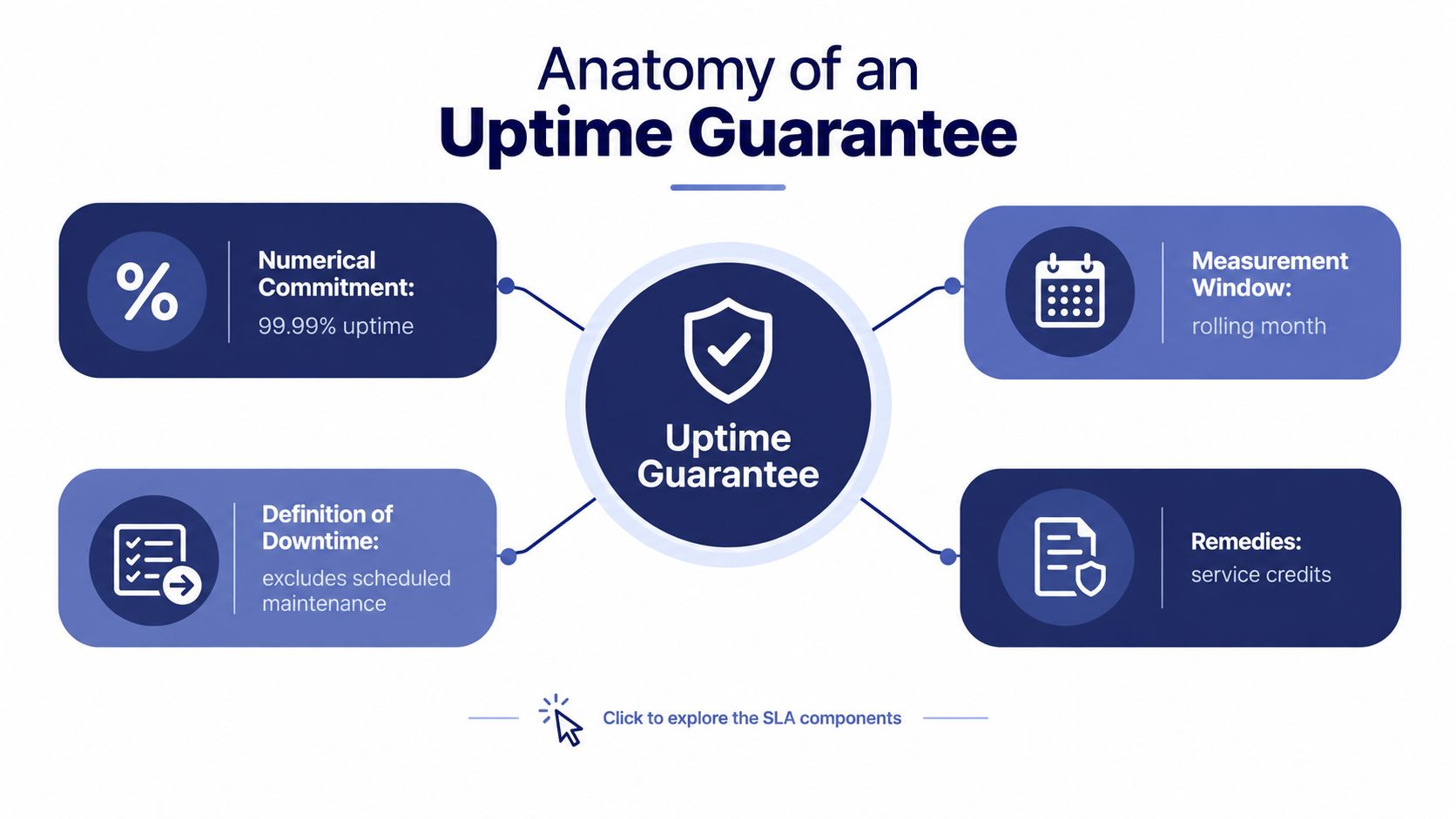
The contract may also exclude defined categories such as scheduled maintenance, force majeure events, customer equipment, or upstream dependencies. Those exclusions aren't automatically unreasonable, but they change the risk the buyer retains.
A vendor's history of publishing a formal SLA can provide useful context, although it doesn't replace contract review. For example, Slack's archived SLA described 99.99% monthly uptime for customers on the Plus plan and above, and defined monthly uptime as the percentage of possible minutes during which the service was available within a monthly measurement window. Slack's archived Service Level Agreement shows how a provider can connect a percentage to a defined calculation.
For communications buyers, the engineering question sits underneath the legal wording. Teams can use stress testing for infrastructure resilience to examine how systems behave when routes, components, or dependencies fail, rather than relying on the contractual percentage alone.
Calculating Allowed Downtime
Uptime math becomes easier when you start with the total minutes in the measurement period. A 30-day month contains 43,200 minutes. To estimate the permitted downtime, multiply that total by the unavailable portion of the target.
For example, 99.9% availability leaves 0.1% unavailable. The calculation is 43,200 × 0.001, which produces about 43 minutes. The exact benchmark commonly cited for a 99.9% monthly target is about 43 minutes and 12 seconds, while a 99.99% target allows about 4 minutes and 19 seconds. The uptime-clause benchmark explains why the additional nine reduces tolerated downtime by roughly ten times.
| Availability | Allowed Downtime (minutes) | Allowed Downtime (hours) | Practical Meaning |
|---|---|---|---|
| 99% | About 432 | About 7.2 | Several incidents can fit inside the monthly budget |
| 99.9% | About 43 | About 0.7 | A regional route failure can consume much of the allowance |
| 99.95% | About 22 | About 0.4 | Short disruptions leave limited margin |
| 99.99% | About 4 | About 0.07 | A few minutes can exhaust the monthly budget |
The table uses the availability tolerances documented by Cloud Computing Authority's SLA overview. Its listed figures include about 43 minutes and 49 seconds for 99.9%, about 21 minutes and 54 seconds for 99.95%, about 4 minutes and 22 seconds for 99.99%, and about 26 seconds for 99.999%. Small differences between these figures and other benchmarks can result from the precise length of the month and rounding method, so the contract's calculation method controls the dispute.
Translate the budget into user experience
A 12-minute call-route failure would fit within a 99.9% monthly budget, but it would consume a substantial share of that allowance. If the incident happened during a busy sales period, the customer experience would be concentrated in those same minutes, not averaged across the month.
A two-minute interruption during a conference call could feel severe to the participants even if the service later meets a monthly target. Under a 99.99% commitment, several such events could consume the entire monthly allowance.
Higher availability therefore demands more than a better number in a proposal. Redundant components, independent routes, rapid detection, and fast failover reduce the chance that one failure domain will consume the budget. The contract measures an outcome, while the architecture determines how often the business approaches that limit.
Comparing Guarantee Types and Exclusions
Buyers often place different promises in the same mental category. A percentage-based uptime guarantee, a service-credit schedule, a maintenance commitment, geographic redundancy, and round-the-clock support all address reliability, but they don't protect the business in the same way.
A percentage target answers, “How much measured unavailability does the vendor permit?” A service-credit clause answers, “What financial remedy applies after a qualifying miss?” An architecture statement answers, “What has the vendor built to reduce correlated failure?” Support language answers, “How can the customer obtain help during an incident?”
| Guarantee Type | What It Promises | Typical Limitation | Buyer Risk |
|---|---|---|---|
| Percentage-based uptime | A measured availability target over a stated period | Exclusions may remove maintenance, carrier events, or other incidents | The headline may overstate practical protection |
| Service-credit remedy | A credit when the qualifying target is missed | Credits may be capped and may require a claim | Recovery may be small compared with operational impact |
| Maintenance commitment | Notice or scheduling rules for planned work | Maintenance may be excluded from downtime | Users can still experience an unavailable service |
| Architecture assurance | Redundant zones, routes, or components | Design language may not create a contractual obligation | The buyer may have no remedy if the design fails |
| Support response assurance | A stated handling or escalation process | Response doesn't guarantee restoration | A fast acknowledgment may not restore calling |
The exclusions deserve line-by-line attention. Customer-side connectivity, force majeure, third-party carrier outages, scheduled maintenance, and abuse-related suspensions can all affect whether an event qualifies. The exact wording controls, so buyers shouldn't assume that an outage visible to employees is automatically counted by the SLA.
Measurement source matters just as much. Vendor probes, third-party monitoring, ticket timestamps, call-detail records, and customer reports may produce different pictures of the same event. Ask which source governs, how conflicting evidence is handled, and whether partial service degradation counts.
For buyers comparing hosted phone platforms, a structured cloud PBX comparison can help organize questions about routing, features, support, and availability. It shouldn't replace the SLA, but it can prevent the review from focusing only on the advertised percentage.
Read the exclusions as carefully as the guarantee. The excluded minutes are part of the risk allocation, not a footnote to ignore.
Monitoring Availability and Performance
A contract becomes useful only when the buyer can verify what happened. Availability percentage is the starting metric, not the whole monitoring plan. A phone system can appear reachable while users experience failed registration, delayed signaling, poor audio, or dropped sessions.
Track both service reachability and call behavior:
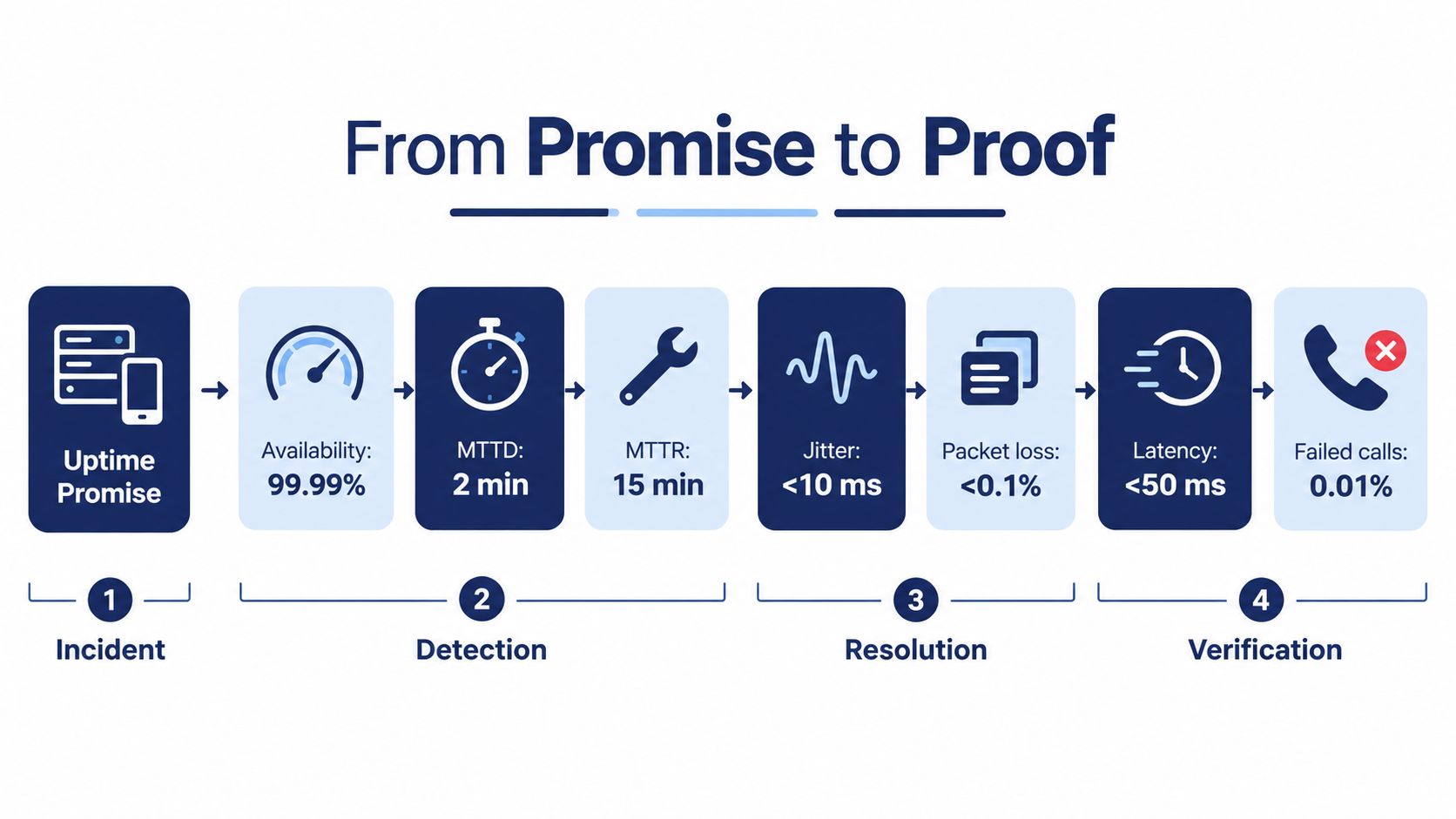
- Availability percentage: Measures whether the service met the defined availability condition.
- Mean time to detect: Shows how quickly the team or vendor recognized the incident.
- Mean time to recover: Shows how long restoration took after detection.
- Jitter, packet loss, and latency: Describe voice quality and network consistency.
- Failed call attempts: Connects technical behavior to the customer's actual calling experience.
Use multiple evidence sources
Synthetic probes should run from outside the vendor's network. They can test login, device registration, inbound delivery, outbound dialing, and dial tone from a user-oriented perspective. A vendor's internal server log may confirm that a component was reachable, but it doesn't necessarily prove that an employee could complete a call from the office or home.
Real-user monitoring adds that missing context. It captures actual call quality, dropped sessions, registration failures, and location-specific problems. Call-detail records can help correlate timestamps, destinations, routes, and outcomes, while packet captures can support investigation of network-related symptoms.
A public status page is useful for communication, but it shouldn't be your only evidence source. It may show acknowledged incidents without exposing the underlying measurement, affected routes, or duration relevant to your account. A dedicated call quality monitoring approach can pair user experience with technical records.
Preserve evidence before an incident
Set a regular health-check cadence that reflects the business's calling pattern. Alert when registration fails, call setup breaks, quality crosses an agreed threshold, or a route behaves differently from the baseline. Retain timestamps, call logs, monitoring results, and relevant packet evidence long enough to support the SLA's claim process.
The practical objective is simple. When a claim is filed, the buyer should have records, not recollections. That discipline turns an uptime guarantee from a sales statement into an accountability mechanism.
Evaluating Remedies and Vendor Claims
A service credit can acknowledge an SLA failure without covering the damage caused by the outage. If the phone system misses customer calls, employees sit idle while routes are tested, and callers lose confidence, a credit against a future invoice may recover only a narrow contractual amount.
This gap matters because service credits are commonly limited. The guidance on SLA guarantees notes that credits are often calculated as a portion of the monthly fee, capped, and designated as the customer's sole and exclusive remedy. They may also be account credits rather than cash, with claim windows and documentation requirements that create another barrier to recovery. Recent SLA guidance on credits and claim requirements describes these limits and the need to examine the remedy clause closely.
The image's illustrative figures aren't a basis for estimating your own losses. Your organization should model its own exposure, including missed opportunities, abandoned interactions, staff disruption, emergency workarounds, and reputational effects. The important distinction is that the contractual remedy and the operational loss are different categories.
Questions to put to the vendor
- Evidence acceptance: Which monitoring records, call logs, and customer reports can support a claim?
- Measurement authority: Does the vendor's telemetry control, or can independent monitoring challenge it?
- Exclusion scope: How are maintenance, carrier dependencies, customer networks, and force majeure events defined?
- Credit limits: Is there an aggregate cap, a tiered schedule, or a sole-remedy clause?
- Claim procedure: How quickly must the buyer file, and what documentation is required?
- Dispute handling: Who reviews conflicting timestamps or partial-service incidents?
- Escalation path: Can the buyer reach an operational team during a live outage?
- Application of credits: Are credits automatic, retroactive, or available only after a formal request?
A strong vendor answer won't eliminate every outage. It will make the boundaries visible, explain how incidents are measured, and show how the service is designed to reduce the chance of a single failure affecting all calling paths.
How SnapDial Supports Reliable Communications
SnapDial offers a cloud-based business phone system with hosted PBX capabilities, calling, conferencing, unified communications, call routing, voicemail, mobile access, and cloud faxing. Those functions connect to uptime planning because employees need more than a reachable web dashboard. They need calls to register, route, connect, and remain usable across office, remote, and mobile contexts.
A managed setup can reduce configuration gaps during deployment. Multi-carrier routing and geographic redundancy can provide alternative paths when a single carrier or location develops a fault. Failover routing can direct calls toward an available destination, while device-level diagnostics and network quality-of-service guidance help identify problems closer to the user.
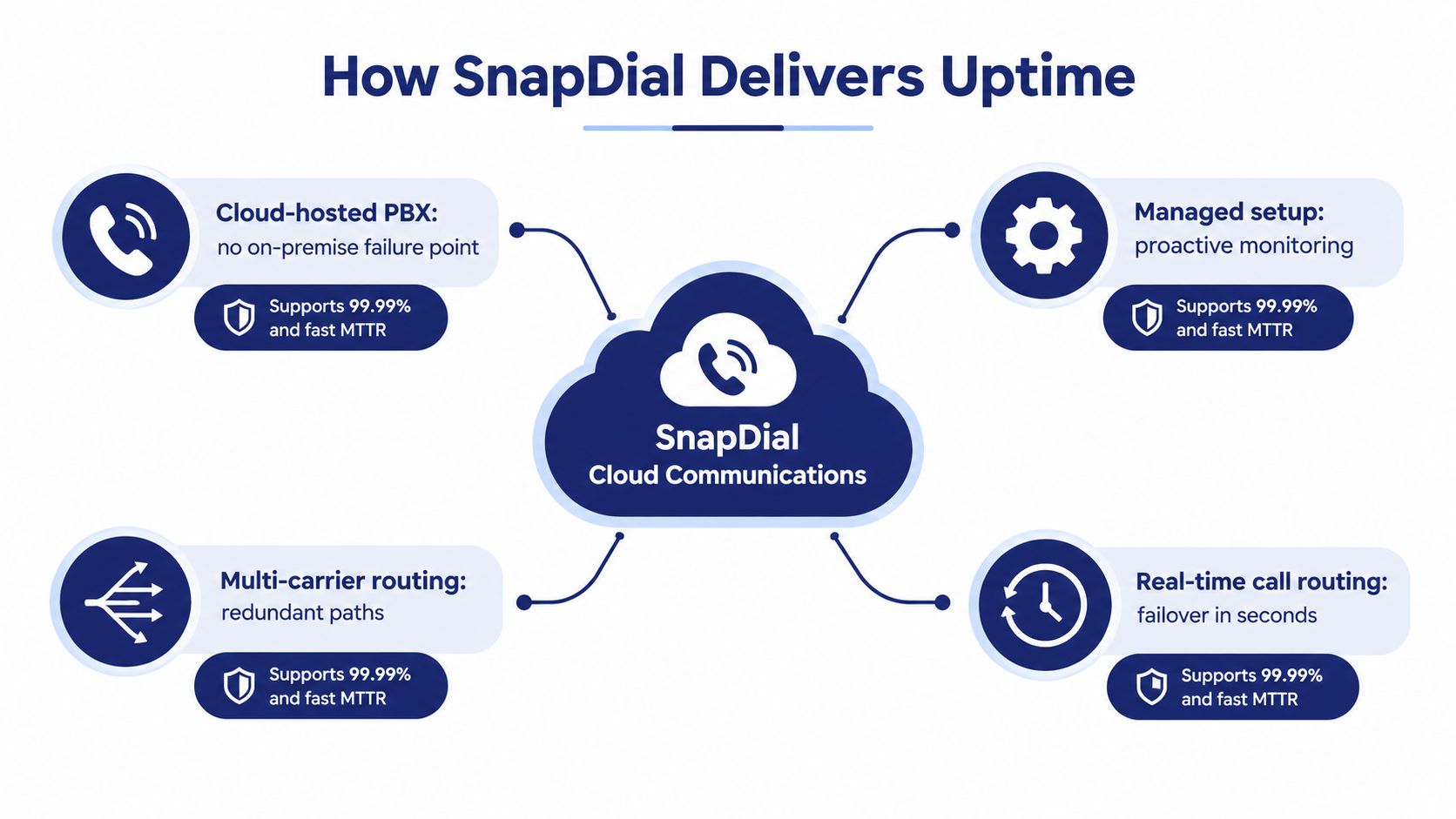
The operational evidence matters as much as the design. Call-detail records can show attempted and completed calls, route behavior, and timestamps. Status dashboards and alert notifications can help administrators identify an incident, while support access gives staff a path for escalation when a phone queue behaves unexpectedly.
Match resilience features to failure modes
- Cloud-hosted PBX: Removes dependence on a single on-premises PBX appliance, although local power and network connectivity still require planning.
- Redundant routing: Offers an alternative path when a carrier or route is unavailable.
- Failover configuration: Helps redirect calls when a destination or service component cannot respond.
- Monitoring and alerts: Shortens the time between user impact and incident recognition.
- Call records and reporting: Provides evidence for troubleshooting and service review.
- 24/7 support: Gives staff a human escalation path outside ordinary office hours.
These capabilities don't make a contract unnecessary. Buyers should still request the applicable SLA, ask how exclusions work, and confirm which monitoring data is available to customers. A resilient service combines architecture, operational procedures, transparent measurement, and a clear response model. SnapDial's cloud communications platform can be evaluated against those criteria without treating any single feature as a substitute for the full reliability design.
Making the Right Reliability Decision
Use four checkpoints before accepting an uptime guarantee.
Read the clause as an operating document
Confirm the measurement window, the exact downtime condition, exclusions, monitoring source, claim deadline, and remedy. Ask whether the contract measures complete unavailability only or also covers the failure of key phone functions such as registration, inbound delivery, or outbound calling.
Convert the target into business time
Use the allowed-downtime table and compare the result with your busiest calling periods. A target that looks adequate for internal collaboration may leave too much exposure for a customer-facing queue, emergency line, or sales team.
Verify the evidence path
Ask for sample status reporting, call-detail records, incident timelines, and monitoring access. Confirm that your team can see enough information to distinguish a vendor outage from a local network fault or an upstream carrier event.
Compare the remedy with the consequence
Treat service credits as contractual recovery, not automatic reimbursement for lost sales or reputation. Review caps, sole-remedy language, exclusions, and claim requirements before assigning the guarantee a financial value.
Your internal readiness matters too. Check network redundancy, power backup, device fallback, alternate contact methods, and staff escalation procedures. A provider can maintain its service while a local switch, internet connection, handset, or power source prevents employees from using it.
Request the complete SLA before signing, schedule a proof-of-concept that tests real calling paths, and confirm that monitoring access and evidence retention are available from the start. Reliability is the combination of a contractual target, resilient service design, and disciplined daily verification.
SnapDial provides cloud-based business phone, conferencing, routing, voicemail, mobile, and unified communications features with managed setup and support designed for distributed teams. Visit SnapDial to review the platform and discuss how its routing, monitoring, and failover practices fit your availability requirements.