
52% of security decision-makers mistakenly believe encryption protects metadata such as location, IP addresses, and communication patterns, while 41% assume communications remain secure after a device is compromised, stolen, or infected with malware. Secure communication therefore means more than encrypting a call. It also requires trusted identities, protected endpoints, controlled network paths, and a response plan for the information encryption can't hide.
That distinction matters most in cloud VoIP, where voice, signaling, recordings, caller identity, and administration all depend on connected systems. A business can encrypt its media streams and still expose call patterns, accept a spoofed instruction, or lose sensitive conversations through a compromised phone or laptop.
The Misconception About Secure Communication That Is Costing Businesses
Secure communication isn't a switch labeled encryption. Encryption protects information while it travels through a channel, but it doesn't automatically prove who initiated the call, conceal every piece of metadata, or protect a device that attackers already control.
The gap is documented in recent survey data. 52% of security decision-makers mistakenly believe encryption protects metadata, including location, IP addresses, and communication patterns, while 41% assume communications stay secure after a device has been compromised, stolen, or infected with malware (BlackBerry's secure communications report). Those misunderstandings create practical risk for small and mid-sized businesses because cloud phone systems often connect office networks, home workers, mobile applications, browsers, desk phones, and third-party integrations.

Encryption protects the pipe, not the entire conversation
A protected audio stream can still reveal who communicates, when they communicate, and how frequently, depending on the systems and logs surrounding the call. Caller ID can also be manipulated before a person answers, and an authenticated employee can still be tricked into disclosing information to a convincing impersonator.
Endpoint compromise creates another blind spot. If malware captures audio before encryption or after decryption, transport protection doesn't solve the problem. The same applies to a stolen phone with an active session, an unmanaged browser, or an administrator account protected by weak credentials.
For businesses evaluating their current setup, understanding what a cloud phone system involves helps separate the hosted platform from the devices, networks, and users that connect to it. Organizations handling especially sensitive conversations may also need controls beyond telecom configuration, including physical assessments such as counter surveillance services London.
Practical rule: Treat encryption as one control in a chain. If identity, endpoint integrity, and response procedures are weak, encrypted calling can still support an unsafe process.
The right question isn't “Is our VoIP encrypted?” It's “Which parts of our communication are protected, which are observable, and which people or devices can still be impersonated or compromised?”
What Secure Communication Means for Your Cloud VoIP System
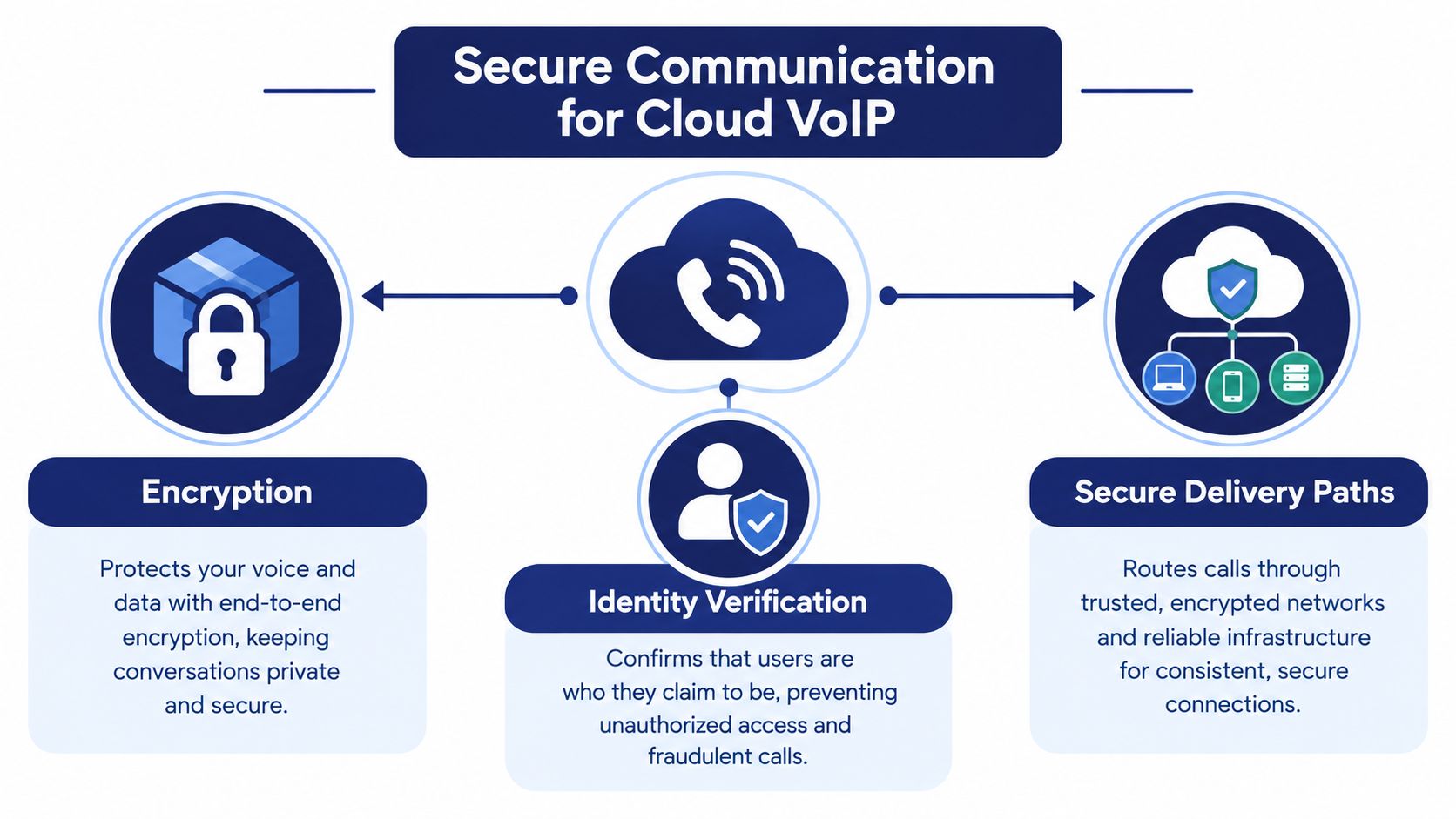
Think of a business call as a secured delivery system. Encryption locks the package, identity verification checks the sender and recipient, and secure delivery paths reduce the chances that someone can intercept or reroute it. A reliable cloud VoIP design needs all three functions.
The first layer is signaling protection. Signaling creates the call, negotiates participants, and manages events such as ringing, answering, transferring, and ending. The second is media protection, which applies to the audio or video exchanged after the call begins. The third involves identity and endpoint trust, so the system and the user can distinguish a legitimate participant from an impersonator or compromised device.
Why the architecture developed in layers
Modern secure communication became practical for open networks because cryptographic systems no longer depended entirely on a secret key being shared in advance. In 1976, Whitfield Diffie and Martin Hellman introduced public-key cryptography, allowing two parties to establish a shared secret over an insecure channel. That shift helped secure communication scale beyond closed environments and laid a foundation for the encrypted web, messaging systems, and enterprise communications (secure communication history).
Cloud VoIP inherits that layered model. TLS protects the signaling relationship, while SRTP protects the live media. Authentication, certificate handling, account controls, device management, and network policy then determine whether the surrounding system deserves trust.
What this means for an SMB
A small business doesn't need to build cryptography from scratch. It does need to verify that its provider enables the correct protections, that endpoints use them consistently, and that remote workers don't bypass approved calling paths.
Operational ownership matters too. A provider may manage the hosted platform while the customer remains responsible for admin accounts, laptops, mobile applications, Wi-Fi, call-recording access, and staff behavior. Businesses assessing specialist capability can use resources such as how a 6 month hire was filled to understand why experienced VoIP and contact-center expertise matters during design or migration work.
The Real Threats Facing Business VoIP Calls
An unprotected VoIP environment doesn't fail in one predictable way. Attackers target different layers, and each layer produces a different business consequence.
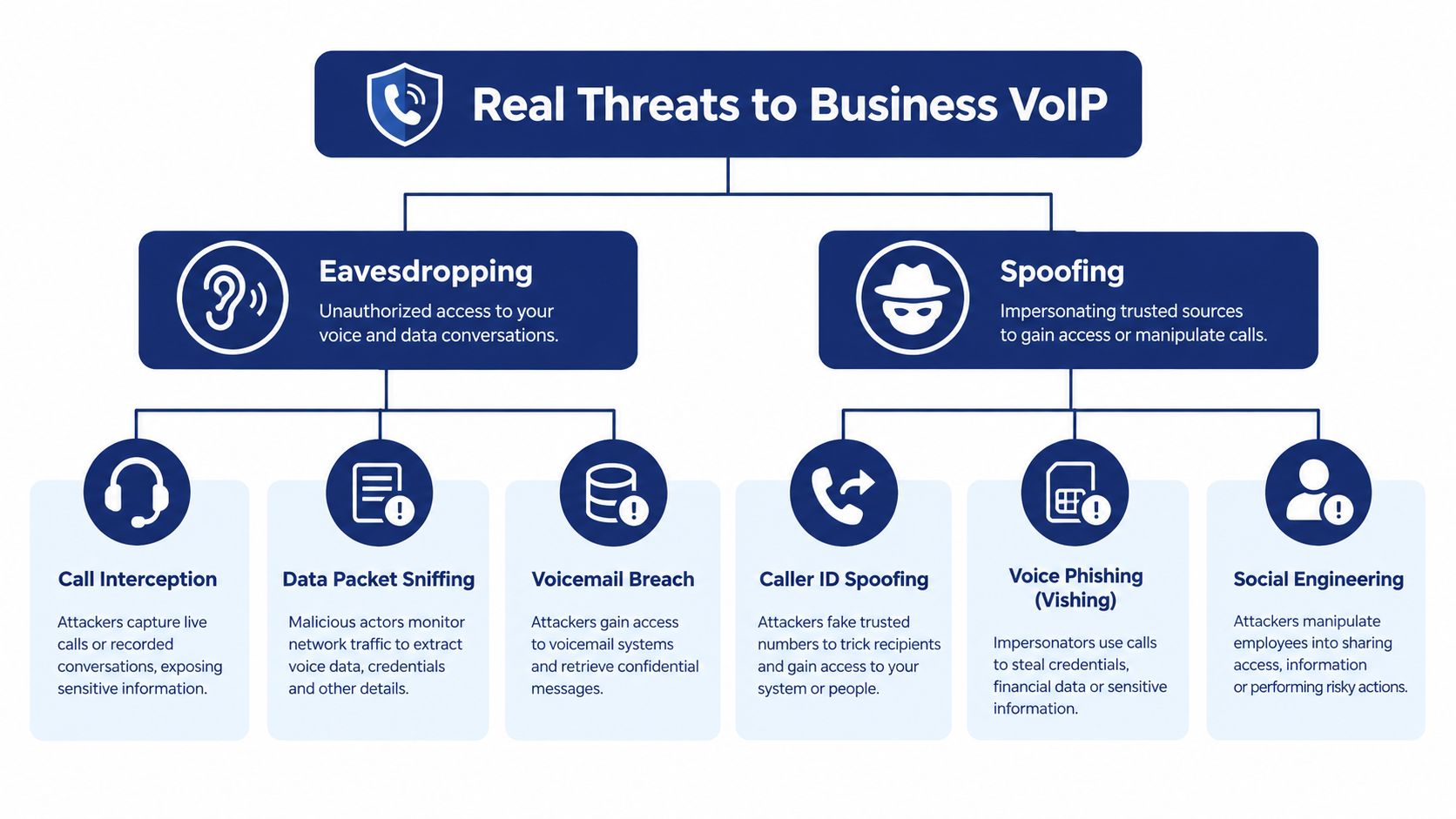
Eavesdropping targets the media
If voice media travels without appropriate protection, an attacker with access to a suitable network position may capture or reconstruct the conversation. A customer support call could reveal account details, a sales call could expose contract terms, or an internal call could disclose operational plans.
Encryption helps with interception, but only when the endpoints negotiate it correctly and maintain it through transfers, mobile sessions, and external trunks. A configuration that secures the call setup but leaves the audio unprotected creates a false sense of safety.
Spoofing targets trust
Caller ID spoofing attacks the person, not just the protocol. An attacker can present a number that appears to belong to a director, finance employee, supplier, or customer. The recipient may then approve a payment, reveal an account detail, or reset access because the displayed identity looks familiar.
Caller ID is a useful routing and recognition signal, but it isn't sufficient proof of identity. Sensitive requests need a second verification method, such as calling back through a known number or confirming the instruction in an approved business system.
Interception targets signaling
A man-in-the-middle attack places an attacker between communicating systems. The attacker may observe signaling, interfere with call setup, redirect traffic, or alter messages while the parties believe they're communicating normally. The result can include failed calls, unauthorized routing, exposed metadata, or disrupted customer service.
The defenses map directly to the stack:
- Signaling layer: Use authenticated TLS connections and certificate validation.
- Media layer: Use SRTP and confirm that endpoints negotiate it rather than falling back without notice.
- Identity layer: Verify sensitive requests independently of caller ID.
- Endpoint layer: Remove compromised or unmanaged devices from trusted calling paths.
The following visual reinforces that a secure calling design must address multiple attack routes rather than one encryption setting.
Protocols and Technologies That Protect VoIP Traffic
Secure VoIP works through protocol layering. TLS protects signaling, while SRTP protects the voice or video payload. Related technologies address key exchange, transport choices, and authentication rather than replacing every other control.
| Protocol | Protects | Port | Best For |
|---|---|---|---|
| TLS | Signaling and session negotiation | Commonly 5061 for SIP over TLS | Securing call setup and control messages |
| SRTP | Audio and video media, authentication, replay protection | Negotiated media ports | Protecting real-time voice and video |
| ZRTP | Peer-to-peer media key agreement | Negotiated media ports | Direct key negotiation where supported |
| SIPS | SIP signaling carried through TLS | Commonly 5061 | Defining a SIP service over protected TLS |
| SIP over TCP | Signaling transport, without encryption by itself | Provider-defined | Reliable signaling transport when paired with TLS |
| SIP over UDP | Signaling transport, without encryption by itself | Provider-defined | Low-overhead signaling where network policy permits |
TLS handles signaling, SRTP handles the conversation
SIP/TLS protects the call-control exchange. It doesn't automatically encrypt the voice stream. SRTP provides encryption of media payloads, message authentication, and replay-attack prevention, which is why secure VoIP commonly pairs SIP-over-TLS with SRTP (Telnyx's SRTP overview).
ZRTP can provide peer-to-peer key negotiation in systems that support it, but compatibility and provider architecture determine whether it fits. SIP over TCP or UDP describes transport behavior, not security on its own. Choosing TCP instead of UDP doesn't turn signaling into encrypted signaling.
Performance is a design decision
Security and performance aren't opposing goals by default. Benchmark data found that TLS 1.3 cipher-suite selection can change handshake latency by up to 4x while retaining the same 128-bit security level. In that benchmark, Curve25519 plus RSA improved computation latency compared with the slowest candidate, P-256 plus ECDSA (the TLS 1.3 benchmark study).
That matters for cloud PBX and contact-center environments handling many concurrent connection events. IT teams should test supported suites, certificate behavior, CPU impact, and failover rather than disabling protection to solve a performance complaint.
For caller identity controls, pair protocol configuration with caller ID authentication guidance. Authentication at the signaling layer and verification by staff solve different problems, and both belong in the design.
Hardening Your Network and Endpoints for Secure Calling
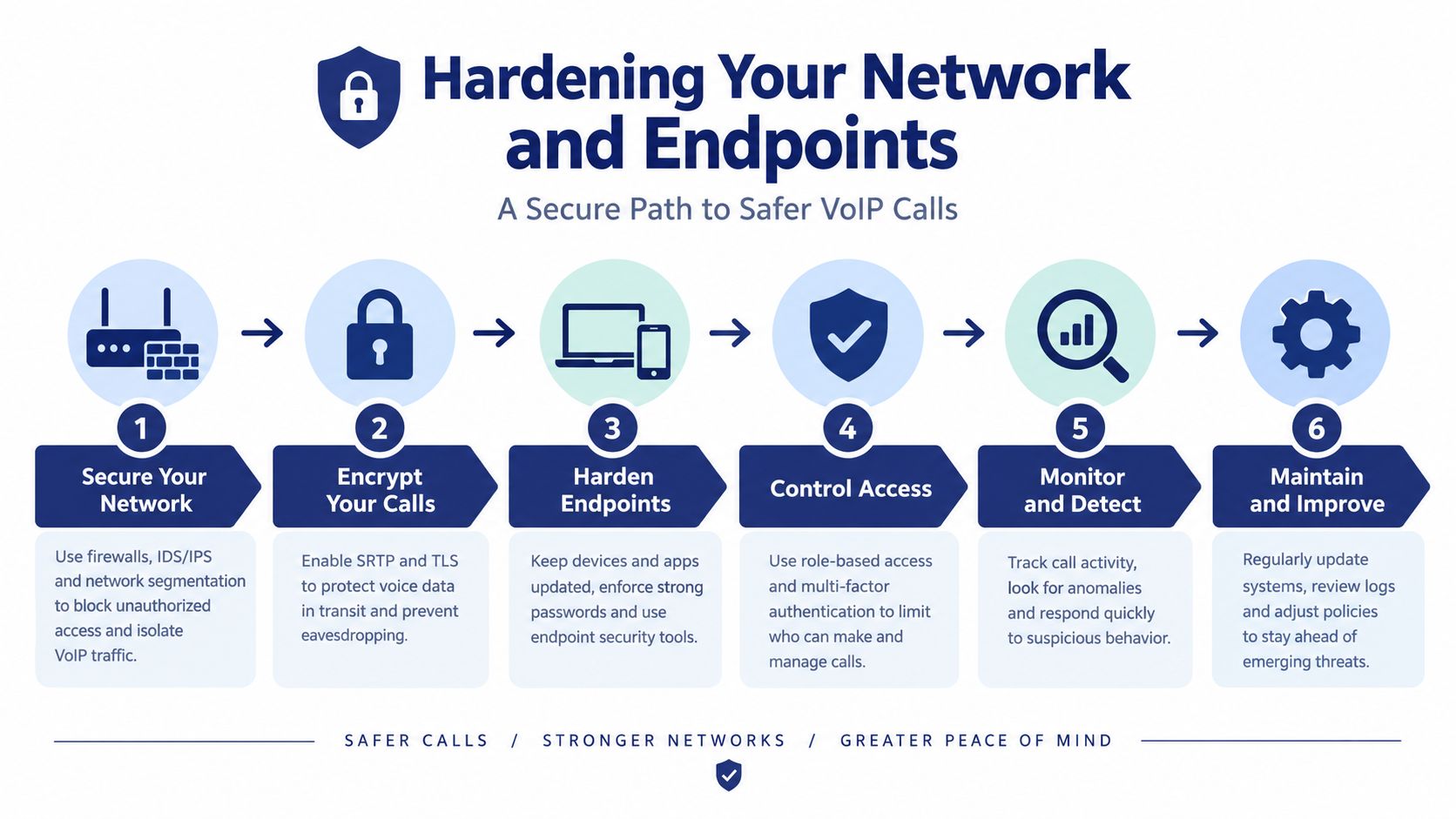
Protocol support won't protect a poorly managed network. SMBs should treat VoIP hardening as a configuration and maintenance process, not a one-time provider setting.
Start at the network perimeter
Separate voice traffic from ordinary workstation traffic where the network supports it. A dedicated voice VLAN limits unnecessary lateral movement and makes quality and security policies easier to inspect. It won't stop an attack by itself, but it gives administrators a cleaner boundary between phones, computers, printers, and guest devices.
Firewall policy should allow SIP and RTP only from authorized providers, trunks, or managed endpoints. Avoid broad exposure of administration interfaces, and review rules after provider changes. For remote employees, use the provider's secure application path or an approved VPN rather than allowing ad hoc access from unmanaged networks.
The port assignments and transport behavior in a deployment should be documented. Use a practical reference such as SIP and IP ports when checking that firewall rules match the provider's requirements instead of opening a broad range without ownership.
Treat every endpoint as a security boundary
A desk phone, laptop softphone, and mobile application all handle credentials or live media. Apply these controls:
- Update firmware: Schedule updates for IP phones and network equipment, then confirm that upgrades don't reset security settings.
- Remove unused services: Disable unused ports, web administration paths, and features on desk phones.
- Protect administrator access: Use strong unique credentials, restrict management access, and avoid shared administrator accounts.
- Manage mobile applications: Require device locks, supported operating-system versions, and remote-wipe capability through mobile management policies.
- Review active sessions: Revoke access for departed staff, lost devices, and devices that fail compliance checks.
A useful hardening workflow moves outward to inward: inventory the provider and trunks, restrict the firewall, segment voice, secure Wi-Fi, update devices, then verify logs and call behavior. The final check should confirm that the intended protections remain active after a handset replacement, remote login, transfer, or software update.
Policy, Training, and the Human Layer of Secure Communication
Technology protects a communication path. Policies and trained employees protect decisions made through that path. A secure call can still produce a breach if an employee trusts a spoofed caller, reads sensitive information aloud in a public setting, or stores a recording where too many people can access it.
Start with four written rules. First, define acceptable use for company calling tools, including personal devices and recordings. Second, require independent verification for payment changes, credential requests, account resets, and other high-impact instructions. Third, give employees a simple route for reporting suspicious calls without fear of blame. Fourth, define how long recordings and transcripts should be retained, who may access them, and when they should be deleted.
Build training around realistic moments
Training works better when employees practice the situations they encounter. Use examples such as a caller claiming to be an executive, a supplier asking to change bank details, or a customer requesting information that policy restricts.
Teach staff to:
- Challenge unusual requests: Pause the call and verify through a known internal channel.
- Treat caller ID as a clue: A familiar number doesn't prove the caller's identity.
- Protect spoken information: Move sensitive conversations away from public areas and avoid repeating unnecessary details.
- Report quickly: Capture the time, displayed number, requested action, and any unusual behavior.
- Use approved tools: Don't move sensitive discussions to an unapproved personal app because it feels convenient.
Limit access to the information around calls
Call recordings, transcripts, logs, and contact-center reports can expose more than the live conversation. Apply role-based access control so supervisors, agents, administrators, and executives receive only the permissions their work requires. A practical overview of role-based access control can help teams turn that principle into a usable access model.
Encryption can't decide whether an employee should trust a caller. Your process has to make that decision explicit.
Include these controls in onboarding, role changes, incident exercises, and periodic refreshers. Keep the guidance short enough to use under pressure, and make reporting easier than improvisation.
Compliance Requirements and Your Implementation Roadmap
Organizations that discuss protected health information or payment card data over business communications must consider the communication channel as part of the wider control environment. HIPAA and PCI DSS obligations don't disappear because a conversation happens over VoIP rather than email or a legacy phone system.
Encrypted signaling and protected media can support confidentiality, but compliance also depends on access control, retention, auditability, vendor responsibilities, device security, and incident handling. Don't describe a phone platform as “compliant” without identifying which controls it provides and which remain with your organization.
A practical implementation sequence
Use this order to turn secure communication into an operating practice:
- Inventory the calling environment. List providers, trunks, desk phones, softphones, mobile applications, recordings, integrations, and administrator accounts.
- Verify active protections. Confirm whether signaling uses TLS, whether media uses SRTP, and whether endpoints negotiate those protections consistently.
- Review access and endpoints. Remove old accounts, update firmware, secure mobile devices, restrict management access, and separate voice traffic where practical.
- Inspect network policy. Confirm that firewalls permit only required traffic and that remote workers use approved access paths.
- Document sensitive-call procedures. Define independent identity checks, recording rules, retention decisions, and escalation contacts.
- Train employees. Practice spoofing scenarios, sensitive-information handling, and rapid reporting.
- Test response. Run a tabletop exercise for a lost phone, compromised account, suspicious call, exposed recording, or provider outage.
Make incident response specific to communications
Your response plan should identify who can disable an account, revoke a device, suspend recording access, contact the provider, preserve relevant logs, and notify leadership. It should also distinguish between a suspected endpoint compromise, a spoofing attempt, a signaling failure, and an exposed recording.
A managed hosted VoIP service can reduce the operational burden when it provides clearly documented encryption configuration, device and firmware management, access controls, recording governance, and support. SnapDial offers cloud calling, conferencing, mobile applications, call recording with transcription, routing, a web administration portal, and continuous support, so an SMB can centralize those functions instead of maintaining a legacy PBX and separate tools.
Genuine secure communication comes from the combination of encryption, identity validation, endpoint hardening, network controls, staff policy, and incident response. Removing any layer leaves a practical gap that attackers or simple human error can exploit.
If your business is replacing a legacy PBX or tightening cloud calling controls, SnapDial provides hosted VoIP with TLS and SRTP-based call protection, managed features, mobile calling, recording and transcription, and support for implementation. Contact SnapDial to review your current calling environment and build a security plan around the devices, users, and workflows your team relies on.