Your team is calling customers back. Sales is returning warm leads. Support is confirming appointments, shipments, and service windows. Yet people don't answer, or worse, they answer already suspicious because their screen says something like “Spam Likely.”
That usually isn't a random carrier glitch. It's a trust problem in the voice network.
Caller ID used to function on good faith. That model broke once spoofing became cheap and common. Now legitimate businesses are dealing with the same damaged channel as scammers, robocallers, and impersonators. If your phone system can't prove who's calling, your real calls get treated like fake ones.
Why Your Business Calls Are Being Marked as Spam
A common pattern looks like this. A business keeps its old phone setup because it still “works.” Outbound calls go through a mix of legacy trunks, forwarded numbers, and reused direct lines. Nothing appears obviously broken inside the office. Then the complaints start.
Customers say they never saw the callback. Prospects say the call came through as suspicious. Front desk staff test the line from their personal phones and see spam labeling or no business identity at all.
Trust broke before your team ever said hello
The voice channel now works a lot like email reputation. If the network can't verify the sender, the receiver gets cautious. That's why the mechanics behind call trust matter as much as mailbox placement matters in email. If you've dealt with outbound email issues before, Robotomail's guide to email deliverability is a useful parallel because the same business lesson applies: technical trust controls determine whether your message gets a fair chance.
For phone calls, caller ID authentication is that trust control.
The market itself shows how central this has become. The global Caller ID Authentication market is valued at USD 1.21 billion in 2024 and is expected to account for 37.2% of the total robocall mitigation solution market share in 2025, according to DataIntelo's caller ID authentication market report. Businesses aren't spending on this because it's fashionable. They're spending because unverified calling now hurts revenue, service quality, and brand trust.
What actually triggers the problem
A business call gets flagged for a few practical reasons:
- Number use looks inconsistent: The same outbound number appears from different systems, routes, or locations.
- Ownership is unclear: Your carrier can't confidently assert that your business has the right to use the number.
- The network path is messy: Legacy forwarding, old PBXs, and mixed trunking make calls look less trustworthy.
- Spoofing patterns hit your range: If a number block gets abused, legitimate calls in that range can face more scrutiny.
Practical rule: If your provider can't clearly authenticate your outbound identity, downstream carriers may treat your calls defensively.
If you've already seen warnings tied to your numbers, review the common causes in SnapDial's documentation on suspected spoofed DIDs. It's a good operational checklist even if you use another provider.
Caller ID authentication isn't just a telecom compliance item anymore. It's part of whether your customers pick up the phone.
Understanding Caller ID Authentication Fundamentals
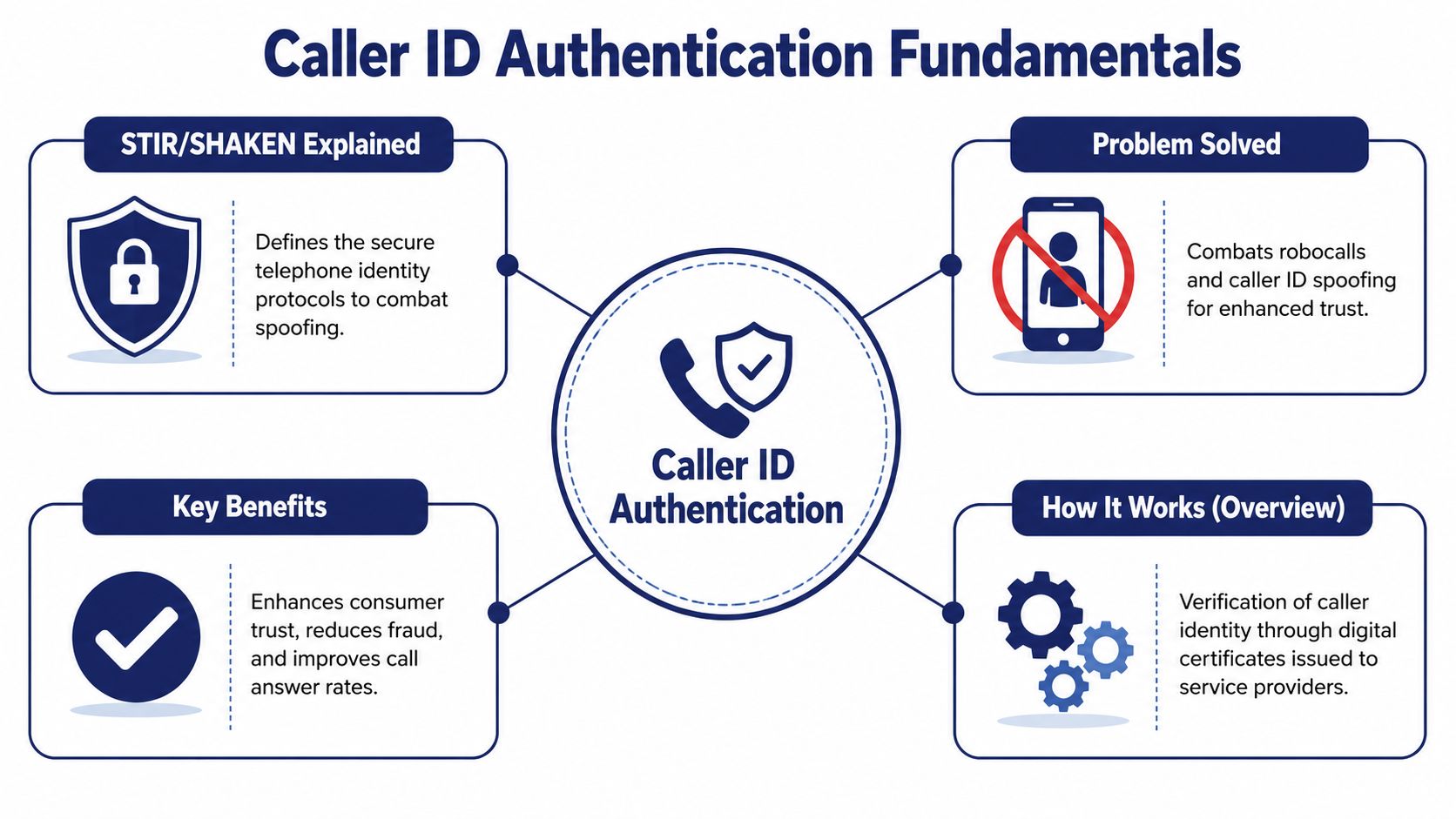
The simplest way to think about caller ID authentication is this: the network needs a way to confirm that the calling party is really allowed to present that number.
Old caller ID didn't do that well. It displayed a number, but display is not proof.
STIR and SHAKEN in plain English
STIR/SHAKEN is the framework carriers use to verify caller identity in modern IP calling environments. The easiest analogy is a certified, sealed envelope.
The phone number on the outside of the envelope is what the called party sees. STIR/SHAKEN adds a digital seal from the originating provider that says, “We checked this caller, and here's how confident we are about their right to use this number.” The receiving provider can inspect that seal before deciding how much trust to assign to the call.
That matters because spoofing relies on the opposite condition. A caller presents a number with little or no trustworthy proof behind it.
Authentication is not the same as display name
Business owners often mix up CNAM and caller ID authentication. They're related, but they do different jobs.
| Item | What it does | What it does not do |
|---|---|---|
| CNAM | Associates a display name with a phone number | It does not prove the caller is authorized to use the number |
| STIR/SHAKEN | Adds network-level verification about the calling number | It does not guarantee a display name will appear exactly how you want |
That's why a call can show a company name and still be treated cautiously, or show no name and still be technically authenticated. Name presentation helps branding. Authentication helps trust.
A polished caller ID name is useful. A verified calling identity is more important.
Here's a good visual primer if you want the high-level flow before talking to your provider:
What this means for an SMB
If you run a small or mid-sized business, you don't need to become a signaling expert. You do need to ask better questions:
- Can my provider authenticate my outbound calls?
- Do they control the numbers I'm using, or can they verify my right to use them?
- Are my calls originating over an IP-based path that supports modern authentication?
- If calls are being labeled, who helps me troubleshoot the attestation and routing path?
A phone system that “can place and receive calls” isn't enough in 2026. A usable business phone system also has to support trust.
The Three Levels of Call Attestation Explained
When providers talk about attestation, they're talking about the confidence level attached to your outbound call. This is the part of STIR/SHAKEN that affects how your call is interpreted downstream.
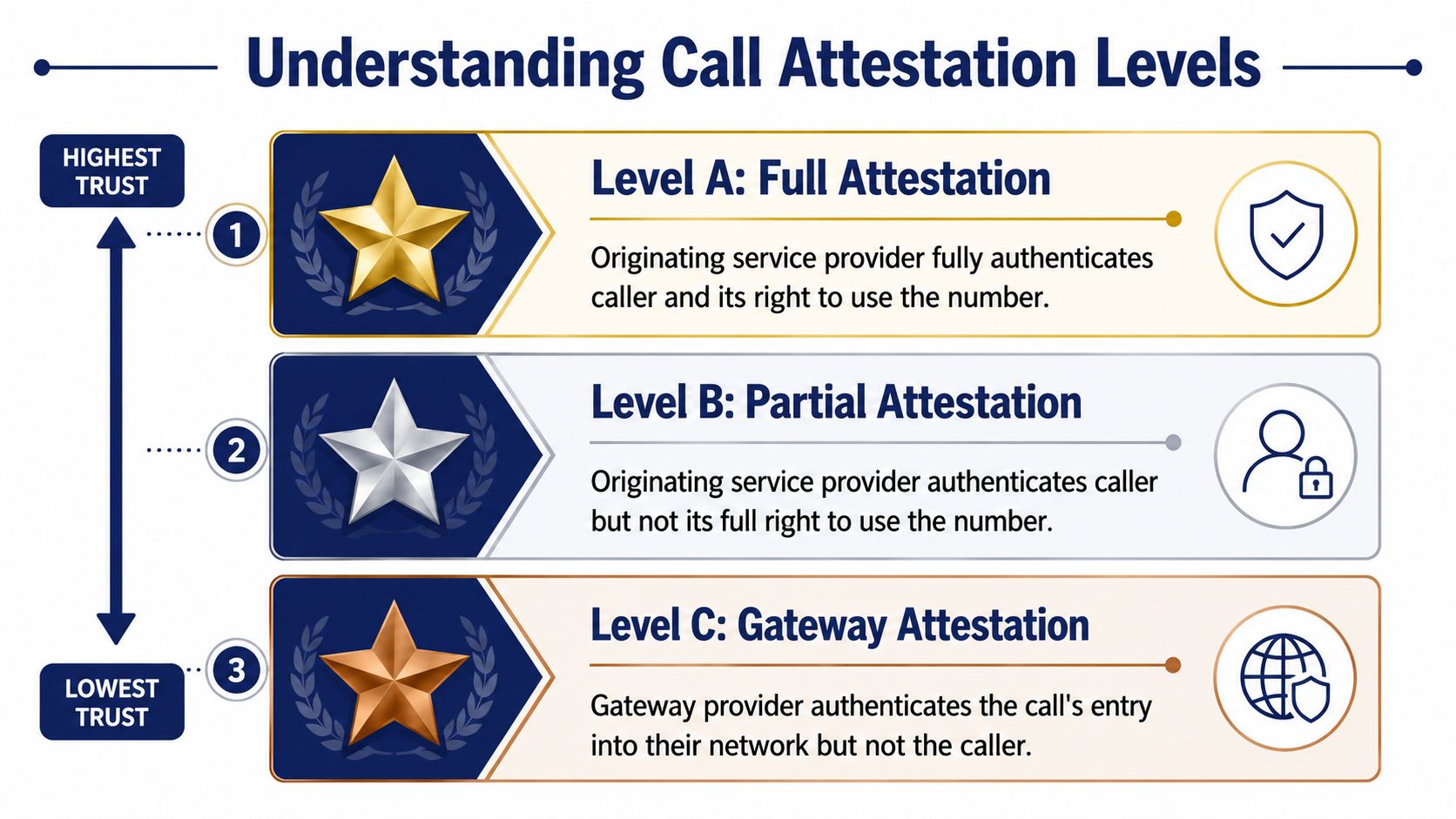
The three levels are usually labeled A, B, and C. Think of them as trust grades, not call quality grades.
Level A means full confidence
With A attestation, the originating provider knows who placed the call and knows that caller is authorized to use the number being presented.
That's the cleanest setup. It usually means your provider has a direct relationship with your business, provisions your numbers in a controlled way, and originates your calls inside an environment it can verify end to end.
For most businesses, A attestation is the target because it gives receiving carriers the strongest signal that the call is legitimate.
Level B means partial confidence
With B attestation, the provider knows the customer placing the call but can't fully confirm the caller's right to use the exact outbound number.
This often shows up in messy real-world environments. A company may be using numbers ported through multiple systems, presenting a number that isn't tightly bound to the originating service, or relying on a setup where the carrier can identify the business but not confidently vouch for every presented caller ID.
B isn't useless. It's just weaker. If your business expects high answer rates for important outbound calls, partial trust is not where you want to live for long.
Level C is gateway trust only
With C attestation, the provider is basically saying, “We know where this call entered our network, but we can't say much about the actual caller.”
That's common with gateway traffic, third-party handoff situations, and legacy environments where the originating identity is opaque. It's better than nothing, but it's not a strong business calling posture.
Field advice: If you keep seeing B or C outcomes, don't start by changing scripts or retraining agents. Start by auditing number ownership, trunking design, and where your outbound caller ID is being set.
What usually determines your attestation
A few factors drive the result more than anything else:
- Provider relationship: Direct, well-managed service usually produces better attestation than layered carrier chains.
- Number control: Numbers assigned and verified by the originating provider are easier to attest strongly.
- Origination path: IP-native calling environments support modern authentication better than patched-together legacy routes.
- System consistency: Calls should originate from the same authenticated environment that owns or verifies the presented number.
Here's the practical takeaway. If your provider can't verify both who you are and that you're allowed to use the number, A attestation becomes hard to achieve. For SMBs, that usually turns caller ID authentication into a provider-selection issue, not just a phone-setting issue.
The Business Impact of Verified and Unverified Calls
Unverified calls don't just create an IT headache. They change customer behavior.
When people don't trust the identity on their screen, they screen harder, ignore more calls, and call back less often. That hurts sales teams, support desks, billing departments, healthcare reminders, field service coordination, and any workflow that depends on someone answering when it matters.
The trust problem is already visible
Numeracle reports that 85% of U.S. consumers rarely trust caller ID information, and 69% miss important or legitimate calls because those calls were unverified or flagged as suspicious. The same release says 14.5 million caller ID events were flagged as problematic in 2025 alone. Those figures come from Numeracle's consumer caller ID trust study.
That's the business case in one paragraph. Even if your team is legitimate, your calls are landing in an environment where skepticism is the default.
Where that shows up inside a business
The cost is rarely captured in a single line item. It spreads across operations.
- Sales teams lose momentum: Prospects don't answer follow-up calls, and rep productivity drops because each conversation takes more attempts.
- Support teams create friction: Customers miss callbacks, then blame the company for poor responsiveness.
- Collections and billing get harder: Time-sensitive outreach becomes less reliable.
- Brand trust erodes: A suspicious label beside your number makes your business look careless at best.
A lot of owners first notice the issue when staff say, “People aren't picking up anymore.” That symptom gets mistaken for weak scripts or bad timing. Sometimes it is. Often it's a trust failure upstream.
Compliance pressure isn't going away
There's also a regulatory angle. Carrier authentication requirements and anti-spoofing enforcement have pushed providers to take call identity more seriously. That means sloppy outbound identity setups face more friction than they did a few years ago.
If you're evaluating how your business identity appears and performs in the network, SnapDial's caller ID services overview is a useful reference for the operational side of caller identity management.
The big shift is this: caller ID authentication used to be viewed as a telecom backend feature. It's now part of customer experience. If your customers don't trust your call, the rest of the conversation never happens.
How to Implement Authentication for Your Business
Most SMBs have two real paths. They can build around their own telecom stack, or they can use a provider that manages the authentication layer as part of service delivery.
Both paths can work. They don't require the same time, expertise, or tolerance for troubleshooting.
Option one is the hands-on route
A self-managed approach usually means you're coordinating pieces such as PBX behavior, SIP trunking, number provisioning, and edge infrastructure. In more technical environments, that can include Session Border Controllers, dial plan cleanup, and careful control over what caller ID is being asserted on outbound calls.
That route makes sense if you already have telecom engineering depth in-house and a strong reason to retain direct control.
What often goes wrong is not the concept. It's the maintenance burden.
- Ownership drift: Numbers get ported, reused, or assigned in ways the carrier can't cleanly verify.
- Configuration sprawl: Different offices or teams present different outbound identities.
- Troubleshooting gets slow: When labeling or attestation issues appear, several vendors may point at each other.
Option two is the managed route
For many businesses, the cleaner path is using a modern hosted VoIP provider that owns the service relationship, provisions the numbers correctly, and supports an IP-native call flow that aligns with caller ID authentication requirements.

A good provider should handle the heavy lifting behind the scenes while your team focuses on business operations.
Here's the practical division of labor:
| Your business handles | Your provider should handle |
|---|---|
| Deciding which numbers each team should present | Number provisioning and verification |
| Keeping user and department ownership current | Carrier-side authentication support |
| Avoiding unauthorized caller ID changes | Routing design that supports trusted origination |
| Reporting delivery or labeling issues quickly | Escalation and remediation with upstream carriers |
What to ask before you sign
Don't ask vague questions like “Do you support STIR/SHAKEN?” Nearly every provider will say yes. Ask questions that expose whether they can support your specific setup.
- How do you verify my right to use each outbound number?
- What happens if I port numbers from an older carrier or PBX?
- Who investigates if calls start showing partial trust or spam labeling?
- Can my remote users and mobile apps still originate calls through the authenticated business path?
If you're also updating how your business name appears on outbound calling, SnapDial's caller ID name change guide gives a useful view into the branding side of caller identity.
The best implementation path is usually the one with the fewest identity gaps. For most SMBs, that means simplifying the stack, not adding more moving parts.
Migrating Legacy PBX and Non-IP Phone Systems
Legacy PBX systems create one of the biggest caller ID authentication problems because many of them were built for a different era. They can still carry voice traffic reliably, but reliable audio and verifiable identity are not the same thing.
That gap matters more now because older non-IP environments can't natively support the digital signing model that modern caller authentication depends on.
Why older systems run into a wall
If your business is still using a traditional PBX, PRI-based setup, or a hybrid environment with old gateways, you may be able to preserve service for years. But preserving service is not the same as preserving trust.
The compliance pressure around this gap is getting sharper. According to Wiley's analysis of the FCC rulemaking on the non-IP caller ID authentication gap, the FCC's April 29, 2026 NPRM targets the non-IP authentication gap, proposing to repeal the current exemption and require IP upgrades or non-IP authentication frameworks. The same analysis notes that non-IP reliance remains high in key sectors.
For a business owner, the message is simple. Waiting on a legacy system may turn a technical debt problem into a compliance and call-completion problem.
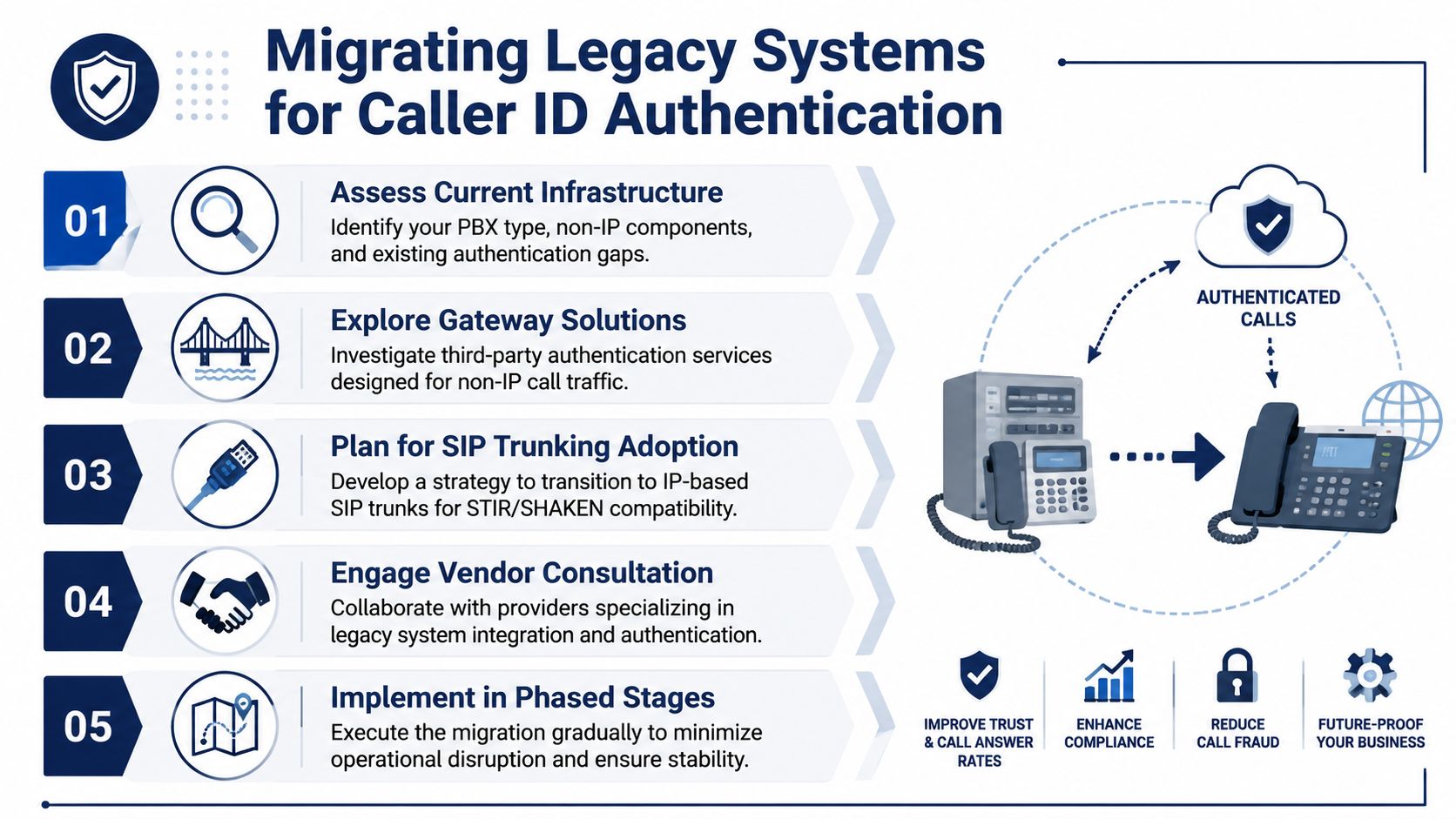
A practical migration path
Migration doesn't have to mean ripping everything out in one weekend. The cleanest projects usually move in controlled stages.
- Inventory the current environment. Identify every live number, every trunk, every fax dependency, and every auto attendant or hunt group that still matters.
- Separate what must stay from what can move first. Main numbers, critical queues, and emergency workflows need special handling. Old desk phones usually don't.
- Move the identity layer first if possible. The sooner outbound calling originates from a modern authenticated path, the sooner you stop fighting trust issues.
- Retire workarounds. Old call forwarding tricks, shadow lines, and ad hoc remote calling setups often undermine authentication.
- Test real business scenarios. Don't stop at “the phone rings.” Test transfers, remote users, queue callbacks, and outbound presentation by department.
Businesses that delay PBX migration often think they're avoiding disruption. In practice, they're often extending a setup that makes their calls harder to trust.
What works better than a rushed cutover
The safest migrations are phased, documented, and boring. That's a compliment. You want number porting, routing changes, and user rollout handled in an order that protects customer-facing continuity.
For SMBs, a cloud-based system isn't just a feature upgrade. It's the most direct route out of the non-IP authentication gap.
Troubleshooting and Operational Best Practices
Some businesses turn on modern calling service and still wonder why results are mixed. That usually means caller ID authentication is only part of the picture.
A call can be technically signed and still underperform if the number is used inconsistently, if branding data is stale, or if the outbound path varies by user, office, or app. When troubleshooting, start with the basics: which number is presented, who owns it, where the call originates, and whether every user is sending calls through the same business system.
When your attestation is lower than expected
Review these first:
- Caller ID mismatch: Users present numbers that aren't tightly tied to their service.
- Multiple outbound paths: Desk phones, softphones, and forwarded mobile calls may not all originate the same way.
- Old routing logic: Legacy failover rules can push traffic onto less trusted paths.
- Porting residue: Recently moved numbers sometimes need cleanup across records and provider workflows.
The operational side matters too, especially for inbound support and help desks.
Don't trust caller ID alone for sensitive actions
Helpdesk teams often don't have a standard way to validate callers beyond whatever number appears on screen. As discussed in a Reddit helpdesk thread about validating callers, teams frequently rely on passive caller ID checks when they should be using layered verification. The practical shift is toward multi-factor authentication and knowledge-based authentication for higher-risk requests, especially with remote support teams.
That means password resets, account changes, and privileged requests shouldn't be approved just because the caller ID looks familiar.
Use a simple rule set:
- Low-risk requests: Basic account questions can use lighter verification.
- Sensitive changes: Require an OTP, callback to a known number, or a defined KBA workflow.
- Escalated access: Give agents a script and an approval path instead of making them improvise.
Good caller ID authentication protects the network layer. Good support procedures protect the human layer. You need both.
If your business is replacing an aging phone system or struggling with outbound trust issues, SnapDial is worth a look. It gives SMBs a cloud-based business phone system with white-glove setup, managed migration from legacy PBX environments, and support built around real-world calling operations, not just feature checklists.